Blog Archives

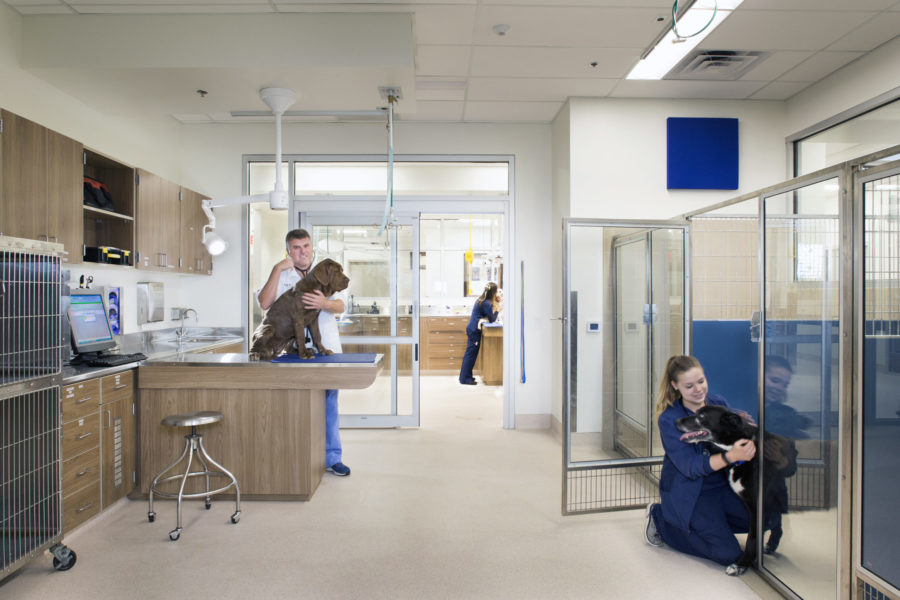
Heather E. LewisMany veterinary practices have developed effective solutions for Fear Free exams and for low-stress patient housing. The next important area to tackle, the treatment room, is an inherently stressful space. Why are treatment rooms so stressful and what can we do to reimagine them?

Treatment rooms are stressful because they are generally designed to be a wide-open space, with many different functions occurring simultaneously. Treatment rooms are this way to ensure efficiency of staffing and safety for patients. For example, animals may be housed in treatment because this is the location where they can be monitored most easily. What if it were possible to maintain safety and efficiency, while de-stressing the treatment and other medical areas of your hospital? I know that it is! Below are a few of our favorite solutions for incorporating Fear Free design concepts throughout the medical areas of the hospital.

Separated Cat Treatment. One of the easiest ideas to implement is a separate cat treatment area located near cat exam rooms and ward. With this design, the cat areas of the hospital can function as a “mini clinic” space. This does not take a lot of room and removes cats from the chaos of the primary treatment space. Designs that include windows into the main treatment room allow for better communication between the cat area and other medical spaces.

Minor Treatment. This treatment space is located behind exam rooms and functions as a quiet area for simple procedures that might need more space or equipment than an exam room might offer. The client can step into this space as well. This minor treatment space is intentionally placed away from potentially frightening and unfamiliar sounds, smells, and activity associated with procedures and surgery. It can remain calmer and quieter because of its placement.

Treatment Curtains. Treatment curtains are borrowed from cubicle curtains used in human medical triage and emergency care. They allow for flexible visual privacy, and they also cut down on noise and visual stimuli, as we have learned anecdotally from using them. A curtain track can be placed in the ceiling around any treatment table to convert it into a semiprivate space.

Separate ICU and Recovery. Separating more critical patients behind glass in the treatment space does wonders. Even if you have few critical or recovering patients, separating them will help create a quieter treatment space and quieter patient space. If you like the idea of glassed wards for more critical patients, ensure that the glass goes to the floor so you can quickly glance in and monitor patients, to continue to keep them safe.

Better Materials and Systems. Once the design is reworked to make treatment areas more specialized, focus on the next layer of design: selecting better materials and systems. Here are a few of our favorite ideas:

  • Dimmable lighting. Lighting that dims allows you to de-stress the space when things are quiet, such as overnight for hospitalized pets.
  • Windows and daylight into treatment. Placing some outside daylight in the treatment room can make it feel more connected to the natural environment, helping to de-stress the space and make your staff feel a lot better.
  • Indoor/Outdoor options. As the Covid-19 crisis has taught us, having some flexible outdoor space can be very helpful for a veterinary practice. What about having a treatment porch, or if that is too ambitious, what about at least having a few operable windows, or a beautiful garden for walking post-surgical patients?
  • Noise control. Noise control is critical. Use good ceiling materials that cut down on noise. Use quiet casters on your chairs, and quiet latches on cages. Every bit of unnecessary noise is an opportunity to rethink design elements.

We have a long way to go with veterinary treatment spaces, but with Fear Free, we’re on our way to reimagining medical care that is far better for the emotional wellbeing of pets than it has been in the past. We are excited to see your ideas implemented in the treatment room of tomorrow, and we know that we will never look back.

This article was reviewed/edited by board-certified veterinary behaviorist Dr. Kenneth Martin and/or veterinary technician specialist in behavior Debbie Martin, LVT.

Heather E. Lewis, AIA, NCARB, is a principal of Animal Arts, an architectural firm that has exclusively designed animal care facilities, including veterinary hospitals and animal shelters, for more than three decades.  She has worked on dozens of projects across the country, both large and small in her 19 years with the firm.  Heather is a member of the Fear Free℠ Advisory Board and assisted in creating the Fear Free facility standards for veterinary hospitals.  Heather is a regular contributor to various veterinary industry magazines.  She has spoken on the design of facilities for the care of animals at dozens of national and regional conferences including Fetch Hospital Design Conferences, the UC Davis Low Stress Animal Handling Conference, and the Humane Society of the United States Animal Care Expo.

Vaccines, Clients & Curbside… Oh My! Navigating Your Practice’s Preventative Care Yellow Brick Road During a Pandemic

Join Dr. Julie Reck, owner and founder of Fear Free Certified Practice Veterinary Medical Center of Fort Mill, for a discussion on vaccines, how to administer vaccines in a Fear Free manner, and how to improve communication throughout your practice to navigate preventative care in a curbside environment.

Brought to you by Elanco.

Course Overview

Are you the only person in your clinic who has a passion for Fear Free? It’s easy to get discouraged and frustrated when we are surrounded by obstacles. This course provides tools to achieve your Fear Free goals even when you feel like you are all alone in your work. Learn how to get buy-in, implement strategies from the ground up, and encourage your colleagues to join your heart’s work of protecting the emotional welfare of our treasured animal patients.

This course, approved for 1 RACE CE hour, was written by Monique Feyrecilde BA, LVT, VTS (Behavior).

This course consists of five lessons:

  • Lesson 1: The essence and importance of Fear Free Practice
  • Lesson 2: Understanding the dynamics of change
  • Lesson 3: Implementing change within your practice
  • Lesson 4: Addressing common push-back topics
  • Lesson 5: Thrive where you’re planted, or transplant to a new garden
Heather E. LewisThe way people interpret color is tied strongly to human culture and language. For example, feeling blue means feeling sad, and seeing red means feeling angry, at least in Western, English-speaking cultures.  But how do animals see and respond to color? The answers are few, as there is little research in this field of study. We can say that dogs and cats see a narrower range of colors than we do. This is because they have traded color vision, biologically speaking, for superior vision at night. Indeed, dogs and cats see much better at night than people do.

Cats have trichromatic vision, just like humans, but they do not see the red end of the human visible spectrum. Dogs have dichromatic vision, which means they do not see anything in the orange and red range in the human visible spectrum. Both species see slightly into the ultraviolet range. This is fascinating as it means that any material that has phosphorous in it, or a whitening or brightening agent derived from phosphorous, will fluoresce slightly under their vision. For example, a piece of paper is a glowing white object to a cat.

Fear Free color palettes have three objectives relating to the little we do know about animal preferences for color and stress reduction for people and animals alike.

  • To avoid anything bright white that may fluoresce. This is the reason behind abandoning a white doctor coat. People often react with stress to laboratory coats, and this is called “white coat syndrome.” If we are trying to create a low-stress medical experience for animals, it is likely best to dress veterinary doctors in colors that do not stand out. Thus, Fear Free practitioners prefer softer colors for coats and scrubs. Architects should also check the building materials we are using in hospital spaces and avoid materials that fluoresce. You can test for this by using a Woods Lamp (a black light used in the veterinary and human healthcare industries for detecting ringworm), in a space with the lights turned off. The lamp will identify materials that fluoresce.
  • To use colors that animals can see well, particularly in low-light conditions. If you were to paint a dog or cat medical ward dark red, and have dim lighting in that space, the space would appear dark grey and shadowy to the animals. A lighter space, painted in hues and tones that are brighter and more toward the blue end of the spectrum, will be more visually understandable to the animals. There is very little research on this idea, but one example is a study in mice, who see similarly to dogs and cats. The study indicated that mice “showed clear and consistent individual preferences for cages when offered a choice between white, black, green and red cages. Overall, most mice preferred white cages, then black or green, and red was the least preferred.”[i]
  • To use colors that are relaxing to people. Think of a spa, and the colors that are used in a spa, which are often toward the bluer end of the spectrum, or they are nature based. Spa color palettes tend to be relaxing to people and remind them to slow down and move carefully and gently. The research of color on human behavior is well understood; fast food restaurants use reds and oranges because they are NOT relaxing, and they motivate you to move along and finish your food quickly, so the booth may be occupied by the next customer. We want to encourage the opposite behavior.

Do not worry about hard and fast rules about color, as they don’t exist. Quite simply, use color as a reminder to yourself to be more considerate of how our animal friends see, and to support a gentler way of being around dogs and cats, and all the animals you care for.

This article was reviewed/edited by board-certified veterinary behaviorist Dr. Kenneth Martin and/or veterinary technician specialist in behavior Debbie Martin, LVT.
Heather E. Lewis, AIA, NCARB, is a principal of Animal Arts, an architectural firm that has exclusively designed animal care facilities, including veterinary hospitals and animal shelters, for more than three decades.  She has worked on dozens of projects across the country, both large and small in her 19 years with the firm.  Heather is a member of the Fear Free℠ Advisory Board and assisted in creating the Fear Free facility standards for veterinary hospitals.  Heather is a regular contributor to various veterinary industry magazines.  She has spoken on the design of facilities for the care of animals at dozens of national and regional conferences including Fetch Hospital Design Conferences, the UC Davis Low Stress Animal Handling Conference, and the Humane Society of the United States Animal Care Expo.

The Business of Fear Free: How to Positively Impact Profitability & Practice Value

A Fear Free approach to veterinary care is better for our patients, but what about our practices?

This presentation from Michael Hargrove, DVM, MBA, will demonstrate how becoming a Fear Free Certified Practice has business benefits that extend well beyond improved patient care. Every stakeholder in the practice benefits from Fear Free: the patients, the clients, the staff, and the practice owner.

Dr. Hargrove will discuss improved client experience, the development of a clearer brand image for the practice, and increased loyalty from clients, as well as how the change in practice culture improves staff satisfaction, increases employee retention, decreases workplace injury, and boosts employee recruiting. As a certified business appraiser, he also discusses how adopting a Fear Free practice culture can translate to an improved practice value when it comes time to sell.

Dr. Michael Hargrove is the owner of a 7-doctor small animal practice in Duluth, Minnesota. His practice has been AAHA-certified for 41 years and in 2018 became the first Fear Free Certified Practice in Minnesota. Dr. Hargrove is a certified Fear Free Professional and is also Certified in Low Stress Handling and a member of the Fear Free Advisory Group.

Dr. Hargrove also works with Summit Veterinary Advisors as a veterinary management consultant. He has an MBA and is a Certified Valuation Analyst (CVA) who works primarily with veterinarians who are buying/selling veterinary practices or are looking for more information on how to improve the financial health of their practice. Dr. Hargrove is married with one son and three stepsons as well as three cats and a stepdog.

Brought to you by Ceva.

Location! Location! Location! How to Prevent & Alleviate FAS Through Stress-Mapping Your Practice

Fear Free proudly presents animal welfare and behavior expert Jennifer Barg, MS, ACAAB, CDBC, for a Fear Free Certified Practice exclusive webinar: Location! Location! Location! How to Prevent and Alleviate FAS through Stress-Mapping Your Practice.

Ask any realtor what the three most important things to think about when buying a home are and they’ll tell you location, location, location. Where a pet resides while in your care can have a significant impact on his or her fear, anxiety, and stress (FAS). Identifying “hot” and “cool” areas of your practice and knowing which pets to put where will have a positive impact on them and your team. This webinar will help you learn how to make the most of your real estate.

Heather E. Lewis
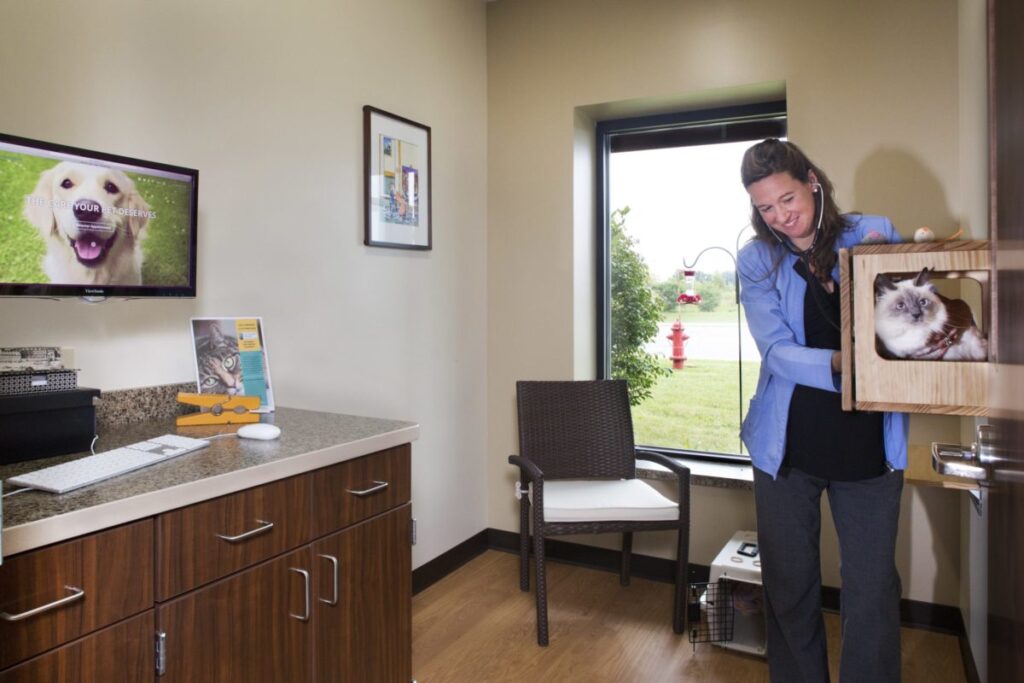
As veterinary practices implement Fear Free design for their patients, it becomes more important to cater specifically to felines. Even if you have a smaller facility, at least one exam room should be properly outfitted to care for cats. Many ideas are easy and inexpensive to implement. Here are some favorite cat exam room ideas:

Room Placement and General Features

  • Choose a room in a quiet spot. Reducing noise, traffic, and activity is a great way to sculpt a quieter and calmer experience for our feline friends. Ensure the walls around the room have sound insulation in them, if possible, to screen noise coming from other spaces.
  • If possible, use a room with a window. Cats see well in low-light conditions. Cats will prefer the room if artificial lights are lowered and the room is flooded with soft natural light. It is useful to have lights on a dimmer switch so they can be brighter for a proper physical exam and then lowered again for client consultation.

Furnishings, Cabinets, and Finishes

  • The exam table should be comfortable. Ensure that your table will have a non-slip surface for cats and that it can be outfitted with something soft. Any exam table is potentially acceptable and can be updated with a yoga mat for slip resistance and a towel for a soft surface. This said, we prefer a smaller table for less awkward maneuvering when working with a cat.
  • Create appropriate retreat spaces. Cats often need to hide to feel comfortable. Avoid designing trash access holes or flaps in cabinets or your feline patients will end up in the trash can! Extend upper cabinets to the ceiling to prevent cats from being able to get into ceiling panels (yikes)! Avoid chairs cats can get underneath; solid-fronted benches work better for seating. Create an appropriate space in the room for retreat, such as a wall-hung basket or a box in an appealing location in the room. The cat can enter this retreat space at will and coaxed out gently or examined there.
  • Choose light colors. We prefer to paint feline exam rooms with lighter colors, so they will function well when the lights are dimmed. However, avoid bright whites as sometimes these appear even brighter to a cat. Calming colors can help reinforce your goal for the room to be a retreat.

Equipment

While equipment may appear to be a small consideration, the right accessories will help your cat exam room become the Fear Free space you envision. Consider the following:

  • Feliway dispensers in the room.
  • A towel warmer to warm blankets and towels for use during examinations.
  • Non-figural artwork and no photorealistic images of cats. Cats can react negatively to this type of visual input. Use soft abstracts and landscapes.
  • Quiet casters on the stool so it does not clatter when rolled.

Feline exam rooms are easy and rewarding to design and finish. We consider cats to be our best architectural students; they tell us when we have executed spaces well. We create for them. Pair good spaces and good operations, and your feline patients will be happier and calmer. Happy patients make for happy clients!

This article was reviewed/edited by board-certified veterinary behaviorist Dr. Kenneth Martin and/or veterinary technician specialist in behavior Debbie Martin, LVT.

Heather E. Lewis, AIA, NCARB, is a principal of Animal Arts, an architectural firm that has exclusively designed animal care facilities, including veterinary hospitals and animal shelters, for more than three decades.  She has worked on dozens of projects across the country, both large and small in her 19 years with the firm.  Heather is a member of the Fear Free℠ Advisory Board and assisted in creating the Fear Free facility standards for veterinary hospitals.  Heather is a regular contributor to various veterinary industry magazines.  She has spoken on the design of facilities for the care of animals at dozens of national and regional conferences including Fetch Hospital Design Conferences, the UC Davis Low Stress Animal Handling Conference, and the Humane Society of the United States Animal Care Expo.
Photo courtesy Loyal Companions Animal Hospital & Pet Resort, Tim Murphy / Foto Imagery.

Fear Free Certified Practices & TeleTails

Fear Free has partnered with TeleTails, a digital vet care platform, to provide Fear Free Certified Practices with an exclusive offer!

Please join Dr. Hilary Jones and Clay Bartlett to learn more about all TeleTails has to offer: simple and secure live video, messaging, and payment capabilities for pet owners to engage with their veterinarians digitally.

Already a TeleTail’s user, Dr. Michele Forbes, owner of Fear Free Certified Practice Compassionate Care Animal Hospital in Ann Arbor, MI, will share her best practices and discuss case examples.

Fear Free Certified Practice Town Hall – April 16, 2020

Please join us for our first-ever Fear Free Certified Practice Town Hall, hosted by Fear Free founder, Dr. Marty Becker. Based on your feedback, we’ve put together an intimate panel of experts to address your concerns during these unprecedented and ever changing times.

Join Dr. Becker as he chats with Gary Landsberg, DVM, DACVB, DECAWBM (CA); Jessica Benoit, RVT, CPDT-KA, KPA CTP; and Laurie Fonken, PhD, LPC, licensed psychotherapist, and director of counseling and wellness programs for the College of Veterinary Medicine and Biomedical Sciences at Colorado State University.

Dr. Landsberg will be discussing:
– Separating pets and owners: what you need to know
– Better living through chemicals: anti-anxiety and sedation options for preventing and alleviating fear, anxiety, and stress

Jessica Benoit will be discussing:
– Keeping Fear Free top of mind in difficult situations
– Exam room preparation
– Body language: yours and theirs

And Dr. Fonken will be discussing:
– Top challenges to personal self-care
– How to care for your emotional wellbeing in an ever-changing and unpredictable environment

You must be a Fear Free Certified Practice member and logged in to view this webinar