Blog Archives

Fear Free and Airvet: A Pawsitive Pairing for Your Practice

Keeping pets (and their vets) stress-free is good for everyone! Fear Free and Airvet have teamed up to help pets live healthier and happier lives. This fireside chat will cover how using Airvet’s connected care platform and Fear Free training can alleviate fear, anxiety & stress in pets while allowing you to easily deliver an outstanding client experience.

Please join Marty Becker, DVM, founder and CEO of Fear Free; Russ Brewer, DVM, CVMA, CVSMT, CCRT of Care Animal Hospital of Pleasant Prairie; and Jeff Werber, DVM, Chief Veterinary Officer of Airvet, as they share their experiences and best practices that will set you and your team apart from the pack.

Steve DaleFor two decades I’ve been speaking at veterinary and animal behavior meetings about the need to enrich indoor environments for companion animals, but most especially for indoor cats. When I began, Tony Buffington, DVM (professor emeritus at The Ohio State University College of Veterinary Medicine), and others at around that time had begun publishing studies demonstrating that living in a dull environment increases stress in cats and may cause or contribute to both behavior issues and a variety of health problems.

By enrichment, I mean providing suitable outlets to meet the specific, hard-wired needs of a particular species. For cats, enrichment includes the manner in which they are fed.

There’s no doubt that cats, being the predators they are, have a built-in prey drive. But what is the best way to activate that drive, and do cats prefer to be fed?

Years ago, it was discovered that some laboratory rodents and a varied roster of zoo species prefer to work for their food, a phenomenon known as contrafreeloading, rather than dining from a free-standing food dish.

Mikel Delgado, Ph.D., a certified applied animal behaviorist and certified cat behavior consultant, set out to learn if domestic cats contrafreeload in a home environment. The only previous study on cats dated to 1971, with six laboratory cats showing no interest in working for their meals.

Delgado hypothesized that in a home environment, domestic cats would readily contrafreeload and show a preference for eating from a food puzzle compared to a dull tray piled with identical food. She also hypothesized that more active cats would be more likely to contrafreeload.

“I’ve long recommended food puzzles to clients with positive results,” she says. “In nature, cats hunt so I was certain that tapping into what cats are hard-wired to do would be no problem and we’d easily prove the previous study [for cats] wrong. However, science can be funny that way, and yes we were surprised [by the results].”

Those results were recently published in a paper called “Domestic cats (Felis catus) prefer freely available food over food that requires effort” (with Brandon Sang Gyu Han, grad student at the University of California Davis School of Veterinary Medicine, and veterinary behaviorist Melissa Bain, DVM, professor of clinical animal behavior at UC Davis School of Veterinary Medicine) in the Journal Animal Cognition.

Seventeen cats participated in the study, using one consistent food puzzle (Trixie Pet Tunnel Feeder Food Puzzle) with a food dish next to it.

Surprise: Cats did little contrafreeloading. Instead, they mostly chose the easy meal from the bowl. Most cats ate some food from both sources, but the amount of food eaten from the easy meal on the tray was significantly higher than the amount of food eaten from the puzzle. Almost half the cats consumed less than 10 percent of food from the puzzle. And none of the cats were considered strong contrafreeloaders.

“Though surprising, our findings were statistically relevant,” says Delgado. “There wasn’t a lot of variability.”

However, veterinary behaviorist Theresa DePorter, DVM (who is boarded both in the U.S. and Europe), says, “We’ve actually known for a very long time that domestic cats do contrafreeload – depending on how we define contrafreeload – as very well fed indoor/outdoor cats who clearly don’t require a meal but apparently enjoy the chase and catch and then deliver rodents or birds as live ‘gifts.’”

Dr. DePorter, who lives in a rural setting, says one of her cats – who happens to be very well fed – catches mice.

Liz Bales, VMD, notes another factor: “The seeking circuit was missing in this study. Cats need to go through seeking and finding their prey, the hunt. The pounce and eat is only a fraction of the process, which was represented by the food puzzle but it just sits on the ground next to a food bowl and may not be stimulating enough for many cats who naturally are hard-wired to seek. Also, there’s no movement involved with this particular food puzzle, and movement is stimulating for cats.”

Dr. Bales adds: “In my experience, cats being cats, the acclimation period, four to 12 days, of a novel way to feed wasn’t nearly long enough. I would think the acclimation period to the food puzzle should be months and not days.” And indeed, Bales does have acclimation experience as she is also an entrepreneur who created “hunting products” for cats, notably the Indoor Hunting Feeder (https://docandphoebe.com/).

Cats may be timid, cautious or at least circumspect about anything novel such as a new food puzzle, adds DePorter. “Yes, they may well require more acclimation time, particularly since these cats may have had no prior experience with food puzzles.”

Neither Bales nor DePorter quibble with the notion that this study was well-thought out and important, but both consider it only a start, and Delgado doesn’t disagree.

Delgado’s hypothesis that generally more active cats would be more into contrafreeloading also fell flat.

Delgado suggests: “Perhaps it means lives are so enriched of the cats in the study that their drives to use puzzle feeders was reduced. Perhaps we could have better acclimated and more motivated by using treats at first in the feeders. Also, individual cats may have individual preferences to different food puzzles.”

Delgado, who co-owns a website that sells puzzle feeders (www.foodpuzzlesforcats.com) is in no way suggesting pet parents diminish use of puzzle feeders. “For starters, do understand most of the cats in our study did eat something from the puzzle feeder.”

Bales says “countless times” she has witnessed her puzzle feeders contributing to solve behavior problems, which in some cases has kept cats in homes.

DePorter also remains a cheerleader for puzzle feeders. “I absolutely don’t interpret this study is suggesting not to use puzzle feeders – that would be a mistake. We know puzzle feedings are enriching, help to control food intake, and provide physical and mental exercise and may reduce obesity – which is so common among cats. And, of course, obesity leads to a laundry list of issues.”

Delgado concludes, “Certainly, there’s more to learn, more to do – understanding cats has never been easy.”

This article was reviewed/edited by board-certified veterinary behaviorist Dr. Kenneth Martin and/or veterinary technician specialist in behavior Debbie Martin, LVT.
Steve Dale, CABC (certified animal behavior consultant), hosts two national pet radio shows and is on WGN Radio, Chicago. He’s a regular contributor/columnist for many publications, including CATSTER, Veterinary Practice News, and the Journal of the National Association of Veterinary Technicians in America. He’s appeared on dozens of TV shows, including Oprah, many Animal Planet Programs, and National Geographic Explorer. He has contributed to or authored many pet books and veterinary textbooks such as “The Cat: Clinical Medicine and Management” and co-edited Decoding Your Dog, by the American College of Veterinary Behaviorists. He speaks at conferences around the world. www.stevedale.tv.
Steve DaleRoxy’s arthritis had worsened. Because of the 18.5-year-old Devon Rex cat’s history of gastrointestinal issues, her veterinarian and owners had few pharmaceutical options for managing her pain.

For clients, seeing a pet in pain is the worst. Cats are especially adept at masking pain, so when they actually show they are in pain, they are really hurting. That’s where we were with Roxy.

Gabapentin had been prescribed, but all it did was increase her catnap time. I consulted an expert. “Let me hold Roxy’s paw and we’ll slowly increase the dosage,” said Robin Downing, DVM, internationally renowned for her knowledge about pain in pets.

Dr. Downing consulted with my Chicago, Illinois-based primary care practitioner Natalie Marks, DVM, who welcomed Dr. Downing’s contribution.

Downing gradually upped the dose of the gabapentin, and her persistent yet measured effort appeared to bring results without an accompanying significant primary side effect of the drug: drowsiness.

“Multimodal is the best approach for osteoarthritis for nearly all cats,” Downing says. To that end, we began to employ a tool called an Assisi Loop, which uses targeted pulsed electromagnetic field technology to treat pain and decrease inflammation. That not only benefited Roxy’s osteoarthritis, but also had the potential to aid her GI issues. In addition, for arthritis I give her injections of Adequan.

That was in 2018 and Roxy clearly benefited from the collaboration between Drs. Downing and Marks and the multimodal approach. However, about a year ago, I noted that Roxy appeared to be struggling a tad more and asked Dr. Marks for further advice.

“The struggle we have as small-animal practitioners is that we only have certain pain medications that are safe and approved for cats as they age, and many are contraindicated for cats with other conditions,” Marks said. “Our goal for our patients is for them to have the best quality of life and to be as pain free as possible every day. The beauty of veterinary medicine today is that we have a variety of integrative therapies which are readily available, and I thought about medical massage therapy. And technology can deliver a way to demonstrate options as never before.”

She suggested I contact Rosemary LoGiudice, DVM, who is boarded in veterinary rehabilitation medicine and practices in Hanover Park, Illinois. She is at least an hour from my home, not to mention this was all happening at the height of the pandemic.

Marks said, “I think this may be the perfect use of telehealth. And I believe massage therapy may help.” Dr. LoGiudice agreed.

LoGiudice noted that ideally she would want to get her hands on Roxy to feel her flexibility and for heat in the joints. But she was able to communicate with Dr. Marks, who has known Roxy most of her life and had recently examined her.

Using my phone, I took video of Roxy moving in her own element from different angles as directed by LoGiudice, who says, “When I can see the dog, cat, or horse moving in a natural way, I can get a good feel for stride and how the joints are moving. Very few dogs and cats are going to show me in the exam room how they move at home.”

LoGiudice and I jumped on a Zoom show and tell call. Dr. LoGiudice held a plush dog in her lap. She showed me exactly what to do, where to do it and how much pressure to exert when offering massage therapy. Old-school written directions could never replicate Dr. LoGiudice demonstrating, and then watching me and directing me, “Move your hand slightly lower.”

I gradually spent more time every night massaging Roxy. Roxy not only didn’t fend off the nightly spa treatment, she began to request it. Even now, a year later, when I stop, she paws at my face demanding more.

That was no surprise to Downing. “If this was causing Roxy pain or discomfort, or Roxy didn’t enjoy it, she still moves well enough to walk away,” she says.

Watching video of Roxy two weeks after the start of the Dale Spa treatment, LoGiudice wasn’t surprised either by the effect of medical massage to slightly but noticeably increase Roxy’s mobility and interest in exploring or moving to whatever room my wife and I are in. Also, LoGiudice is now inspired by the idea of using video and video chat to support clients in a way she hadn’t previously considered.

Downing agreed. “There’s no substitute for being hands-on with our patients, and for office visits, but you can certainly observe more remotely than what is possible in an exam room. And to schedule time for a virtual lesson in medical massage therapy, acupressure techniques, or teaching animals how to stretch are only a few examples.”

From her perspective of having known Roxy for more than half her life, Dr. Marks says, “I absolutely saw a difference in Roxy. What I really loved about this collaboration isn’t only about considering integrative care, it’s about how veterinarians are being creative to help all involved, especially at this time. And right now, we do need to be creative. I hope this specific type of partnership and using technology in the way we did with Roxy becomes a model, sticking around long after the pandemic.”

This article was reviewed/edited by board-certified veterinary behaviorist Dr. Kenneth Martin and/or veterinary technician specialist in behavior Debbie Martin, LVT.

Steve Dale, CABC (certified animal behavior consultant), hosts two national pet radio shows and is on WGN Radio, Chicago. He’s a regular contributor/columnist for many publications, including CATSTER, Veterinary Practice News, and the Journal of the National Association of Veterinary Technicians in America. He’s appeared on dozens of TV shows, including Oprah, many Animal Planet Programs, and National Geographic Explorer. He has contributed to or authored many pet books and veterinary textbooks such as “The Cat: Clinical Medicine and Management” and co-edited Decoding Your Dog, by the American College of Veterinary Behaviorists. He speaks at conferences around the world. www.stevedale.tv.
|

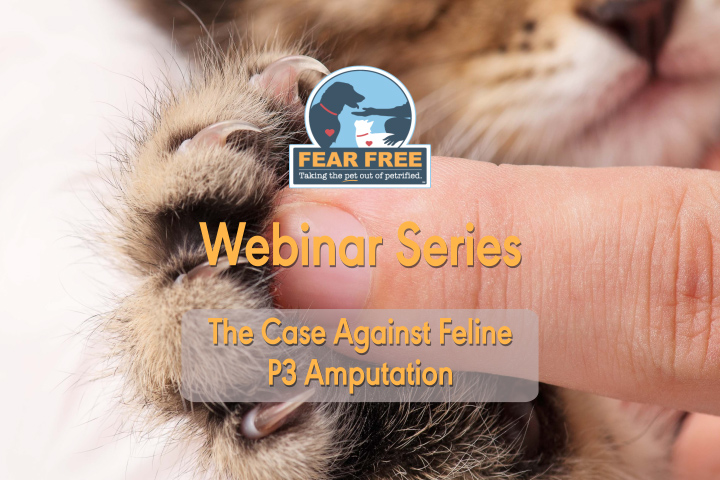
Understanding Declaw Salvage Procedures

Until declaws are eliminated in the United States, you will most likely encounter declawed patients in your practice. With recent advancements in surgery, salvage procedures can help manage pain and improve limb function. Join one of the leading figures in declaw salvage surgery Nicole Martell-Moran, DVM, MPH, DABVP (Feline Practice), to learn about the procedures involved, how to find training, and how you can incorporate it into your practice.

Helping New Pet Owners Create a Fear-Free & Happy Life for Their Pet

New pet owners can be overwhelmed with all the information we want to provide them regarding the health and wellbeing of their pet. However, if a strong human-animal relationship built on trust and empathy is not established, the pet very well may not remain in the home. In this webinar, Kenneth M. Martin, DVM, DACVB, and Debbie Martin, CPDT-KA, KPA CTP, LVT, VTS (Behavior), will provide you with 5 tips to give new pet owners so they can start the relationship off on the right paw, facilitate a strong bond, and keep pets in the home and coming back to your veterinary clinic.

Brought to you by Vetoquinol

Sandy RobinsIt’s not only people highlighted in reality TV shows who suffer from obsessive compulsive disorders; cats do, too. Repetitive and exaggerated behaviors such as sucking on fabrics and chewing plastics, excessive grooming, or bolt-out-of-the-blue aggression are signs of typical compulsive issues in cats. How a pet parent reacts to and understands these issues can go a long way toward controlling and even eradicating them.

According to feline behaviorists, neither age and nor gender are mitigating factors in compulsive behavior. However, wool sucking along with repetitive meowing has been found to be more common among so-called oriental breeds such as Siamese and Birman cats.

Dr. Nicholas Dodman, president and CEO of the Center for Canine Behavior Studies (they study feline behaviors too), who authored The Cat Who Cried for Help: Attitudes, Emotions, and the Psychology of Cats, ranks excessive grooming, known as psychogenic alopecia, as the most common abnormal repetitive behavior among cats generally. Wool-sucking and pica, the ingesting of weird objects, come in second, and, lastly, Dodman says that feline hyperesthesia, often referred to as twitchy skin syndrome, which results in a cat launching unprovoked attacks or suddenly appearing startled and then dashing away, is often also considered to be a compulsive disorder.

Psychogenic Alopecia

Cats are often mislabeled as independent, selfish, and uncaring creatures. In fact, the opposite applies; they are very caring and empathic and very conscious of their surroundings. Thus, all kinds of changes and conflict in their lives can evoke stress and anxiety. One common reaction to their personal situation is over-grooming.

“Feline psychogenic alopecia may begin as a displacement behavior arising from situations of conflict, frustration, or anxiety, but might in time become compulsive,” says Dodman. In an article published on the CCBS website, he spells it out: “The diagnosis of psychogenic alopecia as a compulsive disorder is reserved for those cases in which no underlying medical problem is evident.

“In most cats, over-grooming resulting in alopecia where they have pulled out chunks of fur and licked their skin raw, has an underlying skin disorder such as an allergic reaction to fleas or other external parasites. Inhalant allergies and even food allergies could be the root cause, and it’s important to seek veterinary assistance to rule all these causes out before the excessive grooming can be diagnosed as behavioral.”

In her book Cat vs Cat, Pam Johnson-Bennett says: “Because cats are such meticulous groomers, a cat parent may assume that the behavior is nothing unusual. Displacement grooming is a normal way for cats to recue their anxiety and calm themselves during or after a stressful situation. You may see this after a cat miscalculates a jump and falls to the floor. Although it may look as if she is embarrassed, it has more to do with her need to get her bearings because she was caught off-guard. Also being denied something she wants like getting on a counter and being repeatedly removed and even scolded can prompt displacement grooming,” she explains.

However, Johnson-Bennett points out that it’s easy to dismiss these small stressors. So, they build and suddenly the cat has huge bald patches!

“Interactive play comes to the rescue yet again,” she writes. “Use it to boost confidence and release endorphins.  Pouncing and play games offer mental and physical stimulation.” And she warns, “if you see your cat sitting in a particular position before she’s about to start compulsively grooming, get out the wand and other toys and play instead!”

But play may not be the complete answer. Sometimes medication is necessary to help break the cycle.

Wool Sucking and Pica

Cats who love to chew on a blanket or a piece of cloth may be likened to young children who walk around sucking on pacifiers or hugging security blankets. This behavior often occurs in kittens who have been removed from their mothers too young and have not had the opportunity to nurse until their mothers properly weaned them. Soft, cuddly fabrics become a substitute for mama cat.

The sucking itself is not a problem, but if the sucking turns into chewing and swallowing, it can lead to problems such as gastrointestinal obstructions. Boredom and loneliness, especially when cats are left alone all day, can lead to separation anxiety and can prompt them to turn to material sucking and chewing to soothe themselves. This can lead to pica, the ingestion of material, plastic, and other non-food items.

Often the urge to suck on fabrics subsides as a kitten becomes an adult. However, problematic chewing can recur in adulthood as a defense mechanism for dealing with a stressful situation such as household tensions between cats or separation anxiety.

In the case study on compulsive wool sucking published in the Journal of Veterinary Behavior with which Dodman was involved, two hundred and four Siamese and Birman cats enrolled in the study were tracked for various physical characteristics, current and previous medical conditions, presence of an abnormally intense appetite, and environmental factors. The research ultimately showed that early weaning and small litter size were associated with increased risk of wool-sucking in Birmans only. The presence of a medical condition was associated with increased risk of wool-sucking in Siamese cats. The presence of an abnormally intense appetite was seen in all affected cats. However, no relationship was found between physical characteristics and wool-sucking in Siamese or Birman cats.

Dodman also points out that medical conditions that can trigger abnormal ingestion of inappropriate material include hunger, nutritional deficiencies such as anemia or inadequate dietary fiber, diabetes, or tumors.

Feline Hyperesthesia

“This is a complicated behavioral condition with some features that appear compulsive and others that appear frankly neurological,” says Dodman. “Because of the overlap between symptoms of other issues, it is thought to possibly be a form of partial seizures with compulsive components. There is an apparent sensitivity to touch (episodes may be induced by stroking along the spine), which can trigger attacks and accounts for the name of this syndrome,” he further explains.

Feline hyperesthesia is often referred to as rippling skin syndrome, rolling skin syndrome, or twitchy skin syndrome. Signs include dilation of pupils, excessive skin rippling, and frenetic self-directed grooming that may result in hair loss.  Grooming may be so intense it may manifest as self-directed aggression often focused on the tail (tail-chasing).

Affected cats may emit excessive and unusual vocalizations and appear to hallucinate (act afraid of their tail) and run away. They may appear “manic” (excited look, frantic running, jumping) and are frequently extremely sensitive to touch.  Sometimes aggressive bouts are preceded by attention-seeking and enhanced affection to people. Affected cats are often anxious and restless, constantly wandering and pacing. Sometimes the aggression can be directed at people.

“Almost all aggressive behavior can be traced back to a specific cause. Idiopathic aggression – the name given to totally unprovoked aggression that has no known cause — is rare,” says Johnson-Bennett. “This type of aggression is too difficult and too dangerous for a cat parent to try and correct without professional help.”

Helping Owners

Advise cat parents to be on the lookout for excessive sucking or chewing on fabrics, behaviors such as hunting and pouncing at unseen prey, running and chasing, paw shaking, freezing, excessive vocalization and a manic look, self-directed aggression such as tail chasing, and overgrooming to the point of pulling out fur in patches. While these may start out as signs of conflict or anxiety, if not attended to, they can become compulsive disorders over time.

Ask cat parents about conflicts in the home and whether there are ways to eliminate it. They may need a referral to a veterinary behavior specialist who can help them to recognize and manage such conflicts, whether they are between cats and humans, cats and other cats, or cats and other animals in the home. Other things to try:

  • Environment enrichment may help to distract a cat from compulsive behavior.
  • A tall cat tree or cat condo strategically placed near a window helps keep cats engaged.
  • A fountain not only attracts a cat to drink water but also adds sound and motion enhancements to the environment.
  • Offer the cat an indoor garden of safe plants to nibble on, ideally placed near a water fountain or water dish.
  • Wand toys allow cats to chase, pounce, and play.
  • For cats who enjoy exploring, leash-training can provide safe outdoor excursions. A catio is another option that can provide distractions from self-harming.
  • Suggest puzzles that can be filled with treats or a portion of a meal.
  • If wool sucking or over-grooming are involved, a diet that includes a high-fiber kibble may help redirect the cat from compulsive behaviors to focus on nibbling. A veterinary nutritionist may have suggestions.

This article was reviewed/edited by board-certified veterinary behaviorist Dr. Kenneth Martin and/or veterinary technician specialist in behavior Debbie Martin, LVT.

Sandy Robins is an award-winning pet lifestyle journalist and author of For the Love of Cats, Fabulous Felines: Health and Beauty Secrets for the Pampered Cat, The Original Cat Bible, and Making the Most of All Nine Lives: The Extraordinary Life of Buffy The Cat.