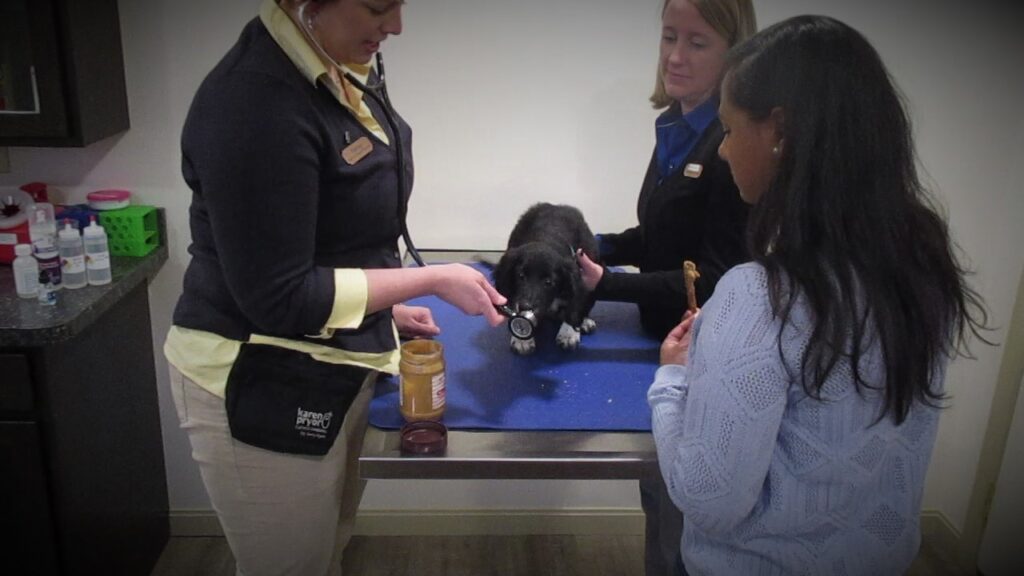
Pet owners teach their animals a variety of cued behaviors that can be helpful for veterinary professionals in the exam room. “Sit” can help keep a patient stationary during an examination. When a patient knows the cue “High Five” or “Paw,” this may aid in assessing interdigital infections or performing nail trims.
One such skill that can be helpful for the veterinary team is targeting: teaching the dog to touch the nose to an object or hand. This behavior can be helpful in a few different ways.
Getting Patients from Point A to Point B
Many patients are uncomfortable with moving onto a lift table, scale, or even moving down the hallway. Instead of forcing the pet, we can use a hand target to move patients who have limited FAS. If this behavior is strong enough, most patients will be more excited about the opportunity to nose-target a hand to gain reinforcement and be less concerned about the “scary” object they need to step on. Using a hand target also gives us the option to keep our hands off of patients if they are concerned or conflicted with being touched by an unfamiliar person.
Instrumental Persuasion
Many patients are fearful of the veterinary instruments used during examination. With targeting, we can change the way they feel about the tools while allowing them to control the interaction. This can be done by presenting an exam tool and allowing the patient to interact with it on their own and then giving reinforcement.
In short, repeated training sessions, the patient learns that when the object is near, amazing things happen when they interact with it. Instead of a fear-related response, we can create a positive response toward presentation of these tools.
Teaching This Skill to Patients
Start this skill during preventive exams with pets who have a low FAS score. Puppies and kittens may be the best patients to start working with because they don’t have any preconceived notions. Patients with a high FAS score may need more therapy, and using this technique may cause additional FAS. Wait to add it until after Victory Visits show that the patient’s FAS is reduced in the veterinary hospital.
If you are a Fear Free Professional, using treats in the exam rooms should be old hat to you. As you teach this skill, use treats to reinforce any interaction with exam tools, the patient stepping onto the table, or interacting with the veterinary team (hand target).
Using a word (Good!) or a tongue “click” may be helpful as an event marker. An event marker gives the patient information about the behavior goal and can capture the desired behavior. In the case of teaching a patient to target, the goal or “wanted” behavior would be to use the event marker when the patient interacts (noses, touches, licks, or sniffs) the object or hand we are using as the target. Always follow the event marker immediately with a treat.
When teaching this behavior, offer the object one to two inches from the pet’s nose. When the patient interacts with the object, use the event marker and reward the patient with a treat. If the patient shows concern regarding the object or FAS increases, move the object farther away until the patient is more comfortable. You may need to break down the behavior into smaller steps to get the patient to interact with the object. These small approximations may include capturing the behaviors of looking at the object, moving toward the object, touching the object with paw or nose.
Example: Presenting a Stethoscope
With an FAS 0 to 1 patient, present the bell of the stethoscope a few inches from the patient’s nose
Observe for any nose touching or interacting with the stethoscope
Say the word “Treat” when the patient’s nose touches the stethoscope
Move the bell of the stethoscope away and give a treat
Repeat if the patient is loose, relaxed, and eating during this training session. If the FAS score increases, discontinue and reassess with the veterinary team.
This article was reviewed/edited by board-certified veterinary behaviorist Dr. Kenneth Martin and/or veterinary technician specialist in behavior Debbie Martin, LVT.
Rachel Lees, a Level 3 Fear Free Certified Professional, is a veterinary technician specialist in behavior, a KPA certified training partner, and lead veterinary behavior technician at The Behavior Clinic in Olmsted Falls, Ohio. She loves helping people create and maintain a strong human-animal bond.

 This post is brought to you by our sponsor, Elanco, the makers of
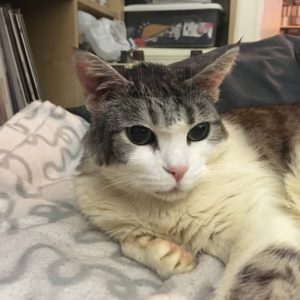 My cat Cleo is nearly 17 and receives sub-q fluids regularly at home. She used to grumble and try to get away but once I started Fear Free, I began giving her favorite crunchy treats before, during, and after administering fluids. Now she purrs through the whole procedure, and any time I approach the spot in the house where we do fluids, she walks up for “crunchie time.” I’ve been able to switch back to a larger needle because she doesn’t notice the poke while snacking, which makes administration faster, too.
 Chewy had a lot of fear and anxiety at the veterinary clinic, causing her to behave aggressively and making it difficult to give her the care she needed. While training her, I observed various signs of pain, which were most likely adding to her anxiety. I alerted her caregiver to my observations so she could better assess and monitor her dog and update her veterinarian. Chewy and her caregiver had previously had negative and traumatic experiences at a veterinary clinic so I referred them to Keystone Veterinary Clinic, which has Fear Free Certified Professionals who created a handling plan to enable Chewy to have a thorough exam, radiographs, and other diagnostics in a safe and low-stress manner. I also worked with the owner to begin muzzle training. The combination of appropriate scheduling, handling, and sedation, Chewy was able to receive the diagnostics and treatment she needed.
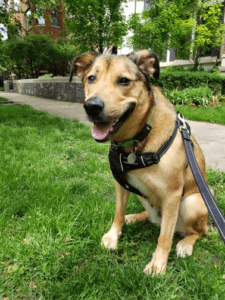 Gus had developed severe resource guarding of his food and water bowls, as well as fear and anxiety regarding being touched and having his gear put on and taken off. As a result, he snapped at and bit a walker. We worked closely with his owners and utilized Fear Free strategies and positive reinforcement training to get Gus comfortable with having strangers in the home. We were eventually able to find a solution that allowed Gus to be comfortable having walkers touch and refill his water bowl and approach his food bowl without any signs of resource guarding or fear, anxiety, and stress. Now Gus happily greets his walker at the door, demands affection, and has no issues on his walk or in his home.