Rachel Lees RVT, KPA CTP, VTS (Behavior)
A variety of animal training programs appear on cable and streaming networks. Some of the concepts depicted in these programs are appropriate for veterinary behavior cases and some are questionable. This article is not written to insult any of these programs, trainers, or networks but instead to discuss the learning theory and training philosophies demonstrated and review why veterinary behavior professionals are using alternative protocols.
Whether you are a veterinary team member working in general practice or are interested in behavior, it is important to recommend the most Fear Free and up-to-date information for patients and clients. Giving outdated information can potentially damage the human-animal bond between client and patient, potentially ending with the patient being rehomed or in some cases euthanized.
Punishment: May the Odds Be in Your Favor
Punishment is a technique used to weaken a behavior. For a stimulus to be “punishing,” the learner must find that stimulus aversive or undesirable enough to eliminate the behavior. Punishment is difficult to use properly and does not teach the learner to perform the correct behavior. Most important, using punishment can be a liability for veterinary professionals recommending this technique because it can put the safety of the owners and pets at risk.
The American Veterinary Society of Animal Behavior’s position statement on punishment reviews the many side effects of using this training method. Using remote punishment collars as well as choke and prong collars can cause physical damage such as damage to the skin, neck, and trachea area, an increase in intraocular pressure, upper airway obstruction, and nerve damage. For punishment to be effective, it must provoke a fear response from the learner, which can unfortunately be generalized to other stimuli in the learning environment. Consequently, this can make the animal become more fearful, anxious, and stressed in these contexts and situations.
Take the owner who is walking down the street with a 7-month-old Labrador Retriever puppy. The puppy shows a loose posture, wide tail wag, and becomes excitable on seeing people, sometimes jumping. For the owner, the dog’s jumping is undesirable. The trainer suggests using a remote “shock” collar for this issue. The owner is coached to shock the puppy for any jumping when interacting with people. The handler may be specifically punishing the pet for one behavior (jumping), but the puppy may begin to be concerned when people approach him because when this occurs, he receives a shock.
In the above example, the puppy may begin to show fear, anxiety, or stress with the approach of unfamiliar people. Using punishment, there is a risk that the learner (puppy) will associate the punishment (shock) with people approaching instead of the punishment (shock) being associated with the unwanted behavior (jumping on people).
Punishment needs to occur within 0.5 seconds of the start of the undesirable behavior. Therefore, the puppy would have to be shocked the moment his shoulders start to lower in anticipation of jumping to associate the punishment with the jumping behavior. Even with perfect timing, there is still a risk that the puppy may not associate the punishment with jumping.
Punishment Fails
Punishment can work to eliminate unwanted behaviors. The challenge is that it does not eliminate the motivation or give the learner a more appropriate behavior to perform.
In another instance, an owner was coached to use a remote collar to eliminate growling and aggression toward family members. If a family member approached the dog while he was eating a coveted bone and the dog growled, the family member was to correct the dog immediately with a shock. The growling behavior may be reduced, but it does not change the anxiety and concern related to the bone. The owners have now given the dog information that the approach of the owner is associated with a shock, which can increase the pet’s anxiety, fear, and stress. Long term, the pet may suddenly display with aggression but give only limited warning signs because the signals were suppressed with the remote collar. The animal was, in effect, told not to give this information. This makes this specific patient more dangerous and could put the family at greater risk.
In the above situation, the growling behavior is not a desirable response, but to the dog it was probably completely appropriate; he communicated his anxiety regarding the owner’s approach. Using punishment made that specific pet more dangerous. Avoiding these situations and confrontations are the first step in addressing this issue. A veterinary behaviorist may recommend specific behavior modification to change the way the pet feels during this interaction.
Veterinary behaviorists recommend that animal training should focus on setting up the environment, so the pet is more likely to perform desired behaviors, reinforcing desired behaviors, removing the reinforcer for undesirable behaviors, and addressing the emotional state of the learner. The use of punishment can slow learning, suppress behavior, increase fear and fear-based aggression, create damaging and unintended associations with owners and other environmental stimuli, and damage the human-animal bond.
Even though these techniques may be seen on TV, remember that you are the veterinary professional and your clients value your opinion and recommendations. Giving them the most up-to-date information regarding behavioral training can be lifesaving. Observe training classes that you may recommend to confirm that they use recommended Fear Free techniques. For more information, see resources from AVSAB on “Finding a Trainer” as well as the “Position Statement on Use of Punishment.” The Fear Free Level 3 course for professionals provides the tools to address typical dog and cat behaviors using Fear Free methods.
This article was reviewed/edited by board-certified veterinary behaviorist Dr. Kenneth Martin and/or veterinary technician specialist in behavior Debbie Martin, LVT.
Rachel Lees, a Level 3 Fear Free Certified Professional, is a veterinary technician specialist in behavior, a KPA certified training partner, and lead veterinary behavior technician at The Behavior Clinic in Olmsted Falls, Ohio. She loves helping people create and maintain a strong human-animal bond.


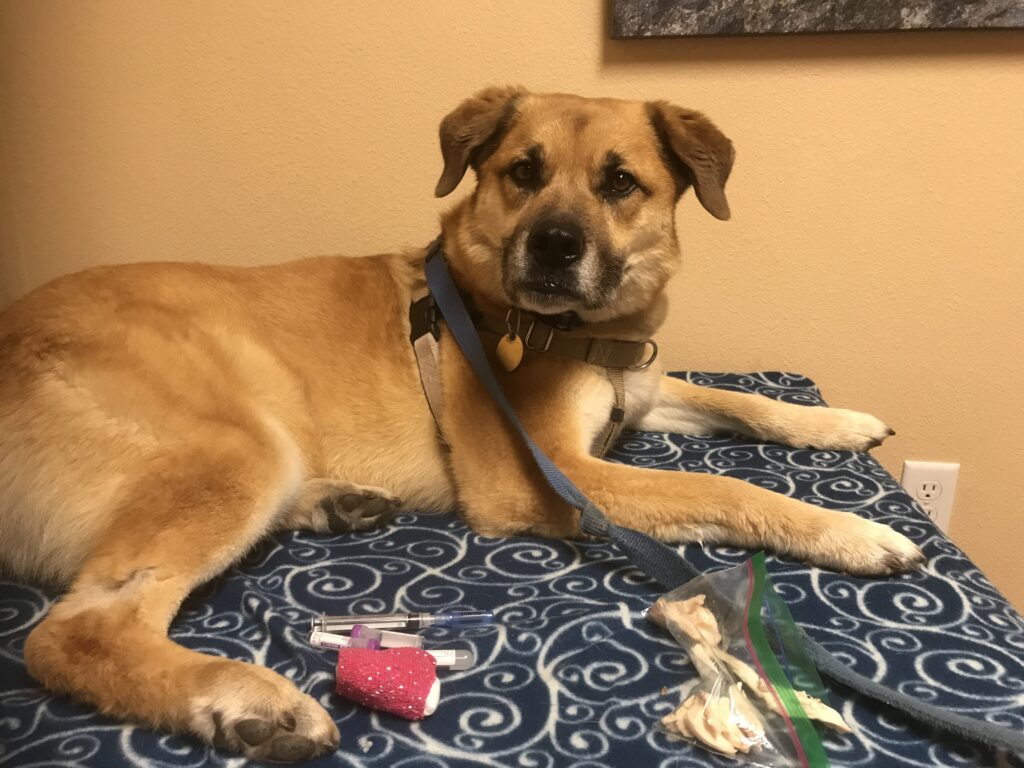
 Hunter, a 2-year-old mixed breed, enjoys looking out the windows in the lobby of our clinic. By starting his visit there, asking his mom questions and listening to his heart and lungs, we can make sure he is comfortable enough to continue his exam in the exam room. But it was a different story when he first came in almost two years ago. Because of a previous frightening experience at another clinic, he was wary of us and the handling and procedures being done. He would bare his teeth, growl, and even try to nip at Dr. Gamble’s hands when she tried to touch him. Through consistent Victory Visits, pre-visit training and medications, and desensitization to areas where vaccines and other needle pokes are typically given, we are now able to provide him and his owner with a comfortable and rewarding experience every time he is in. Now he sits patiently and lets Dr. Gamble examine him—with the help of some cheese and marshmallows, not to mention smears of his favorite treats, peanut butter and canned food. During Hunter’s victory visits, we commonly work on the desensitization process without actually following through with an injection. “Happy visits, along with some training classes and behavior work on our part, have made a world of difference to Hunter,” writes his owner, Beth. “Hunter is now excited to see Emily, Heather, Dr. Gamble, and many other staff members as soon as he walks through the front door. He is a much happier dog at the vet thanks to Gamble Pet Clinic’s Fear Free work.”
 Recently, there was an event called Woof Fest held during a downtown pub crawl. Our clinic sponsored “Dog Trivia,” and I focused the questions on a pet’s emotional health, such as “Is this dog’s body language calm or stressed?” and “A dog wagging their tail is always happy. True or False?” Hundreds of people played our trivia game, and it was such a rewarding experience to educate the public on the topic.
 Sammy had grown up in a hoarding situation and was fearful at the time of his adoption. Unless he was sedated, the six-year-old dog would bark and lunge or even eliminate from fear during veterinary visits. A prescription for an SSRI helped and the team tried additional medications at different doses, but Sammy would push through the medications and continue to show fear aggression. At first, he was unable to generalize that humans weren’t scary, so it was important for him to see the same person at the hospital on each visit. That wasn’t easy, but eventually the right person came along who was able to take the time and effort for Sammy to become comfortable. It took six months of Victory Visits spent eating chicken, practicing chin rests and lying on his side, and undergoing desensitization to having his leg shaved, the scent of alcohol, application of a topical product for numbness, and the pretend poke of a needle, but in July Sammy underwent his first successful blood draw. Now we are routinely doing happy visits to keep the momentum going.
 Bruno is a goofy 8-year-old Bull Arab Cross (a type of Australian working dog). He has always been very friendly at the vet, but once pats stopped and the examination started, he would become suspicious and communicate his discomfort with aggressive behavior. Fortunately, Bruno’s owner has been committed to training. They had private training sessions and attended a Ready, Vet, Go! course. As part of Bruno’s training we incorporated a lot of owner education on subtle body language changes, as well as start and stop cues for Bruno. Bruno was trained with a sustained chin target, using a towel on a chair, as his start cue, meaning “I’m ready for procedure.” If he lifted his head, we immediately stopped the procedure. Bruno was also trained to be comfortable with a Baskerville Ultra Muzzle. We spent time teaching Bruno specific body parts such as tail, ear, and scruff, so that he knew what was about to happen. Over time we were able to pair several good vet clinic experiences (training on a Sunday in clinic) with lots of his fave foods, body scratches, and games. We also introduced veterinary equipment, including syringes, blunt needle, alcohol swabs, and stethoscope. When we weren’t actively training, he was taught a default “chill” behavior and rewarded for relaxed head, tail, and big breaths. He had several socialization visits at the vet, and when he required surgery for a lump removal we did practice runs with pre-visit medication to see what would work best for him. A planned course of action on admission saw him anesthetized as soon as possible to limit buildup of anxiety. Since then Bruno has had further training sessions and socializing vet visits. Recently he had his vaccinations and we were able to give his injection without any restraint by utilizing his muzzle and target training. Bruno is a great example of what teamwork can achieve when you have a committed owner and a Fear Free-trained vet and trainer, not to mention a goofy, food-motivated dog!