Mikkel Becker
The fear of visiting the veterinarian and the anxiety of riding in the car isn’t limited to dogs or cats. Other animals experience these anxieties as well, including pigs. I know, because I was part of a major effort to help one adorably sweet and sizably grand pet pig, Dee Dee, to overcome her fear of car trips and veterinary visits.
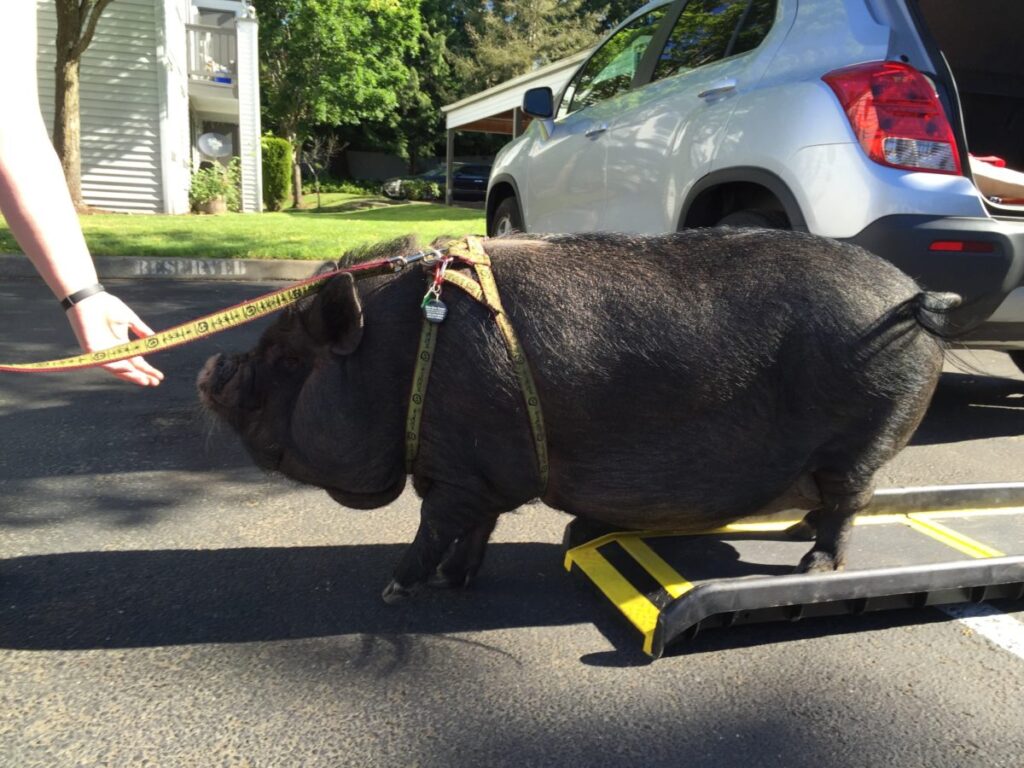
Dee Dee’s fears were anything but mild when I met her. At one time she enjoyed riding in the car and veterinary care was a non-issue. But that changed after a spay surgery with a previous veterinarian when she was received third-degree burns from a heating pad during the procedure. The extreme pain and distress of the experience changed her behavior any time she rode in the car or was taken to the veterinary clinic. Any indication that she was going to be placed in the car sent all 250 pounds of Dee Dee into a flailing, fighting fury to flee to safety. She seemingly paired the car ride and traveling to new places with the distress and pain of the one experience.
From Chaos to Calm
Just getting Dee Dee into the car involved recruiting neighbors and the strength of many large men to push, pull, and pick her up into the car while other people blocked her movements and view using cardboard boxes. Dee Dee squealed in panic the entire trip and in her distress peeing and pooping all over the inside of the SUV in which she rode.
By the time I met Dee Dee, not only was she in distress, so was her owner, Olive. She was overwhelmed by the impossibility of getting her pig the care she needed, including hoof trims, a long overdue necessity. Olive was trapped between the duty of caring for her pig’s health and the guilt of not wanting to put Dee Dee through any more terror to get the care she needed. Thankfully, with the right Fear Free partnerships and training, Dee Dee was able to get the physical care she needed without losing her emotional wellbeing in the process.
As a trainer who is Fear Free certified, I was able to incorporate aspects of reward-based training that I commonly use with dogs into my training with Dee Dee. In addition to training, an essential step was to find a Fear Free-certified exotic animal veterinarian. We came across Dr. Alicia McLaughlin from the Center for Bird and Exotic Animal Medicine near Seattle, Washington, who was equally committed to reducing Dee Dee’s fear, anxiety, and stress.
We taught Dee Dee to touch and follow a target, in her case a plastic serving spoon. This became her go-to way to say hi to new people. Targeting was also an excellent way to encourage her to willingly follow toward, away, onto, or off certain spaces to better guide her movements. This was useful both for getting her to willingly approach the car and walk up the ramp, as well as to move onto spaces such as the scale or into the exam room.
Dee Dee also had an impressive array of other fun tricks we capitalized on as relationship builders for her care, including sit, down, and Zen down, during which she would lie on her side. Such behaviors were vital to earn her participation during care, for keeping her in a stationary position, and for getting a better view of her hooves and belly.
Training for Travel
To get Dee Dee ready, an essential step was to replace her car ramp with a far sturdier version. Dee Dee was petrified of her previous ramp and avoided it at all costs. This time we took ramp training slowly by introducing it on a flat surface and teaching her to walk across it following a treat trail and her target spoon.
After successful ramp crossings on the flat surface, she graduated to higher spaces, including the curb and couch. Dee Dee liked this training so much she often opted to walk across the ramp and lie down atop it in her free time.
Separately, we desensitized Dee Dee to being around the car, including opening car doors or turning on the car while she did tricks, without actually getting in or going anywhere. We incorporated “go to your space” by training her to move to her blanket, which was useful as a portable safe space during trips in the car and at the vet.
In preparation for the visit to the hospital, Dr. McLaughlin prescribed pre-visit medications to help keep Dee Dee calm and reduce her panic.
Edible and Physical Treats
For training treats, we chose small, healthy snacks, including measured portions of her regular food, a cut-up apple or banana, and Cheerios. Our go-to treats were veggies cut into bite-size bits, including red, green, and yellow peppers, and her favorite, cherry tomatoes (reserved for the most challenging behaviors). Dee Dee’s previously expanding waistline began to shrink.
Dee Dee also liked back scratches and “getting forked”: a massage-like action with gentle poking of a fork that sent her into a euphoric trance. We used this to encourage her to relax as well as a reinforcer for performing certain behaviors. In getting Dee Dee up the ramp and into the car on the actual day of her veterinary trip, a human to scratch her back helped to keep her settled.
Challenging Setback
Unfortunately, our gradual acclimation timeline was thrown off because of a hoof injury that required veterinary care sooner than we had planned in our training timeline. We had to adapt the foundation we did have to help Dee Dee into the car, despite not having the full timeframe to practice with the ramp. This big jump was undeniably going to be too much for Dee Dee, so we coupled our training efforts with Dr. McLaughlin to provide pre-visit sedation that would keep her calm while still alert and mobile.
The first attempt at sedation wasn’t enough to take off the edge. Rather than forcing the issue, we settled on stopping with her moving partway up the ramp for treats and then taking a break when we noticed that past that point she was showing increased signs of FAS. The dose was adjusted, as was the angle of the ramp, so that it had a more gradual incline. Dee Dee then loaded calmly and was on her way, this time with less distress and visibly less mess.
Dee Dee’s list of known tricks was used when she arrived at the vet to increase her familiarity and cooperation with the staff and to pair the positives of trick training alongside care. The team also created a relaxed ambiance by dimming the lights and playing calming classical music. Then, by giving her pre-sedation medication of oral Valium hidden within food treats, she became sleepy and calm to the point that a sedation mask was easily placed over her nose. The care for Dee Dee’s hooves was then able to be performed without fear, anxiety, and stress being associated with the experience.
Continuing Education
After her visit, Dee Dee’s instruction continued, along with desensitization to hoof care at home. She has also learned to give in to pressure rather than to fight against it to help both with her walks and with tolerating minor restraint or guidance. Dee Dee has also been working on informational cues that teach her to turn when asked, even learning to differentiate left from right turns when asked; yet another sign of the brilliance of pigs.
The future for Dee Dee is full of hope with the help she was provided through Fear Free care. Despite a less than ideal start, she’s on track to become the healthiest and happiest pig she can be.
This article was reviewed/edited by board-certified veterinary behaviorist Dr. Kenneth Martin and/or veterinary technician specialist in behavior Debbie Martin, LVT.
Mikkel Becker, CBCC-KA, CPDT-KA, KPA CTP, CDBC, CTC, is lead animal trainer for Fear Free Pets. She is a certified behavior consultant and trainer who specializes in reward-based training that’s partnered closely with the pet’s veterinary team. Mikkel is coauthor of six books, including From Fearful to Fear Free.

 This post is brought to you by our sponsor, Elanco, the makers of
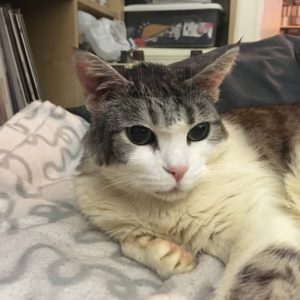 My cat Cleo is nearly 17 and receives sub-q fluids regularly at home. She used to grumble and try to get away but once I started Fear Free, I began giving her favorite crunchy treats before, during, and after administering fluids. Now she purrs through the whole procedure, and any time I approach the spot in the house where we do fluids, she walks up for “crunchie time.” I’ve been able to switch back to a larger needle because she doesn’t notice the poke while snacking, which makes administration faster, too.
 Chewy had a lot of fear and anxiety at the veterinary clinic, causing her to behave aggressively and making it difficult to give her the care she needed. While training her, I observed various signs of pain, which were most likely adding to her anxiety. I alerted her caregiver to my observations so she could better assess and monitor her dog and update her veterinarian. Chewy and her caregiver had previously had negative and traumatic experiences at a veterinary clinic so I referred them to Keystone Veterinary Clinic, which has Fear Free Certified Professionals who created a handling plan to enable Chewy to have a thorough exam, radiographs, and other diagnostics in a safe and low-stress manner. I also worked with the owner to begin muzzle training. The combination of appropriate scheduling, handling, and sedation, Chewy was able to receive the diagnostics and treatment she needed.
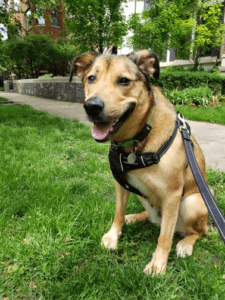 Gus had developed severe resource guarding of his food and water bowls, as well as fear and anxiety regarding being touched and having his gear put on and taken off. As a result, he snapped at and bit a walker. We worked closely with his owners and utilized Fear Free strategies and positive reinforcement training to get Gus comfortable with having strangers in the home. We were eventually able to find a solution that allowed Gus to be comfortable having walkers touch and refill his water bowl and approach his food bowl without any signs of resource guarding or fear, anxiety, and stress. Now Gus happily greets his walker at the door, demands affection, and has no issues on his walk or in his home.
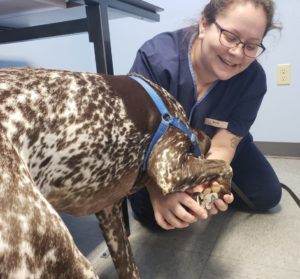 Eva, a spunky and energetic German Shorthaired Pointer, is a staff favorite for more than just her adorable, tongue-hanging-out smile, but there’s one thing Eva never liked: nail trims! Prior to the hospital’s transition to Fear Free in early 2017, it was a challenge to trim Eva’s nails, requiring three or four technicians to assist with restraint, plus a muzzle and calming cap. We started implementing Fear Free teachings right away with all of our patients, but one staff member has really gone above and beyond her commitment to Fear Free training to help Eva overcome her fear. Kayla McNeely volunteered to assist with Eva’s nail trims, and she can now perform Eva’s nail trims solo, standing, with minimal assistance from Eva’s mom, Sheila, who says, “Kayla’s patience and kindness have worked wonders with my girl.” Our hospital requires all staff members to go through Fear Free training to help ensure that all of our clients, patients, and staff have a pleasant experience during their exams. We have seen a tremendous difference in many patients at our hospital since our transition to Fear Free, but Kayla and Eva’s journey together is by far our most successful Fear Free adventure to date.
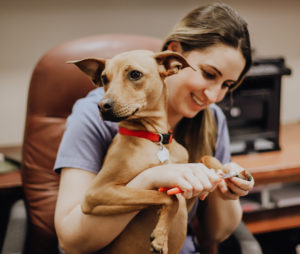 One-year-old Ruba disliked having her feet touched and her nails trimmed. We trialed trazodone for six months for all nail trim visits. It started to work well, and we discovered she preferred sitting in Dr. DaCosta’s lap. Ruba now comes in for frequent nail trims with minimal restraint and no trazodone needed. We are so proud of her progress and the team’s dedication to using Fear Free techniques.
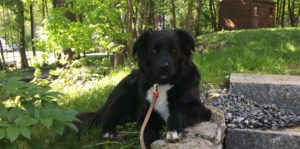 Mikey Bear used to require sedation before blood draws, but I showed his amazing humans how to hold his back leg for a blood draw and wet the vein while giving him treats to get him used to the feeling. They worked on this for a month, and when they came back, the blood draw was a snap. I discovered they had added another step to the homework and were poking the vein with a toothpick at home.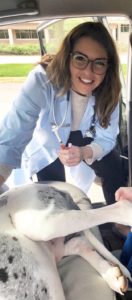
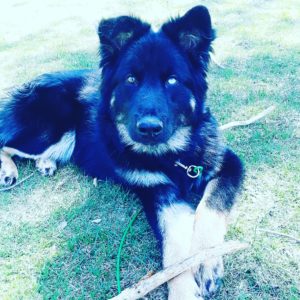 When I worked at a veterinary emergency clinic, one of the dogs in the hospital was so fearful that he would begin to thrash and hit his head in the ground if anyone touched his leash. I sat in front of his cage with my back to him so he could become accustomed to my scent. Then I started placing treats in his cage and turning my back again. Eventually, I opened the door and put a leash on him and sat next to the door. When he came out of the cage on his own, I was able to walk him with no tension on the leash. Gaining an animal’s trust is a beautiful thing.