Blog Archives

Sight Serenity: Considerations for a Tranquil Visual Experience

In this final webinar of a three-part series, Jacqueline Neilson, DVM, DACVB, reviews how cats and dogs have different visual experiences than humans do in the same environment. She explains why ignoring those differences can often trigger fear, anxiety, and stress in our patient population. By understanding their perspective, we can provide a more tranquil visual experience for our patients during veterinary visits and thereby improve their overall emotional experience.

Sponsored by Elanco.

Rachel Lees RVT, KPA CTP, VTS (Behavior)

A variety of animal training programs appear on cable and streaming networks. Some of the concepts depicted in these programs are appropriate for veterinary behavior cases and some are questionable. This article is not written to insult any of these programs, trainers, or networks but instead to discuss the learning theory and training philosophies demonstrated and review why veterinary behavior professionals are using alternative protocols.

Whether you are a veterinary team member working in general practice or are interested in behavior, it is important to recommend the most Fear Free and up-to-date information for patients and clients. Giving outdated information can potentially damage the human-animal bond between client and patient, potentially ending with the patient being rehomed or in some cases euthanized.

Punishment: May the Odds Be in Your Favor

Punishment is a technique used to weaken a behavior. For a stimulus to be “punishing,” the learner must find that stimulus aversive or undesirable enough to eliminate the behavior.  Punishment is difficult to use properly and does not teach the learner to perform the correct behavior. Most important, using punishment can be a liability for veterinary professionals recommending this technique because it can put the safety of the owners and pets at risk.

The American Veterinary Society of Animal Behavior’s position statement on punishment reviews the many side effects of using this training method. Using remote punishment collars as well as choke and prong collars can cause physical damage such as damage to the skin, neck, and trachea area, an increase in intraocular pressure, upper airway obstruction, and nerve damage. For punishment to be effective, it must provoke a fear response from the learner, which can unfortunately be generalized to other stimuli in the learning environment.  Consequently, this can make the animal become more fearful, anxious, and stressed in these contexts and situations.

Take the owner who is walking down the street with a 7-month-old Labrador Retriever puppy. The puppy shows a loose posture, wide tail wag, and becomes excitable on seeing people, sometimes jumping. For the owner, the dog’s jumping is undesirable. The trainer suggests using a remote “shock” collar for this issue. The owner is coached to shock the puppy for any jumping when interacting with people. The handler may be specifically punishing the pet for one behavior (jumping), but the puppy may begin to be concerned when people approach him because when this occurs, he receives a shock.

In the above example, the puppy may begin to show fear, anxiety, or stress with the approach of unfamiliar people. Using punishment, there is a risk that the learner (puppy) will associate the punishment (shock) with people approaching instead of the punishment (shock) being associated with the unwanted behavior (jumping on people).

Punishment needs to occur within 0.5 seconds of the start of the undesirable behavior. Therefore, the puppy would have to be shocked the moment his shoulders start to lower in anticipation of jumping to associate the punishment with the jumping behavior. Even with perfect timing, there is still a risk that the puppy may not associate the punishment with jumping.

Punishment Fails

Punishment can work to eliminate unwanted behaviors. The challenge is that it does not eliminate the motivation or give the learner a more appropriate behavior to perform.

In another instance, an owner was coached to use a remote collar to eliminate growling and aggression toward family members. If a family member approached the dog while he was eating a coveted bone and the dog growled, the family member was to correct the dog immediately with a shock. The growling behavior may be reduced, but it does not change the anxiety and concern related to the bone. The owners have now given the dog information that the approach of the owner is associated with a shock, which can increase the pet’s anxiety, fear, and stress. Long term, the pet may suddenly display with aggression but give only limited warning signs because the signals were suppressed with the remote collar. The animal was, in effect, told not to give this information. This makes this specific patient more dangerous and could put the family at greater risk.

In the above situation, the growling behavior is not a desirable response, but to the dog it was probably completely appropriate; he communicated his anxiety regarding the owner’s approach.  Using punishment made that specific pet more dangerous. Avoiding these situations and confrontations are the first step in addressing this issue. A veterinary behaviorist may recommend specific behavior modification to change the way the pet feels during this interaction.

Veterinary behaviorists recommend that animal training should focus on setting up the environment, so the pet is more likely to perform desired behaviors, reinforcing desired behaviors, removing the reinforcer for undesirable behaviors, and addressing the emotional state of the learner. The use of punishment can slow learning, suppress behavior, increase fear and fear-based aggression, create damaging and unintended associations with owners and other environmental stimuli, and damage the human-animal bond.

Even though these techniques may be seen on TV, remember that you are the veterinary professional and your clients value your opinion and recommendations. Giving them the most up-to-date information regarding behavioral training can be lifesaving. Observe training classes that you may recommend to confirm that they use recommended Fear Free techniques. For more information, see resources from AVSAB on “Finding a Trainer” as well as the “Position Statement on Use of Punishment.” The Fear Free Level 3 course for professionals provides the tools to address typical dog and cat behaviors using Fear Free methods.

This article was reviewed/edited by board-certified veterinary behaviorist Dr. Kenneth Martin and/or veterinary technician specialist in behavior Debbie Martin, LVT.

Rachel Lees, a Level 3 Fear Free Certified Professional, is a veterinary technician specialist in behavior, a KPA certified training partner, and lead veterinary behavior technician at The Behavior Clinic in Olmsted Falls, Ohio. She loves helping people create and maintain a strong human-animal bond.

Canine Allergic Dermatitis: Creating a Higher Quality of Life for Everyone Involved

What better way to decrease stress than by increasing quality of life? In this webinar, Dana Liska, DVM, DACVD, expands the discussion surrounding canine allergic dermatitis and the stress chronic disease causes for dogs and for owners and veterinarians caring for them. She looks at data supporting an improved quality of life for everyone involved in the veterinarian-client-patient relationship.

Sponsored by Zoetis Petcare.

Canine Allergic Dermatitis: Creating a Higher Quality of Life for Everyone Involved

What better way to decrease stress than by increasing quality of life? In this webinar, Dana Liska, DVM, DACVD, expands the discussion surrounding canine allergic dermatitis and the stress chronic disease causes for dogs and for owners and veterinarians caring for them. She looks at data supporting an improved quality of life for everyone involved in the veterinarian-client-patient relationship.

Sponsored by Zoetis Petcare.

Rachel Lees
Pet owners teach their animals a variety of cued behaviors that can be helpful for veterinary professionals in the exam room. “Sit” can help keep a patient stationary during an examination. When a patient knows the cue “High Five” or “Paw,” this may aid in assessing interdigital infections or performing nail trims.

One such skill that can be helpful for the veterinary team is targeting: teaching the dog to touch the nose to an object or hand. This behavior can be helpful in a few different ways.

Getting Patients from Point A to Point B

Many patients are uncomfortable with moving onto a lift table, scale, or even moving down the hallway. Instead of forcing the pet, we can use a hand target to move patients who have limited FAS. If this behavior is strong enough, most patients will be more excited about the opportunity to nose-target a hand to gain reinforcement and be less concerned about the “scary” object they need to step on. Using a hand target also gives us the option to keep our hands off of patients if they are concerned or conflicted with being touched by an unfamiliar person.

Instrumental Persuasion

Many patients are fearful of the veterinary instruments used during examination. With targeting, we can change the way they feel about the tools while allowing them to control the interaction. This can be done by presenting an exam tool and allowing the patient to interact with it on their own and then giving reinforcement.

In short, repeated training sessions, the patient learns that when the object is near, amazing things happen when they interact with it. Instead of a fear-related response, we can create a positive response toward presentation of these tools.

Teaching This Skill to Patients

Start this skill during preventive exams with pets who have a low FAS score. Puppies and kittens may be the best patients to start working with because they don’t have any preconceived notions.  Patients with a high FAS score may need more therapy, and using this technique may cause additional FAS. Wait to add it until after Victory Visits show that the patient’s FAS is reduced in the veterinary hospital.

If you are a Fear Free Professional, using treats in the exam rooms should be old hat to you. As you teach this skill, use treats to reinforce any interaction with exam tools, the patient stepping onto the table, or interacting with the veterinary team (hand target).

Using a word (Good!) or a tongue “click” may be helpful as an event marker. An event marker gives the patient information about the behavior goal and can capture the desired behavior. In the case of teaching a patient to target, the goal or “wanted” behavior would be to use the event marker when the patient interacts (noses, touches, licks, or sniffs) the object or hand we are using as the target. Always follow the event marker immediately with a treat.

When teaching this behavior, offer the object one to two inches from the pet’s nose. When the patient interacts with the object, use the event marker and reward the patient with a treat. If the patient shows concern regarding the object or FAS increases, move the object farther away until the patient is more comfortable. You may need to break down the behavior into smaller steps to get the patient to interact with the object. These small approximations may include capturing the behaviors of looking at the object, moving toward the object, touching the object with paw or nose.

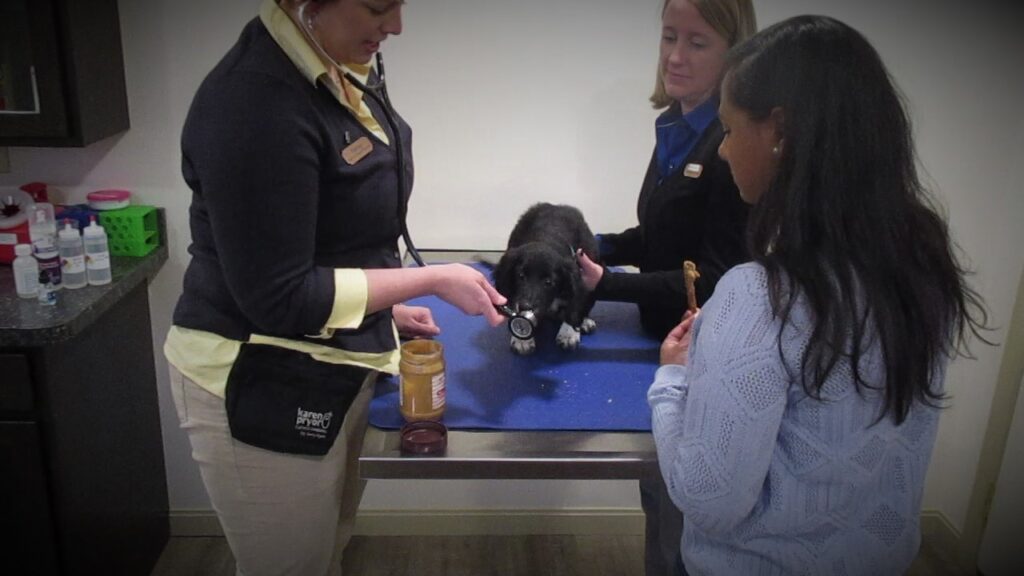
Example: Presenting a Stethoscope

With an FAS 0 to 1 patient, present the bell of the stethoscope a few inches from the patient’s nose

Observe for any nose touching or interacting with the stethoscope

Say the word “Treat” when the patient’s nose touches the stethoscope

Move the bell of the stethoscope away and give a treat

Repeat if the patient is loose, relaxed, and eating during this training session. If the FAS score increases, discontinue and reassess with the veterinary team.

This article was reviewed/edited by board-certified veterinary behaviorist Dr. Kenneth Martin and/or veterinary technician specialist in behavior Debbie Martin, LVT.

Rachel Lees, a Level 3 Fear Free Certified Professional, is a veterinary technician specialist in behavior, a KPA certified training partner, and lead veterinary behavior technician at The Behavior Clinic in Olmsted Falls, Ohio. She loves helping people create and maintain a strong human-animal bond.
 

Fear Free on a Budget

Listen to Practice Certification Manager Dr. Rachel Abrams for tips on how many Practice Certification standards can be met with little to no strain on your budget.

Course Overview

There are lots of ways to make visits Fear Free when there is time for you and the client to discuss the animal’s FAS, add pre-visit pharmaceuticals, take your time, and even postpone non-essential procedures. But, what about in an emergency or critical care situation? Even though the procedures are not elective, there are still things you can do to help ease patients’ FAS.

This course, approved for 1 RACE CE hour, was written by Kenichiro Yagi, MS, RVT, VTS (ECC, SAIM)

There are four lessons in this course.

Lesson 1: Challenges in Emergency and Critical Care
Lesson 2: Why is Fear Free Important for ECC Patients?
Lesson 3: Solutions for Patients in the Emergency Room
Lesson 4: Solutions for Patients in Critical Care

Kitten Socialization: Do Kittens Need Kindergarten?

Getting kittens off to a good start lays the foundation for an adulthood free of fear, anxiety, and stress. But just what does a “good start” mean? What exactly is kitten socialization? What role does genetics play, and what should we be doing for our kitten patients? In this webinar, Dr. Krista Sirois answers these questions and discuss the benefits of establishing a Kitty Kindergarten program in your clinic for your patients, pet parents, and your team.

Weathering the Storm: Disaster Preparedness for Pet Professionals and Pet Owners

If a disaster hit your community tomorrow, would you and your business be prepared? How about the animals that live in your home or community? It is never too late to begin planning for a disaster or business disruption. In this webinar, representatives from State Farm talk about disaster preparedness, having a business continuity plan, and what insurance does and doesn’t cover. Whether you are a pet professional or a pet parent, this webinar can help you prepare for and recover from the unexpected.

Sponsored by State Farm.