Blog Archives

Mikkel Becker
One of the best ways to earn a pig’s trust and friendship is by appealing to the pig’s big appetite. The saying “eat like a pig” holds true for many pigs who are highly focused on food. At The Center for Bird and Exotic Animal Medicine near Seattle, Washington, Dr. Alicia McLaughlin and her team have found that food talks when it comes to swaying swine to seeing veterinary team members as friends rather than foes, and in doing so, obtaining their calm cooperation.

Creative strategies have also shown big benefits for some of Dr. McLaughlin’s patients. One strategy that works for some pigs is to “fork” the pig using gentle presses of a fork on the pig’s back. Pigs who are calmed by such touch will often lie down on their side to soak up the soothing massage, exposing their underside and allowing belly and foot exams to be completed with the pig’s willing cooperation.

Dr. McLaughlin also incorporates the owner’s participation into the care experience. With one pig, the trick for getting a willing hoof trim was as simple as the owner bringing in a favorite treat: cucumbers! On one end of the pig, a person held on to a whole cucumber for the pig to chomp on, while at the undercarriage another team member performed hoof care. By the time the entire cucumber was finished, so was the hoof care, making it a win-win for pig and people.

One technician during the exam or care is often charged with the task of giving tasty treats with the pig’s owner nearby to keep the swine distracted during the exam. The trick of treats is finding what works best for each patient. Pig owners are encouraged to bring in their pig’s favorites in addition to the ones already on hand in the hospital.

Three delectable delights for pigs to pig out on during Fear Free exams and procedures are peanut butter, cream cheese, and Cheerios. For instance, peanut butter placed on a tongue depressor or smeared inside a small bowl may be used to distract the pig during the exam.

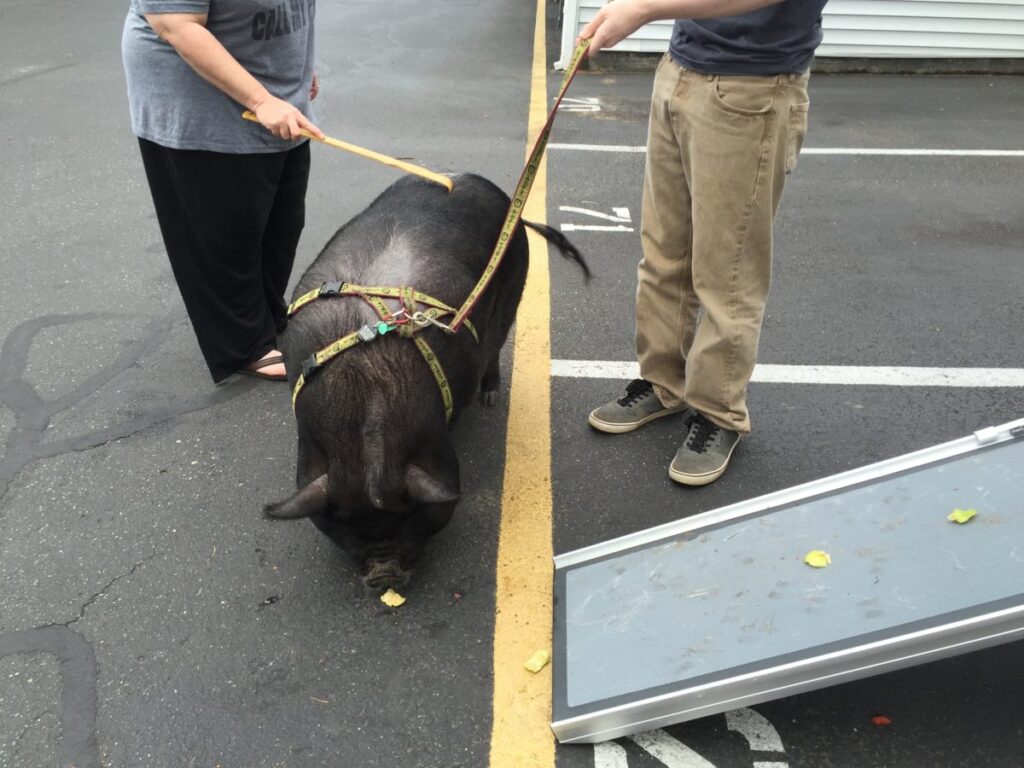
One of the greatest challenges of pig exams is getting a weight. Pigs don’t like to be lifted or restrained, and with the size of many pigs, doing so to get the swine onto the scale would be upsetting, causing avoidance in the future.

A solid approach is to get the pig to move onto the scale on his own. This is best achieved with a combination of teamwork, time, and treats.

“Make your job as easy as possible by creating a chute-type scenario leading up to the scale using human bodies or other items to funnel the pig onto the scale,” says Dr. McLaughlin.

A line of Cheerios or other tasty treats can be placed for the pig to follow through the chute and onto the scale. In the center of the scale, place a pile of treats to keep the pig in place momentarily while being weighed.

Most important, avoiding force is critical for earning trust.

“Don’t push it. I’m a firm believer in giving a pig a little more time, and it will end up taking less time in the long run,” says Dr. McLaughlin.

This article was reviewed/edited by board-certified veterinary behaviorist Dr. Kenneth Martin and/or veterinary technician specialist in behavior Debbie Martin, LVT.

Mikkel Becker, CBCC-KA, CPDT-KA, KPA CTP, CDBC, CTC, is lead animal trainer for Fear Free Pets. She is a certified behavior consultant and trainer who specializes in reward-based training that’s partnered closely with the pet’s veterinary team. Mikkel is coauthor of six books, including From Fearful to Fear Free.
 

Arden Moore
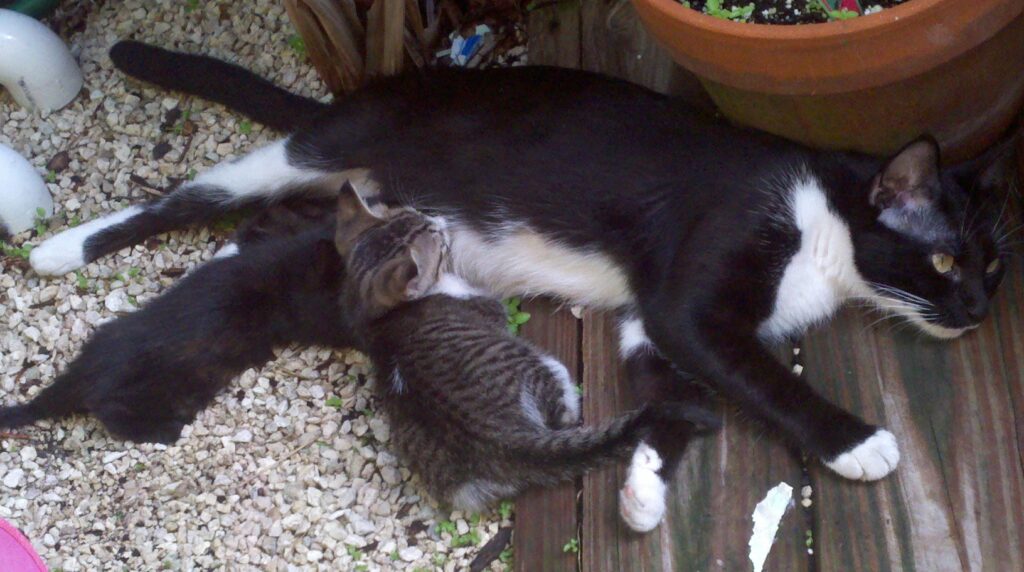
His official title is Community Outreach TNVR Coordinator, but most of the time, Paul Bates feels like a mediator, problem solver, and teacher. That suits him just fine.

Bates leads the team at Peggy Adams Rescue League in West Palm Beach, Florida. The organization works closely with shelter volunteers, cat rescue groups, and cat-caring neighbors to ensure free-roaming cats in Palm Beach County are properly vaccinated, sterilized, and fed.

It is estimated that more than 200,000 cats live on the streets in Palm Beach County. Once called feral cats, they are now identified as community cats.

“These are cats who live outside, who do not belong to anybody, and who are not adoptable because they are not socialized with people,” says Bates. “They certainly do not belong in animal shelters where they are often euthanized. Our job is to work with community cat advocates to make sure these community cats are neutered/spayed, vaccinated, and returned to their outdoor homes.”

On the Case

It’s a tall order, but Bates is up for the challenge. He is a Fear Free Pets Shelter Course graduate who works to educate people about the mindset of community cats and safe ways to trap, vaccinate, spay/neuter, and return these cats back to their colonies without stressing them or getting injured.

His shelter also helped get a county-wide law adopted that requires these cats to be sterilized, vaccinated, implanted with a microchip, have left ears clipped to identify these actions and then released to the same area where found.

Bates makes daytime and night-time visits to community cat sites in neighborhoods, car dealership parking lots, and alleys behind restaurants. He gives talks to volunteers and shares tips and resources on two key Facebook pages: Project CatSnip and Community Cats of the Palm Beaches. Project CatSnip is a program of the Peggy Adams Rescue League that provides free TNVR through grant funding and conducts free humane trapping classes.

Safety 101

Even though many of these cats appear friendly and may even allow a trusted person who feeds them to pet them, they are still capable of lashing out if they feel threatened.

“If you see a stray, friendly cat, do not attempt to pick up the cat and put him in a carrier because chances are that you will be bit or scratched,” he cautions. “Scooping up a cat in your arms can make them go into panic mode. The nails come out, and the teeth are ready to bite. It is far safer to set up humane traps to get them in so we can give them vaccinations and spay/neuter them and return them to their cat colony.”

To reduce fear or anxiety in the cat during transport, Bates recommends placing bed linens made of breathable fabric over the trap to help the cat settle down.

“A cat in an uncovered trap is apt to freak out and bounce off the sides of the cage,” he says. “Covered humane traps look like safe spots to a cat. Avoid using heavy blankets, thick towels or quilts because a cat inside could overheat due to the lack of air flow. And, he could also have to inhale the strong ammonia smell if he urinated or defecated during transport.”

To reduce fleas and ticks among these community cats, Bates recommends mixing food-grade diatomaceous earth powder with catnip and allowing the free-roaming cats to roll in it. This powder is safe for pets and people, but destroys exoskeletons in these parasites.

Tips for Success

Other insights shared by Bates:

  • Community cats should not be relocated. Many risk injury or death from vehicles or predators in their determination to travel miles to return to their colonies.
  • Attempts to completely remove a cat colony will only result in another cat colony moving in and producing kittens, a phenomenon known as the vacuum effect.
  • The best way to lure intact community cats into humane traps is to place traps where cats gather to eat and allow a few days for the cats to get used to them. Then create a trail of food leading into the traps and placing the highest-quality smelly food (to these cats, that is usually sardines or tuna or even Kentucky Fried Chicken) in the middle of the traps.
  • If you find a homeless cat whose left ear is notched, do not bring him to a shelter unless he is injured or ill. This is the universal sign that he is a community cat who has been neutered.
  • Do not leave bowls of food out; they attract raccoons and other wildlife. Set up specific feeding times and remove bowls within an hour.

Numbers indicate that this multi-approach effort is working. Before the TNVR program began in 2009, Palm Beach County shelters took in 19,000 homeless cats with more than 14,000 cats euthanized in 2008. That number has been cut to fewer than 2,000 cats euthanized this year in county shelters.

“It really takes a village to help these cats,” says Bates. “We have a passionate group of board members, staff, volunteers, and people in neighborhoods all doing their part to help feed and keep these cats healthy.”

This article was reviewed/edited by board-certified veterinary behaviorist Dr. Kenneth Martin and/or veterinary technician specialist in behavior Debbie Martin, LVT.

Arden Moore is The Pet Health and Safety Coach. She is a best-selling author, radio show host, in-demand speaker and master certified pet first aid/CPR instructor who travels the country teaching with Pet Safety Dog Kona and Pet Safety Cat Casey. Learn more at www.ardenmoore.com and www.facebook.com/ardenmoore.


By Kim Campbell Thornton

Reducing fear, anxiety, and stress during visits and procedures takes time, teamwork, and sometimes a little experimentation. Here are three success stories shared by a veterinarian, trainer, and owner.

Tyson’s Turnaround

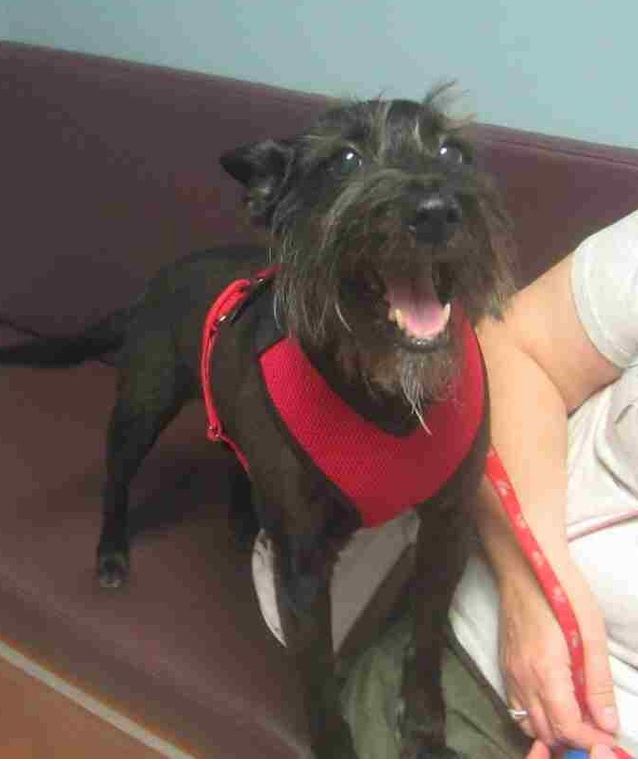
Tyson is a 12-year-old Schnauzer mix who first came to us last year for a wellness visit. The owner told us that his previous clinic had to muzzle him, and he was handled somewhat roughly. She wanted to get away from that. On his first visit we just got a feel for his comfort level. He barked and growled at us in the room but took treats willingly. He allowed an otoscopic exam but was tense, and when the stethoscope was introduced, he actively tried to bite. Approaching him with a muzzle sent him into a panic. We sent some Trazodone home with him that day for future visits and discussed doing a set of behavioral visits to help desensitize him to handling and instruments.
Tyson returned five months later for scheduled vaccinations. With Trazodone on board he was still on edge but performed tricks for us and approached us for treats. He allowed me to auscult him while he had treats to eat. This was great progress! We still decided to sedate for the remainder of his procedures to avoid backtracking on his progress.
Over the course of the next year Tyson’s owner took her own Fear Free steps at home, buying her own grooming table and clipping him herself. She was patient with him and even learned to Dremel his nails.
When it was nearly time for Tyson’s annual exam she set up behavioral sessions with us, so we could work on desensitization. We discovered Trazodone made him a little grumpy at home, so we switched to gabapentin, which worked well for him. On his first behavioral visit the difference was obvious. He came right up to staff for treats, did all of his tricks, and allowed us to touch him everywhere. We could feel his belly, touch his ears and legs, and look in his mouth. We started doing mock injections with a capped needle with no reaction. The only thing that still triggered him was obvious restraint.
For his annual wellness visit, Tyson allowed a full exam. We applied topical lidocaine at his injection sites and where we planned to draw blood for a heartworm test. We put a donut collar on Tyson prior to his vaccines as a precaution, and asked the owner to hold his harness to keep him steady (he was really into the treats and a bit wiggly). He did not react to his vaccinations and even held still long enough for us to get a blood draw from his back leg.
Tyson made a huge turnaround, and I think the owner’s willingness to do her part played a big role. It has been great to see the difference Fear Free techniques have made!

Susan Sappington, DVM, Rock Bridge Animal Hospital, Columbia, Missouri 

Elke’s Excellent Experience

Elke had her annual veterinary checkup yesterday, and by doing some simple things we were able to make her visit less stressful and even a bit enjoyable. Our veterinarian is part of a Fear Free practice (Thank you, Animal Hospital of North Asheville) and embraces a cooperative care approach that allows animals to have choices and dictate the pace at which we move through the visit.
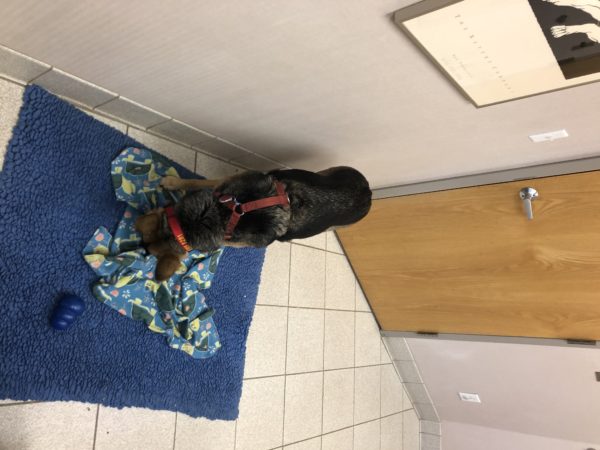
In the photo, you see that there is a comfortable mat for Elke to use. Having a soft spot to rest on is so much nicer for dogs than just having the cold, hard floor. She was a bit nervous, so we created a treat search for her by hiding treats in the blanket and Kong. It is one of her favorite things to do, and sniffing is an activity that we know helps calm dogs. During the actual exam, all of us (veterinarian, veterinary technician, and myself) gave her treats each time a new body part was examined. While Elke does not love going to the veterinarian’s office, with cooperative care and the Fear Free method she was able to relax and have a calm visit.

Joann Rechtine, CPDT-KA, MS, MPH, RN, The Loose Leash Academy, Black Mountain, North Carolina

Roger’s Routine

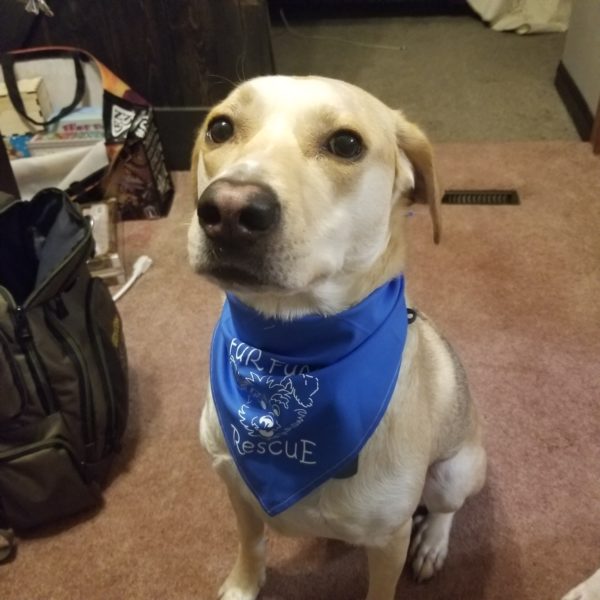
dog with handkerchiefWe were beside ourselves on how to handle taking Roger to the vet. We put him through basic obedience and advanced obedience classes twice to learn manners and how to act appropriately. He has done great in our home and in our families’ homes as we know how to handle his anxiety. In our vet’s office, though, Roger would go crazy as his anxiety shot through the roof from all the smells and people. Thanks to the Fear Free program and team at Frey Pet Hospital, Roger can feel safer and happier going to the vet now. We are thankful for Fear Free Way!
Nicole Schroeder, Cedar Rapids, Iowa

This article was reviewed/edited by board-certified veterinary behaviorist Dr. Kenneth Martin and/or veterinary technician specialist in behavior Debbie Martin, LVT.

Kim Campbell Thornton is content manager for Fear Free Pets and is a Level 3 Fear Free Certified Professional. She has been writing about dogs, cats, wildlife, and marine life since 1985.
We can’t be a Fear Free Certified Practice because…How many times have you thought this?

We don’t like to be negative, but, well, you’re wrong. Here are the top 10 myths about the difficulty of earning Fear Free Practice Certification and what you might be surprised to learn about getting your practice certified.

  1. We don’t have separate cat and dog entrances.

Species-specific entrances are not required. If you have them, that is great! There is an optional standard for which you will score points for having them, but they are not a requirement.

  1. We don’t have a designated cat room.

A designated cat room is a plus, but it’s not a must. You can earn points for having one, but you won’t lose points for not having one.

  1. We can’t afford to pay for everyone’s memberships on top of Practice Certification.

Once a practice is certified, you pay only the annual Practice Certification dues; you no longer pay for individual members.

  1. We have to repaint the practice in Fear Free colors.

We don’t expect you to! If you are already planning to refresh the practice, it makes sense to pick some Fear Free colors, but it’s not a requirement.

  1. We are a Fear Free Practice already; every team member is certified.

Congratulations on getting everyone certified! However, to be an official Fear Free Certified Practice, you must complete the Practice Certification process. Chances are you will save money!

  1. Not everyone in the practice is Fear Free Certified.

To be eligible for Practice Certification, only 25 percent of your staff must be Fear Free CertifiedÒ with an active membership.

  1. The standards aren’t available to review prior to applying.

Members can download and begin implementing the Standards and Supporting Examples at any time.

  1. We don’t have room for separate dog and cat waiting areas.

Separate waiting areas are not required, though visual blocks are encouraged if clients and patients are unable to wait outside or be moved straight into an exam room.

  1. Our scrubs aren’t in “Fear Free-approved” colors.

Team members of Fear Free Certified Practices are not required to wear any specific-colored scrubs or lab coats.

  1. The process is too difficult.

Practice Certification is a commitment, but it is worth it.

For more information, learn more at fearfreepets.com/practice-certification.

This article was reviewed/edited by board-certified veterinary behaviorist Dr. Kenneth Martin and/or veterinary technician specialist in behavior Debbie Martin, LVT.


Weathering the Storm: Disaster Preparedness for Pet Professionals and Pet Owners

If a disaster hit your community tomorrow, would you and your business be prepared? How about the animals that live in your home or community? It is never too late to begin planning for a disaster or business disruption. In this webinar, representatives from State Farm talk about disaster preparedness, having a business continuity plan, and what insurance does and doesn’t cover. Whether you are a pet professional or a pet parent, this webinar can help you prepare for and recover from the unexpected.

Sponsored by State Farm.

By David Hustead, DVM, M.P.H.Balancing the importance of necessary care with the emotional care of pets in the Fear Free clinic can be challenging. There are countless situations, from the dog hit by a car to an outbreak or emerging disease, where the timeliness of medical care seems to outweigh the need to take things slowly and minimize fear, anxiety, and stress (FAS) in the pet.

Consider Lyme disease. While we as well as our clients may be reluctant to add another injection to a dog’s prevention program, new information about Lyme disease’s risks, transmission, and prevalence provides a compelling reason to reconsider that reluctance. What information do we need to balance those risks with the benefit of prevention?

The risk of Lyme disease is increasing, changing, and spreading.

It’s important to understand that what we know about the risk of Lyme disease may be outdated. There is increasing evidence the risks of Lyme disease continue to expand for both people and dogs in the U.S. The CDC reports that vector-borne disease has more than doubled from 2004 to 2016. Of this, human Lyme disease accounts for 82 percent.  Additionally, during this period, nine new vector-borne diseases were first observed in the U.S.1

The risk to dogs is also increasing in areas not normally considered at-risk for Lyme disease. According to the Companion Animal Parasite Council (CAPC), while the Northeastern states, upper Midwest, and Pacific Northwest still have the majority of canine Lyme cases, dogs exposed to Borrelia burgdorferi continue to be discovered outside of those areas. Their biggest areas of concern for increases in canine Lyme disease in 2019 include eastern Pennsylvania, eastern Ohio and Kentucky, West Virginia, western Virginia and North Carolina. Northwestern Minnesota and some areas in Indiana are also expected to see higher than average seroprevalence in 2019.

Other longstanding beliefs about transmission may now be outdated. For instance, many of us think the risk of disease transmission from exposure to the Lyme disease tick vector I. scapularis is greatest in the spring, but the CDC says the risk of exposure to these ticks is really greatest throughout spring, summer, and fall. In addition, adult ticks can be active at any time of the year when the temperature is above freezing.3

Consider the critical role of the veterinarian.

It’s easy to see that Lyme disease prevention is a critical issue to raise with clients, and one that requires the expertise of a veterinarian. There is no replacing the combination of client education about the disease and exposure risk reduction and proper vector control, including systemic or topical insecticides and vaccination. But some Fear Free veterinarians are hesitant to add a Lyme vaccine to their protocols, thinking it means yet another needle stick and more vaccine volume administered. The good news for Fear Free Certified practitioners is that, for the majority of your patients, you can add a Lyme vaccine without adding needle sticks or more volume.

For example, dogs needing only a Lyme vaccine can receive Elanco’s TruCan™ Ultra Lyme. TruCan™ Ultra Lyme has only half the volume of most vaccines. While half the volume may not seem like a big deal to you, clients interested in Fear Free techniques will appreciate a reduced-volume vaccine. Let them know you have a Lyme vaccine that offers the same protection but with half the dose volume.

Elanco has options for dogs who need distemper and parvo protection as well as those at risk of Leptospiroris, another disease with changing risk. TruCan™ Lyme L-4 + TruCan™ DAPPi+Lyme L-4, and TruCan™ DAPPi+Lyme CL-4  all provide protection with one needle stick and the same vaccine volume as a 4-way Lepto-only vaccine.

TruCan, Elanco, and the diagonal bar logo are trademarks of Elanco or its affiliates.

©2023 Elanco or its affiliates. PM-US-23-0569

References

    1. 1 Rosenberg, R. Et al. Vital Signs: Trends in Reported Vector Borne Disease Cases US and Territories 2004-2016. MMR Weekly 67 (17) May 4 2018.
      2 Yabsley, M. Despite the Availability of Preventative Measures—the Risk of Vector-Borne Disease Remains High in 2019. CAPC website accessed on 16 May 2019 at  https://capcvet.org/articles/despite-the-availability-of-preventative-measures-the-risk-of-vector-borne-disease-remains-high./
    2. 3 CDC accessed Geographic distribution of ticks that bite humans. Accessed at:https://www.cdc.gov/ticks/geographic_distribution.html

This article is brought to you in collaboration with our friends at Elanco.
Akita nose|Akita nose
Until recently, disinfection was considered to be a necessary evil, killing infectious microbes at the cost of exposing pets and people to harsh chemical odors. Disinfectants with unpronounceable names, such as sodium hypochlorite (bleach), quaternary ammonium compounds (QUATs), and potassium peroxymonosulfate, may have been the industry standard for a long time, but just like any other aspect of animal health, we always strive to do better for our pets and create a more positive experience for them in and out of the vet clinic.Accelerated Hydrogen Peroxide® (AHP®) technology had been used extensively in human healthcare to kill some of the toughest pathogens while putting patient safety at the forefront. When Virox Animal Health saw the same need for veterinary care, they knew that AHP would be a perfect fit to help protect people and animals while reducing fear, stress, and anxiety in a veterinary hospital. That led to the creating of Rescue, a disinfectant specifically tailored to protect companion animals and the people who care for them.

While traditional disinfectants have been a trade-off between safety and efficacy, Rescue eliminates the need to make this choice. Rescue’s safety profile, coupled with the lack of harsh chemical odor, realistic contact times, and superior cleaning powers, can help your facility along its journey in becoming Fear Free.

Reducing FAS in the disinfection process doesn’t, however, mean a loss of efficacy. AHP disinfection covers all the bases in a Fear Free approach to animal health. These include:

1. Other chemicals like bleach and QUATs can be harsh. We all know that from experience, but we might not realize that bleach can cause serious skin and eye irritation and respiratory illness1. QUATs, although safer than bleach, have been associated with asthma and can also be irritating to the eyes and skin2. Rescue kills those tough-to-kill pathogens, but its gentle formulation is non-toxic and non-irritating for the safety of your patients, staff, and clients.

2. Bleach and QUATs can often take up to 10 minutes of contact time to kill pathogens, which can really slow down your practice. When was the last time you waited 10 minutes for a disinfectant to do its job before wiping it off? Not to mention the fact that these chemicals may not stay wet on the surface for long enough to meet this contact time. Rescue has realistic contact times, ranging from 30 seconds to 5 minutes. Furthermore, its wetting agents help make sure that it stays wet long enough to disinfect. This means less product used, less waiting between patients, and a more efficient practice overall.

3. Rescue has broad-spectrum bactericidal and viricidal claims against the vast majority of pathogens we encounter in the veterinary setting, so you can be confident that even the toughest pathogens don’t stand a chance. AHP also has none of the odors associated with chemical disinfection, preventing additional stress to our patients during their visit.

4. Cleaning power. Many older disinfectant chemistries have been poor cleaners and were only able to kill pathogens on surfaces that had been pre-cleaned with soap and water. AHP contains powerful detergents, which break down soil and allow it to work in the presence of organic material. This brings cleaning and disinfection into one easy step, saving valuable time and resources along the way. Rescue is also a natural odor eliminator, which may help get rid of some of the smells that can contribute to fear, stress, and anxiety within your clinic.

References

      1. 1. Acute Antimicrobial Pesticide-Related Illnesses Among Workers in Health Care Facilities – California, Louisiana, Michigan, and Texas, 2002-2007. CDC Morbidity and Mortality Weekly Report. May 14, 2010.
        2. Omidbakhsh N, Sattar SA. (2006). Broad-spectrum microbicidal activity, toxicologic assessment, and materials compatibility of a new generation of accelerated hydrogen peroxide-based environmental surface disinfectant. AJIC 34(5), 251-257.

This article is brought to you in collaboration with our friends at Virox.This article is brought to you in collaboration with our friends at Virox/Rescue Disinfectants.

Susan M. Ewing

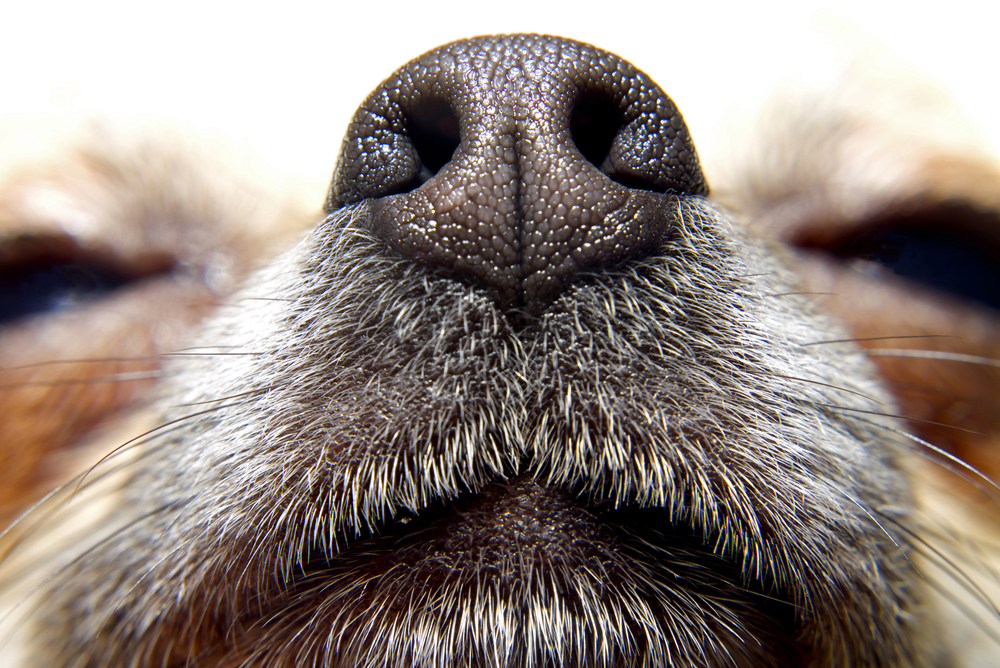
Both dogs and cats rely heavily on scent to interpret their surroundings while humans rely more on sight. Blindfold a human just before a visit to a doctor or emergency room, and the stress level would be higher than if the person could see, but most people would at least be able to hear and understand what was happening in the way of treatment. We can’t explain to our pets what is happening, or why they are in a hospital. Take away their sense of smell and you’ve taken away their ability to interpret their world, adding more stress to an already stressful situation. By understanding the effects of scents, you can help them stay calm.

Ban Bleach

No one intentionally stops a dog or cat from smelling, but disinfectants can do just that. Bleach and other disinfectants with a harsh odor can make a pet “nose blind,” creating stress when they try, and fail, to learn about their environment. In one study, “Minimising Stress for Patients in the Veterinary Hospital: Why It Is Important and What Can be Done About It” (published online in Veterinary Sciences, April 13, 2017), lead author Janice K.F. Lloyd cites Karen L. Overall, VMD, in the Manual of Behavioral Medicine for Dogs and Cats: “A solution of bleach, even as low as 1 percent, can destroy olfactory neurones, resulting in a loss of information and heightening anxiety.”

While disinfecting is essential, using one that doesn’t have a harsh odor may help to lessen the negative effect on a pet’s nose. At Applebrook Animal Hospital in Ooltewah, Tennessee, Kathryn Primm, DVM, uses Rescue disinfectant, a hydrogen peroxide product with little odor, which also dries quickly.

Scents From Other Animals

When pets are able to smell, identifying stress in other animals can increase their own level of stress. Secondarily, humans may also experience some stress when smelling clinic odors. Most pets are quick to respond to their owners’ emotions, and if that emotion is stress, it’s going to affect the pet.

“When we have bad odors suddenly, like anal glands,” says Dr. Primm, “it is critical that they be cleaned and deodorized completely, or they will cause fear in all the pets that perceive them.” For those kinds of odors, Primm uses K.O.E. (Kennel Odor Eliminator) by Thornell, a product that quickly eliminates odors and comes in a concentrate, a spray, and individual wipes.

Sometimes, when possible, opening a window can help. Many pets will become distracted from their environment as they process scents from outdoors. Synthetic pheromones may also help to calm a dog or cat. Plug-in pheromone diffusers may reduce stress in a waiting room, and doctors or technicians can spray their clothes with the pheromones. Use diffusers or sprays with caution around birds and fish.

Many people appreciate the calming effects of lavender and chamomile, and both of these scents seem to calm pets, too. Be careful how you use them, though. Certain diffused essential oils can cause some respiratory distress in cats so use them with caution, and alert clients to the risks of active diffusers in the home to pets.

With so many pets depending on their noses for information, it makes sense to pay attention to scents.

This article was reviewed/edited by board-certified veterinary behaviorist Dr. Kenneth Martin and/or veterinary technician specialist in behavior Debbie Martin, LVT.

|

Do You Hear What I Hear? Noise Aversion Beyond Thunder and Fireworks

Noise aversion isn’t only about thunder and fireworks. Many of your patients are suffering daily from noise aversion to everyday environmental events.

What can the veterinary professional do? In this webinar, sponsored by Zoetis, board certified veterinary behaviorist and Fear Free Executive Council member Dr. Lisa Radosta discusses a variety of treatments that can help patients with noise aversion live happier lives.

By Deb M. Eldredge, DVMSometime when it is fairly busy, take a few minutes and go out to sit in your clinic waiting room. Sit down, close your eyes and just listen. Listen carefully for little noises as well as the loud and obvious noises.

After a minute, the sounds may seem a bit overwhelming to you. Think of how much more cats and dogs hear than we do and how they don’t understand what many of the noises are. For our pets, the veterinary hospital may be a horror house of sound.

How can we help pets with sound issues to feel more comfortable at the clinic? Carpet is often used to mute sounds, but it doesn’t really make sense in a clinic where cleanliness is important. Barriers can help to block sounds, and soundproofing exams rooms is not a bad idea, although it can be expensive.

Playing background music may help some pets, but an individual pet may not like your music choices. That sounds silly but anyone who has done musical freestyle with a dog can tell you that dogs have definite opinions on music. Luckily, there are some research-backed CDs of soothing music composed specifically for dogs and/or cats. Through A Dog’s Ear, for instance, has pioneered soothing music for anxious pets. These CDs are excellent for waiting rooms, exam rooms, and kennel areas.

To really help your patients prepare for a veterinary visit or hospital stay, consider making a CD of the sounds at your clinic. Start by doing a walking tour of the clinic with one of your own pets. Begin with the sound of the door opening and closing and the sound of toenails on the floor. If the scale squeaks, catch that. Try to record the voices of all of your receptionists as well as the ringtone of your phones and your computer and printer beeps and squeaks.

Move on to the noises heard in a waiting room: doors opening and closing, laboratory equipment dinging off, refrigerator and cupboard doors opening and closing. Record the voices of your veterinary technicians, assistants and kennel help. Record some barking dogs, cage doors opening and closing, and cats meowing (or even screaming or hissing). Note any noises that your own pet reacts to. Washing machines, dryers, blow dryers, vacuums, furnaces, and air conditioners can all make noises that startle or panic an already anxious pet.

The goal is to create a CD of sounds that pet owners can take home to play for pets to accustom them to the sounds they will hear at your hospital. These are not CDs to play at your clinic but rather CDs to loan out to clients. Have them start by playing the sounds very quietly and try to pair the CD with positive things such as meals or belly rubs. If you have any clients who are breeders, loan them a copy of the CD to play for their litters so the puppies and kittens are familiar with the sounds right from the start.

Some pets will never smile about their veterinary visits. But if you can at least make the noises a pet will encounter seem routine, you will have helped reduce the pet’s fear of the veterinary clinic.