Blog Archives

Sandra Toney

When she was 12 years old, Karina Salvo, DVM, CTPEP, CVFT, CVMMP, volunteered to work for a one-doctor practice. Cleaning cages, doing laundry, and walking dogs led to watching her first surgeries. From that point, she knew that her career path would lead to veterinary school.

But one thing she and the veterinarians she grew up working for—and later, with—didn’t learn was how to make exams easier on pets. When she became aware of Fear Free®, though, it made sense to her that veterinary visits should be less frightening and more fun for patients.—not to mention for veterinarians and technicians themselves.

“The one thing that I noticed in each and every practice was the frequency in using force to hold a patient,” says Salvo, now an Elite Fear Free Certified® DVM who also has certifications as a palliative and end-of-life practitioner (CTPEP) and in branches of Traditional Chinese Medicine (CVFT and CVMMP). “Some of the staff wrestled what I thought were highly aggressive dogs down to the ground in order to give a single vaccine or draw blood. The end result was someone got hurt, scratched, urine and feces everywhere, and a dog that was left splayed out and panting on the floor in exhaustion or cowering in the corner. This was the ambience of the veterinary field I grew up in.”

As she learned more from Fear Free, she found that in-clinic exams became easier.

Now she owns her own practice, AcuVetDoc Veterinary Reproduction & Animal Care Wellness Clinic, in Royal Palm Beach, Florida, where she treats not only pets but also wildlife. That allows her to see only one patient at a time.

“I can practice 100 percent the way I choose to. I intentionally do not have a receptionist or a technician,” Salvo says. “Patients are scheduled on the hour instead of every 15 minutes. This allows me to work one on one with the patient and the owner. My ‘team’ in my practice is the owner, myself, and the patient. By working together, all of us can better understand the patient and the medicine. Practicing this way has allowed me to build trust in my patients as well as owners because both are comfortable.”

Salvo greets clients and patients at the door so she can watch how the animal walks into the building. If owners have given permission beforehand, treats are on the carpeted floor as they enter.

Animals who have previously had poor experiences at veterinary clinics may be directed into an exam room that resembles a living room—with carpet, a bookcase, leather sofa, chair, and hidden treats. While Salvo sits on the floor, pockets filled with treats, and talks to the owner, patients can explore, approaching when they’re comfortable. If they need more time, Salvo may simply hand out treats during the visit, holding off on an exam. She discusses this possibility with clients beforehand so that they’re aware the first interaction may be a “meet-and-greet,” with the exam portion on a subsequent visit.

Many of her patients enjoy “playtime,” a rewarding exam in which Salvo uses tasty treats to get patients to move on their own but in a fashion that allows her to examine them. For instance, she might get them to sit or turn their head so she can look inside ears or examine the mouth.

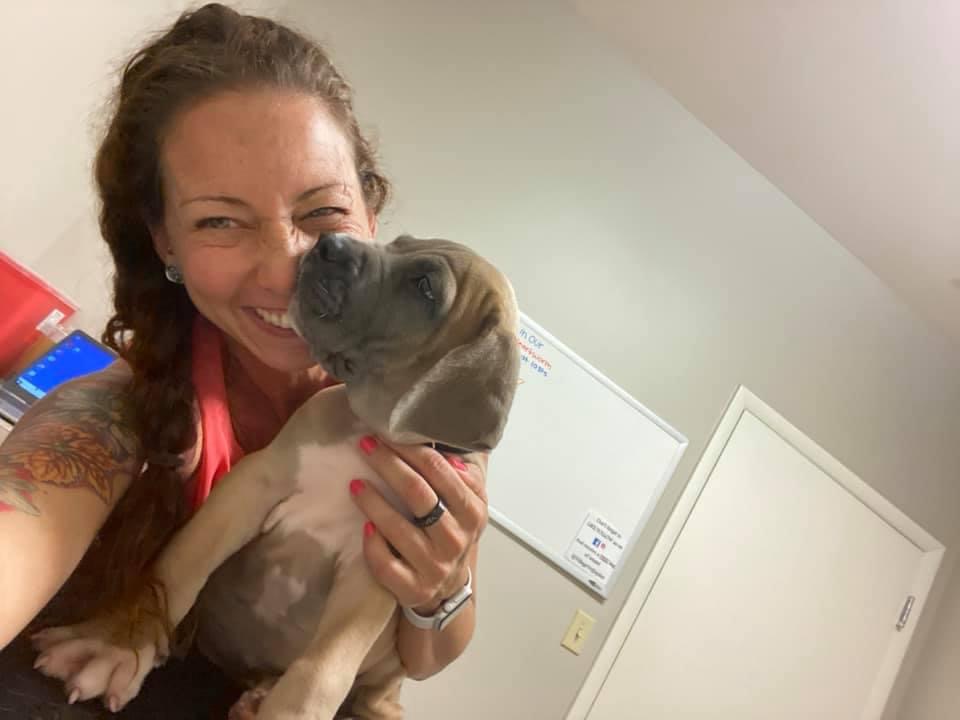
One patient who stands out in her memory was a 12-week-old Cockapoo puppy whose first experience at a veterinary clinic had involved being held on an exam table while he screamed, attempted to bite, and urinated and defecated. The veterinarian told the owners that their puppy had mental health issues and should be returned to the breeder. This time they were hoping for a better experience.

Salvo met the owners outdoors, where she had set up chairs and some treats. They sat down, talked about how the puppy was doing at home, and handed out treats to the puppy. Salvo assigned homework: to find tasty, high-value treats that could be dropped on the floor any time visitors came to the home and to be used as rewards during training. She suggested walking the puppy in areas far enough away from people that strangers wouldn’t want to pet the dog but close enough that he could see people, other dogs, and vehicles such as carts. Offering high-value treats during these walks would contribute to forming a positive association with the experience and a connection with the owners.

At the second visit a few days later, Salvo again met the owners outside and had tasty treats already on the ground for her new friend to gobble up. Eventually, the puppy approached her and she was able to perform an exam and give an oral vaccine as the puppy sat next to the clients and received treats.

“On subsequent visits, we sat next to each other outside, and he came and laid on my lap and became more interactive with me and less afraid of the environment,” says Salvo. “With a cheese and Cheerio trail to lead him inside, we made it to the scale and an exam room!”

Three months after that first visit, the puppy frequents farm fairs, Home Depot, and PetSmart, and comes running into the clinic to greet Salvo.

“This is an amazing story with very patient owners who were willing to take their time to understand and provide their dog with what he specifically needed when he needed it, redirection to something positive, protection from being thrown into the middle of a chaotic situation, and to slow introduction to the world around him,” she says.

Fear Free continues to make a difference in her practice. “The best feeling is when the owners are ready to leave and the patient stays behind and makes eye contact with me waiting for another fun treat,” Salvo says, “or when they return and they are pulling their owner into the building.”

This article was reviewed/edited by board-certified veterinary behaviorist Dr. Kenneth Martin and/or veterinary technician specialist in behavior Debbie Martin, LVT.

Sandra Toney has been writing about cats for over 25 years and is an award-winning member of Cat Writers Association and Dog Writers Association of America. She has written for many print and online magazines about cat health and behavior as well as authoring eight books. She lives in northern Indiana with her cat, Angel.

Want to learn more about Fear Free? Sign up for our newsletter to stay in the loop on upcoming events, specials, courses, and more by clicking here.
 
|

The FAS Scale Deconstructed: The Importance of Addressing Stress Early On

In this recorded webinar, Fear Free’s Education Manager Lori Chamberland takes a closer look at each level of the FAS scale to empower you to score pets with greater confidence. You’ll see video examples of pets at each level of the scale and understand why it’s important to address stress early, rather than waiting until FAS 3 or higher to intervene.

You must be a Fear Free member and logged in to view this webinar.

|

Successful Medication Strategies in a Fear Free World

In this recorded webinar, Sharon Minninger, DVM, discusses how we can modify our thoughts and actions to improve the “just medicate my pet” problem. She also addresses what other medication forms can be considered and how to develop strategies to train your team and your clients for success.

Brought to you by our friends at Covetrus

Building a Fear Free Team Culture

In this recorded webinar, join Dr. Julie Liu, DVM, as she discusses ways to engage and empower your team to get on board with Fear Free and provide a greater level of compassion for your patients.

Brought to you by our friends at Blue Buffalo

Unleash Your Inner Muttgyver: Tips and Tactics to Deal With Dog and Cat Pet First Aid Situations

In this recorded webinar, join health and safety coach Arden Moore as she demonstrates first aid on Pet Safety Dog Kona and Pet Safety Cat Casey, unleashing new ways to safely render aid without a pet first aid kit handy and safely transport injured pets. Learn how to incorporate Fear Free techniques to combat fear, anxiety, and stress in injured pets and build a confident, can-do attitude in you.

Happier Cats and Happier Clients: Diagnosing and Treating Feline OA

In this recorded webinar, Michael Petty, DVM, CVPP, CVMA, CCRT, CAAPM, covers how fear, anxiety, and stress can impact pain and vice versa, along with a team- and case-based approach to diagnosing and treating feline OA. A new treatment option, recently approved for controlling the pain associated with feline OA, is also discussed.
Brought to you by our friends at Zoetis

Hospital visits can be a scary experience for people and pets. Learn ways to reduce fear, anxiety, and stress (FAS) that will improve the safety of staff members and help bond clients to your practice for life. Join Heidi Reuss-Lamky, LVT, VTS (Anesthesia/Analgesia), (Surgery), Elite FFCP (Veterinary), CFVP, as she discusses how to implement Fear Free concepts into companion animal anesthesia.

Attendees will learn how to:
• Minimize fear, anxiety, and stress (FAS) in hospital environments
• Utilize Fear Free handling and physical exam tips
• Consult emotional medical records (EMR)
• Properly care for pets post-op

Course Overview

This course is dedicated to helping animal care professionals learn and practice skills to promote a more positive personal welfare. Throughout this course, you will learn how to care for yourself—and the humans around you—to create an environment and a lifestyle that is Fear Free for people as well as for pets! Through thought-provoking material, tips, and engaging content, you’ll learn healthier habits by challenging old ways of thinking and learning how to better protect human emotional welfare just as we do for animals!

This course contains 6 lessons:

  • Lesson 1: Intersections of Perfectionism & Veterinary Medicine
  • Lesson 2: The Role of Vulnerability in Professional Life
  • Lesson 3: The Practice of Generous Assumptions
  • Lesson 4: The Practice of Clear Expectations & Communication
  • Lesson 5: Healthful Communication With Teams & Clients
  • Lesson 6: Tips for Emotionally Intelligent Professional Self-Care

This course was written by Monique Feyrecilde, BA, LVT, VTS (Behavior) and is approved for 1 hour of RACE CE and 1 hour of CVPM CE

Looking for practical ways to improve happiness and productivity while decreasing burnout and dysfunction in your practice?

Join Natalie Gruchow, CVPM, SHRM-CP, Elite FFCP (Veterinary) who will explore ways to overcome leadership obstacles and strengthen a Fear Free culture.

In this webinar, Natalie Gruchow covers:

  1. Identify dysfunction in your practice
  2. Embrace vulnerability to repair trust with your employees
  3. Apply advanced Fear Free concepts

About the Presenter

My life is full of love, laughs, adventures, dogs, and critters. I have a wonderful husband named Tim and we travel every chance we get. We have a black lab named Sniff, 2 bearded dragons named Piney & Lanky, and a 120-gallon aquarium.

My passion in life is helping people & animals, so my career as the Certified Veterinary Practice Manager at the Animal Health Clinic is the perfect fit for me. I take pride in my work and am very loyal and dedicated. I am in charge of all business functions for the company. The Animal Health Clinic is a 6-doctor, small animal, avian, & exotic practice. We have been American Animal Hospital Association (AAHA) Accredited since 1979 and Fear Free Certified since 2019. Since my start date, I have tripled our social media following, strengthened our brand image, and built an amazing team. Revenue has increased over $1 million.

As a CVPM, it is important to me to be involved with the community and I regularly provide general pet education at rescue events, 4-H programs, and school activities. Topics include Leash Etiquette (see flyer), Fear Free Pets, Fear Free Happy Homes, and exotic pet awareness.

My favorite roles are in marketing and human resources. I design all marketing materials for Animal Health Clinic and am a leader for over 30 employees.

You must be a Fear Free member and logged in to view this webinar

Audrey Pavia
For many young people who love animals, becoming a veterinarian is a life-long aspiration that starts in high school and culminates in acceptance to a veterinary college. Reaching that goal takes an incredible amount of work and dedication and can take a toll on a student’s mental health.

Veterinary schools around the country have come to recognize the emotional challenges veterinary students face as they work to complete their degrees and have stepped forward to provide them with help. Right now, every Association of American College of Veterinary Medicine (AACVA) member school offers some kind of program design to help students maintain mental health.

How It Started

Kathleen Ruby, PhD, a psychologist based in Neskowin, Oregon, helped create the first mental health program for vet students, at Washington State University College of Veterinary Medicine.

“I was hired as one of the first counselors/mental health practitioners in the country for a college of veterinary medicine in 1998,” she says. “At the time, the position was quite ill-defined. It had been set up at the request of several faculty who found themselves counseling struggling students not just academically, but regarding personal issues and mental health problems.”

Dr. Ruby had been informed of two suicides of students in the college within a decade, and between these tragedies, and some faculty feeling uneasy about the one-on-one care many students seemed to require, the administration was persuaded to hire a professional to aid and support students.

“As a PhD mental health therapist with 12 years of experience running a private practice, as well as having helped a medical social worker work with students in my husband’s medical residency, I was seen as a good candidate,” she says.

At first, Ruby’s position was viewed as similar to an in-house university counseling center, where students made counseling appointments when they felt they were needed, and the counselor served as an in-house therapist.

“The program continued this way for a couple of years, and I found myself inundated with anxious, depressed, and overwhelmed students,” Ruby says. “The levels of anxiety, anxiety disorders, and mild to moderate depression were much higher than I was used to seeing in my private practice.”

Ruby notes that most vet students are young adults, which is the prime age for some mental illnesses to appear.

“I found myself dealing with several bipolar breaks,” she says. “Acutely, there were students who were victims of sexual assault, rape, and domestic violence, as well as divorce.  More chronically, we had several students who had a great deal of childhood trauma, which they’d been able to cope with until put within the pressure cooker of an extremely difficult curriculum challenge.”

Ruby found–and other counselors in CVMs agreed–that the academic intensity; the closed nature of programs in which classes are small, with approximately 100 students who remain together all four years; the financial challenge of paying for medical school; the young-adult life stage; relationship challenges; and personal challenges inherent in medical training all contributed to making veterinary medical training a challenge to student mental health and well-being.

“Once this was ‘diagnosed,’ we began to craft programs to address some of the major stress points in the environment of training itself,” she says.

Helping Students

Fast forward to 2022, and students at vet schools in the U.S., as well as some in Australia and New Zealand, have access to mental health programs designed specifically for them. In addition, the AAVMC now offers an Accepted Student Wellbeing course for new vet school students, and is partnering with several organizations, including the Veterinary Mental Health Initiative, to create tailored resources on specific topics for students, staff, and faculty.

At University of California at Davis, the school of veterinary medicine student mental health program is designed to be multifaceted to meet student needs through the entirety of their professional school experience, according to A. Zachary Ward, Ph.D., coordinator of mental health and wellness programs.

“We start by interfacing with our first-year students in their first weeks of the program,” he says. “We work to overtly promote the focus on mental health and wellness at our school, and reduce the perceived stigma associated with reaching out for help when needed. We provide multiple presentations on mental health topics over the years and serve as mentors to the Health and Wellness Club, a student-run organization on our campus.”

The program also provides consultation to students, faculty, and staff on mental health-related topics, with particular focus on consultation around how someone can help a student when concerned about their mental wellbeing.

“We also explore methods for promoting mental wellbeing within the systems of our campus,” says Ward. “However, the bulk of what we do is provide direct clinical services to our students through individual psychotherapy, crisis intervention, group counseling, and couples therapy.”

It Works

These efforts to help vet students navigate life is paying off at UC Davis, according to Ward.

“Results can be measured in several ways, using metrics that we use to show psychotherapy works, via students’ responses to mental health symptom surveys and client satisfaction surveys,” he says. “However, to me, it’s the qualitative feedback that we receive from students that really tells me that our program is making a significant impact in their lives.”

Ruby believes the best gauge of success is how far and wide the understanding of mental health issues and the importance of personal well-being has spread throughout all echelons of the veterinary profession in the past two decades.

“Leadership at veterinary colleges and throughout the profession have gone from being somewhat apprehensive about the need for such care and training to becoming enthusiastic supporters and advocates,” she says. “Almost all the colleges now have at least one mental health professional, and some more than one. Most have well-integrated and sustainable wellbeing programs that are woven throughout the curriculum.”

Veterinary mental health and its challenges have been recognized, studied, and reported on throughout academic journals and popular media, Ruby says. She finds that this proliferation of knowledge, resources, training, and awareness-building has been a positive and helpful force within the profession.

“Perhaps the most exciting trend for me is that many of the speakers at educational conferences, and some of the current counselors, authors, and researchers are now DVMs who have recognized the need within their profession and have gone on to get additional certification in mental health and well-being fields to work within and improve the health of their own profession,” she says. “I can think of no greater validation than that!”

This article was reviewed/edited by board-certified veterinary behaviorist Dr. Kenneth Martin and/or veterinary technician specialist in behavior Debbie Martin, LVT.

Audrey Pavia is a freelance writer and author of Horses For Dummies and Horseback Riding for Dummies. She lives in Norco, California, with her two Spanish Mustangs, Milagro and Rio.