Blog Archives

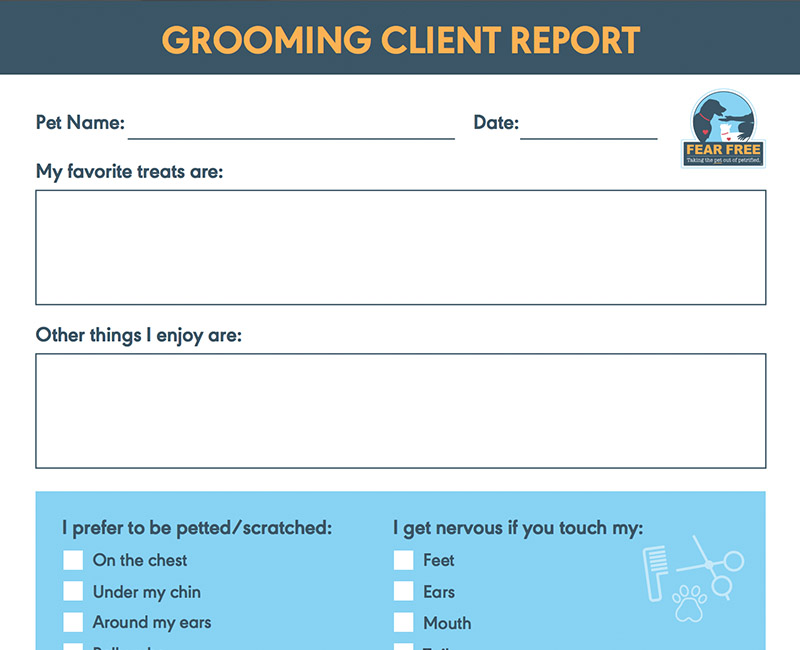
Fear Free Groomer Client Report

When it comes to creating Fear Free grooming visits, thinking about an animal’s individual needs is critical. Communicating those needs to the pet’s owner is also very important, as many of the pet’s preferences and behavioral tendencies carry over into other aspects of the pet’s life and future grooming visits.

Use this digitally fillable or printable “Groomer Client Report” to help connect with the client and ensure they go home with an understanding of their pet’s needs and emotional health while at the groomer.

||

By Liz Bales, VMD

If we asked a client, “what are you doing for environmental enrichment?” the likely response would be, “what?”

And that’s a problem.

In our profession, we suffer from compassion fatigue.  I get it. I really do. Our clients break our hearts and wear us out. When they are at the end of their ropes because their cats are chronically urinating outside of the litter box, they might implore us to perform a convenience euthanasia. When their cat has destroyed their furniture and they just can’t deal with it anymore, they ask us to perform a declaw. When their cats keep fighting with each other we drain their abscesses, sew them up and talk about re-homing. And to top it off, if we either recommend an alternative or tell them that we don’t perform a debatably ethical service, we risk having our Yelp reviews tarnished. Some days it is just too much to bear.

But, my colleagues, we CAN get in front of this problem. After all, isn’t this why we became veterinarians? Our clients are looking to us for education and support at their first kitten visit. They are looking for more than vaccines and screening blood work at their annual visits. The time to inform and educate our clients about environmental enrichment is before the human-animal bond, and our professional spirits, are broken.

The science is there. The American Association of Feline Practitioners has beautifully laid out the 5 pillars of feline environmental enrichment, why they are important and the consequences of denying our cats the resources that they need to be physically and emotionally healthy in the indoor environment.

In case you have not had the opportunity to read this entire paper, here’s my favorite bit:

“Many behavioral and physical disorders that are seen in cats are often secondary to stress from lack of appropriate stimulation. Environmental enhancement (EE) should be part of the overall treatment plan for these disorders. As part of the wellness exam, it is the responsibility of the veterinarian to discuss the current state of the environment and to provide resources for EE to indoor cat owners.

It is well known that if an appropriate environment is not provided for indoor cats, they are at greater risk of stress induced illnesses such as the following:

  • Feline lower urinary tract disease
  • Obesity
  • Different forms of aggression
  • Over grooming and other compulsive disorders
  • Upper respiratory infection

In an attempt to prevent the above conditions, it should become routine for the veterinary team to inform owners of the importance of EE and to provide resources to owners. It is also important to consider EE in shelter cats for the same reasons.”

The cats are counting on us to get this information from the page to their caretakers. One way or another, this is a veterinary job—our job!

We study kidney disease, endocrine disease, ophthalmology, oncology, along with so many other specialized areas of medicine and thus we are prepared for those cases when they walk through our exam room door. But do you know what every cat in our care has in common? Every cat is our care is completely dependent upon their human to create an environment where they stand a chance of being physically and mentally well. Are we prepared with information and resources to treat or cure this?

If I haven’t convinced you yet, I would like to share with you the statistic that changed my life. Do you know the #1 cause of death for cats? My guesses were kidney disease, or hyperthyroidism. Nope. Well, we know so much about feline obesity and it’s consequences, perhaps that’s the answer? Again, no. The #1 cause of death for our feline patients is euthanasia.

So what do we do about that? Where and when do we talk about environmental enrichment? We are already squeezed with the amount of information we need to simultaneously digest and communicate back to our patients in addition to the procedures that we need to cram into a 15-20 minute appointment, it might seem impossible. Easier said than done, of course, but why not simply train our technicians (and ourselves) to carve out just a little extra time for every feline appointment to walk the client through the five pillars of environmental enrichment. At the very least, there are resources available both digitally and in print that we could simply email to our clients or hand out in our waiting rooms or at check out.

Just like with Fear Free, I promise you it’s worth it. Sometimes those seemingly small things can make all the difference for the pets we took an oath to help treat. And also like Fear Free, the benefits will actually save us time in the long run.

As a profession, we can figure out how to incorporate this into our practice. I know we can. And the time starts now, with a very simple question:

“What are you doing for environmental enrichment?”
Customer Service Representative Fear Free Training Tool

This checklist is mainly used for customer service representatives. Each client can be assured a Fear Free experience because the person on duty is ensuring that each box is checked throughout each client’s experience.

See What Changes Can Be Made in Your Hospital

This tool will guide you through recognizing stimuli that may affect the senses of clients and patients. As you take a fresh look at your own practice, you’ll begin to see what changes can be made. From there, you’ll write down what changes can be made while having access to helpful tips and resources to ensure your practice is sweet on the senses.

Talking points and resources to facilitate a successful Fear Free visit

Share these helpful handouts with your staff to ensure a Fear Free visit for every client and pet. Get everyone on board from the moment the client and patient walk in the front door, to the exam room, and when saying goodbye. The Fear Free approach takes the whole team.

Fear Free Promotional Videos

Looking for a creative, touching, narrative way to communicate Fear Free to clients, colleagues, coworkers and more? These promotional videos are the perfect combination of heartfelt and realistic about the way Fear Free is changing the veterinary industry. We encourage you to share directly from YouTube, embed on your website, share across social media and more.

Adding Youtube Videos to Your Site

Adding one of our promotional videos to your site is easy! Simply click on the link below the video and you will be re-directed to the video’s page on YouTube. Click the ‘Share’ button and then click ‘Embed’. Copy and paste this HTML code to your webpage.

[wcm_restrict plans=”level-1-group-leader, certified-practice, certified-practice-leader, groomer-certification, animal-trainer, student, sitter-certification-program, boarding-daycare-certification-program”]

Fear Free: Gives Abandoned Dog Hope and Healing with Fear Free

YouTube Link

Fear Free: Practice Like You’ve Always Dreamed

YouTube Link

Fear Free: How Pet Owners Can Enjoy Veterinary Visits with Their Pets(Best for showing clients)

YouTube Link

[ddownload id=”109263″ style=”button” button=”blue”]

Fear Free: A Transformative Initiative for Veterinary Professionals(Best for showing other Veterinary Professionals)

YouTube Link

[ddownload id=”109262″ style=”button” button=”blue”]

[/wcm_restrict]

Emotional Medical Record Template

A customized care routine is crucial to a successful Fear Free veterinary visit. Use this Fear Free Emotional Medical Record (EMR) template to organize each patient’s preferences of examination area, motivational aid, and specifics of incidents of FAS. Templates are available for dogs/cats and also for birds.

Fear, Anxiety, and Stress (FAS) Scale

Because it is critically important to rate an animal’s level of FAS, Fear Free created this FAS scale for certified professionals. This scale will give you the opportunity to be consistent in assessing and recording every animal’s FAS level, and it will give you recommendations on how to proceed. Page two of the scale is your tool to record details on each animal.

Print out the scale, laminate it, and hang it on the wall. The second page goes into each patient’s medical record. Scales are available for dogs, cats, horses, and birds.

Body Language and Signs of FAS in Dogs & Cats

Understanding and assessing your patients’ body language is an essential part of Fear Free. It also plays an important role in client education for a client to understand and buy into Fear Free and your recommendations. Print out the two pages of body language slides, laminate them, and place them into each exam room. You could also place them into your waiting area, and into your staff common areas to serve as an educational tool.

FAS Spectrum Handouts

The bulk of communication between humans is through body language and the same goes for animals. It’s important for both your team and your customers to understand the often subtle signs of fear, anxiety, and stress that their pet is expressing. Use these FAS Spectrum sheets to visually explain the different signs of FAS and the corresponding levels of arousal. Handouts available for dogs, cats, horses, birds, and rats.

By Kathyrn Primm, DVM

I lost a client today because of Fear Free. I knew it would probably happen, but I was not ready for the scathing email. She accused us of “requiring drugging” and asserted that she would not drug her dog “for any reason”. She thought it was ridiculous that we “hurried her to an exam room” because her dog was frantically barking and explained that her dog always barks like that because she is “just a barker”.  She was a fairly new client as this was her second visit with us and the first was prior to Fear Free implementation. Her chart was riddled with warnings about muzzles, biting, struggling and nail trim horrors.

My mother used to say that if someone criticizes me I would be wise to first consider if what they say is true, so I did. I asked myself if my staff and I took the time to explain the Fear Free principles to her. We did. I sat on the floor with a dog that no one could touch last year and did a full exam (with the help of some peanut butter and considerate approach) and completed vaccines with the dog comfortable and happy. She did not bark in my exam room and I was elated. She did not even flinch when I vaccinated her. She was so relaxed that we took her photo.

I pointed out the change for her owner and all was well until the nail trim was mentioned. We explained that we would like to finish the visit on a positive and comfortable note, but if she wanted the dog’s nails trimmed, we would send her with a PVP and book it the next day. Everything seemed fine. The lady and dog left and we were all pleased with the process…or so we thought.

I guess when she got home, she decided that we were being unreasonable. I lost the client and she may bash me all over the Internet, but what I did was right. It was following the Golden Rule by that dog. I know in my heart that it would have been cruel to force that dog to have her nails forcibly clipped. I also know that she won’t have to go far down the street to find a vet who will.

In the end, I have to feel good about MY choices. I took an oath to use my skills in the prevention of animal suffering. Putting that dog in a situation where she feels that she must defend her life is wrong and there is no other way to name it. If this owner had let me help her dog, I could have given her the gift of a lifetime free from fear over nail trims and vet visits. Then one day when her life is ending and she must see me for the last time, she would feel safe and loved, not afraid. What an amazing gift I could give!

Not for this dog. Sadly, she has already found a vet who will “never drug her for any reason” and life goes on. But I won’t give up. In my mind I renew my oath with each new puppy. This lady will not stop my surge to be completely Fear Free and I won’t let her daunt my staff either. We ARE Fear Free and if this owner wants Fearful, she has made the right choice for her.