For a long time, the behavior of pet cats and dogs was of little interest to science. Times have certainly changed, but one area that’s somewhat neglected is the question of how and why cats play.
A recent review of the literature published in Applied Animal Behaviour Science sums up the findings and points to directions for future research. While there’s much we still don’t know, there are a number of results we can put into practice to give cats more enriched lives.
Play With Toys
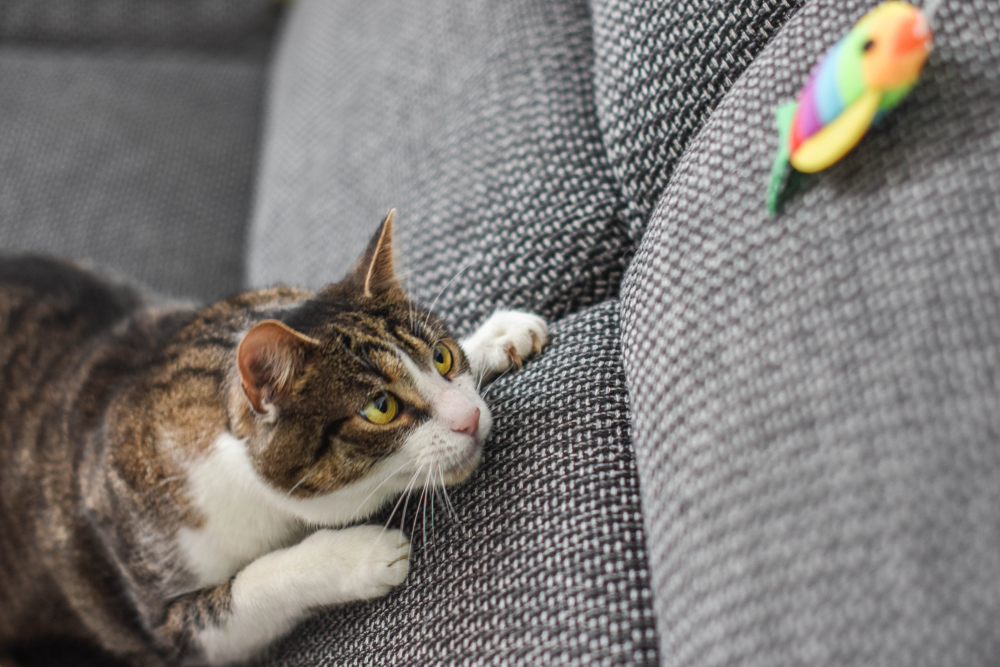
Research into cat play with toys confirms a common observation: it is a lot like hunting. “The patterns of behavior are similar, and the things that entice cats to hunt also get them excited about toys,” says coauthor Mikel Delgado. “What we see from research is that the more similar to realistic prey the toy is, the more of a response the cat shows.”
There’s always going to be the individual cat who likes to play with a ball. But for the most part, the more a toy looks, feels, smells, and moves like prey, the better cats like it. They do have preferences, so it’s best to offer choices: toys that resemble different kinds of prey like mice, birds, bugs, and snakes.
Movement is important as well. After about 21 weeks of age, kittens start to lose interest in things that don’t move. Sure, you can bat a ball with your paw, but it’s not the same.
“They can’t really get lost in the hunting experience like they can when someone else is moving the toy,” says Delgado.
Novelty also matters: cats get bored quickly. In one study, cats presented with the same toy three times became progressively less interested, then showed more response to a new, clean toy that was identical except for color.
The practical takeaway: leaving a bunch of toys lying on the floor all the time isn’t enrichment, because they don’t move, and they don’t change. Owners need to play with their cats: move the toys and remember that they get bored with the same object before they’re bored with play itself.
Why Play?
Although cat play resembles hunting, research doesn’t really support the idea that play is a kind of practice; it doesn’t seem to help cats be better hunters later. “What seems to be most effective for hunting later is exposure to prey. Hunting experience helps you be a better hunter,” says Delgado.
Play does seem to be important to social development, however, which makes it all the more important to understand, given that most of us want sociable cats more than we want mousers.
It’s a common misconception that cats aren’t sociable. “Even cats that are living outside of human homes, free-roaming cats, live socially in colonies together,” say Krystin Vitale of Oregon State University. “They live both socially and solitarily. We see a lot of flexibility.”
Kittens learn to get along with other cats by playing. The first type of play seen in kittens is social, and research shows that kittens who don’t have playmates have difficulty with other cats later. Singleton kittens tend to direct play at their mothers, even though their mothers find this behavior irritating.
“As a cat behavior consultant, I get so many calls from people who can’t understand why the kitten is attacking their legs and hands,” says Delgado. “Kittens who don’t have littermates will direct that behavior toward other beings: their mother, their human, or the poor 12-year-old cat who the person adopted the kitten to be a companion to.”
The takeaway: encourage people to adopt more than one kitten at a time. “When we allow kittens to get adopted without littermates, we’re not recognizing that we’re tearing apart families,” she says. “Social play is very important for kittens and a lack of outlets for social play can be very problematic. Toys don’t fulfill that social need.”
What We Don’t Know
Research into cat behavior lags behind the recent explosion of studies about dogs, partly because they’re harder to study in the lab. “Dogs are used to being in new environments. But a cat that is friendly and playful in a home environment, if you take them to a strange place, they’re going to be terrified,” says Delgado. “So their behavior is not valid beyond that context; it doesn’t tell you anything about how they normally behave.”
Now that we have better technology that lets us study cats in their homes, research is increasing, but many questions remain. For instance, little research has been done on play between adult cats, so right now, science can’t tell you whether your cats are getting along. From her observations, Vitale suggests concentrating on what happens before and after the interaction to distinguish rough play from aggression.
“Before, was there aggressive vocalization? Was their fur already standing on end and were their eyes dilated and were they baring teeth? After, what did they do? Often when it’s play, you’ll see that afterwards they’ll plop down and lay together and start grooming each other. If you see one run off and try to get away that might be more of an indication that it was aggression.”
Social play with humans also hasn’t been well studied, but it may be important to cats. In one study, Vitale tested how cats reacted to a moving toy controlled by a human who was in the room, or one controlled remotely from outside the room. Cats preferred the person moving the toy to be visible, which suggests that kind of play may have a social component.
Delgado also wants to see more research into the process of object play. Prior studies have focused on actual contact with the toy, but for cats, watching and stalking seem important. This makes sense given their natural hunting style. “The way cats hunt is not highly cardiovascular. It’s very cognitive,” she says. “When they play with cats, people tend to concentrate on the cardiovascular aspects and expect backflips and running around, but that’s not really cats’ hunting style.”
Play and Welfare
Delgado says there’s an assumption that play must have a survival benefit. We don’t know for sure if it does, and in fact, research has shown that cats spend a fairly small proportion of the time playing and that it’s not very energetically costly.
But we’re not just concerned about what helps animals survive. We also want to know what helps them thrive.
“I think that one big thing that’s come out of studies about cat play and that this paper shows is that it’s really important for cats to engage in play in order for them to engage in healthy normal behaviors,” says Vitale. “If you’re giving your cat an under-enriched environment with low stimulation, potentially aggression can come out of that, and stereotyped behaviors like overgrooming, that they’re doing because they don’t have anything to engage with.”
One measure of an animal’s welfare is whether they have the opportunity to engage in species-specific behaviors. Owners need to understand what those behaviors are and how to provide the right toys and social situations to “allow cats to behave in the ways that make them cats,” she says. “They need something for all those motor patterns and biologically relevant behaviors to be directed towards.”
This article was reviewed/edited by board-certified veterinary behaviorist Dr. Kenneth Martin and/or veterinary technician specialist in behavior Debbie Martin, LVT.
Linda Lombardi writes about the animals who share our planet and our homes for magazines including The Bark, websites including National Geographic and Mongabay.com, and for the Associated Press. Her most recent book, co-authored with Deirdre Franklin, is The Pit Bull Life: A Dog Lover’s Companion.
 This post is brought to you by our sponsor, Elanco, the makers of
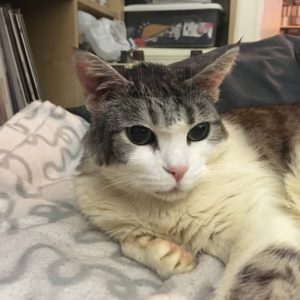 My cat Cleo is nearly 17 and receives sub-q fluids regularly at home. She used to grumble and try to get away but once I started Fear Free, I began giving her favorite crunchy treats before, during, and after administering fluids. Now she purrs through the whole procedure, and any time I approach the spot in the house where we do fluids, she walks up for “crunchie time.” I’ve been able to switch back to a larger needle because she doesn’t notice the poke while snacking, which makes administration faster, too.
 Chewy had a lot of fear and anxiety at the veterinary clinic, causing her to behave aggressively and making it difficult to give her the care she needed. While training her, I observed various signs of pain, which were most likely adding to her anxiety. I alerted her caregiver to my observations so she could better assess and monitor her dog and update her veterinarian. Chewy and her caregiver had previously had negative and traumatic experiences at a veterinary clinic so I referred them to Keystone Veterinary Clinic, which has Fear Free Certified Professionals who created a handling plan to enable Chewy to have a thorough exam, radiographs, and other diagnostics in a safe and low-stress manner. I also worked with the owner to begin muzzle training. The combination of appropriate scheduling, handling, and sedation, Chewy was able to receive the diagnostics and treatment she needed.
 Gus had developed severe resource guarding of his food and water bowls, as well as fear and anxiety regarding being touched and having his gear put on and taken off. As a result, he snapped at and bit a walker. We worked closely with his owners and utilized Fear Free strategies and positive reinforcement training to get Gus comfortable with having strangers in the home. We were eventually able to find a solution that allowed Gus to be comfortable having walkers touch and refill his water bowl and approach his food bowl without any signs of resource guarding or fear, anxiety, and stress. Now Gus happily greets his walker at the door, demands affection, and has no issues on his walk or in his home.



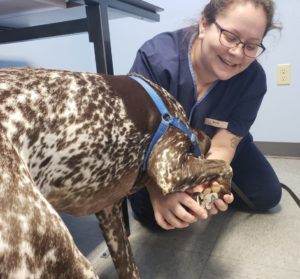 Eva, a spunky and energetic German Shorthaired Pointer, is a staff favorite for more than just her adorable, tongue-hanging-out smile, but there’s one thing Eva never liked: nail trims! Prior to the hospital’s transition to Fear Free in early 2017, it was a challenge to trim Eva’s nails, requiring three or four technicians to assist with restraint, plus a muzzle and calming cap. We started implementing Fear Free teachings right away with all of our patients, but one staff member has really gone above and beyond her commitment to Fear Free training to help Eva overcome her fear. Kayla McNeely volunteered to assist with Eva’s nail trims, and she can now perform Eva’s nail trims solo, standing, with minimal assistance from Eva’s mom, Sheila, who says, “Kayla’s patience and kindness have worked wonders with my girl.” Our hospital requires all staff members to go through Fear Free training to help ensure that all of our clients, patients, and staff have a pleasant experience during their exams. We have seen a tremendous difference in many patients at our hospital since our transition to Fear Free, but Kayla and Eva’s journey together is by far our most successful Fear Free adventure to date.
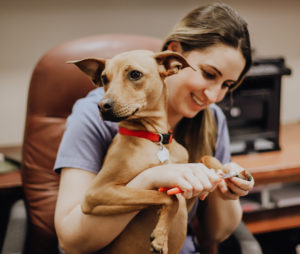 One-year-old Ruba disliked having her feet touched and her nails trimmed. We trialed trazodone for six months for all nail trim visits. It started to work well, and we discovered she preferred sitting in Dr. DaCosta’s lap. Ruba now comes in for frequent nail trims with minimal restraint and no trazodone needed. We are so proud of her progress and the team’s dedication to using Fear Free techniques.
 Mikey Bear used to require sedation before blood draws, but I showed his amazing humans how to hold his back leg for a blood draw and wet the vein while giving him treats to get him used to the feeling. They worked on this for a month, and when they came back, the blood draw was a snap. I discovered they had added another step to the homework and were poking the vein with a toothpick at home.
 When I worked at a veterinary emergency clinic, one of the dogs in the hospital was so fearful that he would begin to thrash and hit his head in the ground if anyone touched his leash. I sat in front of his cage with my back to him so he could become accustomed to my scent. Then I started placing treats in his cage and turning my back again. Eventually, I opened the door and put a leash on him and sat next to the door. When he came out of the cage on his own, I was able to walk him with no tension on the leash. Gaining an animal’s trust is a beautiful thing.