Blog Archives

This course introduces veterinary professionals to the Fear Free approach specifically tailored for feline patients. Through a series of focused lessons, learners will explore communication strategies, considerate handling techniques, touch gradients, appropriate use of rewards, and gentle control methods. Practical scenarios and case studies will help reinforce strategies for reducing fear, anxiety, and stress (FAS) in cats during veterinary visits. Learners will leave equipped with the knowledge and resources to integrate cooperative care into daily workflows, creating a better experience for cats, clients, and veterinary teams.

Zoonotic diseases are a critical concern in environments where close contact between animals and humans is common, such as veterinary clinics and boarding facilities. With a wide range of bacterial, viral, parasitic, and fungal infections to consider, understanding how these diseases spread and how to prevent them is crucial for safeguarding the health of both people and animals.

Join us for a webinar with Sami Engle Price, MS, PHR, CVPM, CPACO, CCFP, as we explore common zoonotic diseases, how they spread, and key prevention strategies to protect both animals and people. You’ll also learn how to manage outbreaks effectively and minimize risks in high-exposure environments.

Feline Infectious Respiratory Disease (FIRD) is a highly contagious illness that can affect cats in both household and multi-cat environments. With multiple pathogens involved, it’s essential to understand how the disease spreads and how to prevent it—especially in high-risk settings like veterinary clinics and boarding facilities.

Join us for a webinar with Sami Engle Price, MS, PHR, CVPM, CPACO, CCFP, as we explore the key causes, symptoms, and transmission of FIRD. We’ll also cover effective prevention strategies, including vaccination, isolation techniques, and disinfection protocols to help reduce risk, manage outbreaks, and support feline wellbeing in any care environment.

Canine Infectious Respiratory Disease Complex (CIRDC), commonly known as “”Kennel Cough,”” is a contagious respiratory illness that can affect dogs in various environments, including veterinary clinics and dog boarding facilities. With its many causes and transmission methods, it’s important to stay informed on prevention strategies, hygiene practices, and early detection to minimize outbreaks and ensure the health of both dogs and staff.

Join us for a webinar with Sami Engle Price, MS, PHR, CVPM, CPACO, CCFP, as we dive into CIRDC, exploring its causes, symptoms, and transmission, as well as effective prevention and control measures to implement in high-risk environments.

Food or toy distractions can be an exceptionally useful tool in Fear Free. But they must be used appropriately, and in the correct situations, to ensure they actually decrease or prevent FAS, rather than inadvertently make things worse.

This one-hour course will empower you to know when to use distractions (and when not to use them), how to properly implement them, and what to do “in the moment.” Through several video examples and scenarios such as nail trims and vaccines, you will learn what to do “in the moment” as well.

This course, approved for 1 RACE CE hour, was written by Monique Feyrecilde, LVT, VTS (Behavior)

Lesson 1: Introduction to the distraction method
Lesson 2: Types of distractions
Lesson 3: Appropriate times to use distraction
Lesson 4: How to implement distractions
Lesson 5 & 6: When and why a distraction may not be appropriate
Lesson 7: Examples of appropriate use of distractions
Lesson 8: Alternatives to the use of distractions

1 RACE CE hour

Creating Inclusive Spaces in the Pet Professional Industry

In honor of Pride Month, join us for an insightful discussion on the importance of inclusivity in the workplace and how it leads to better care for pets, owners, and professionals in the industry. Our panel of experts will share their experiences and best practices for fostering a culture of acceptance and support within your community.

|

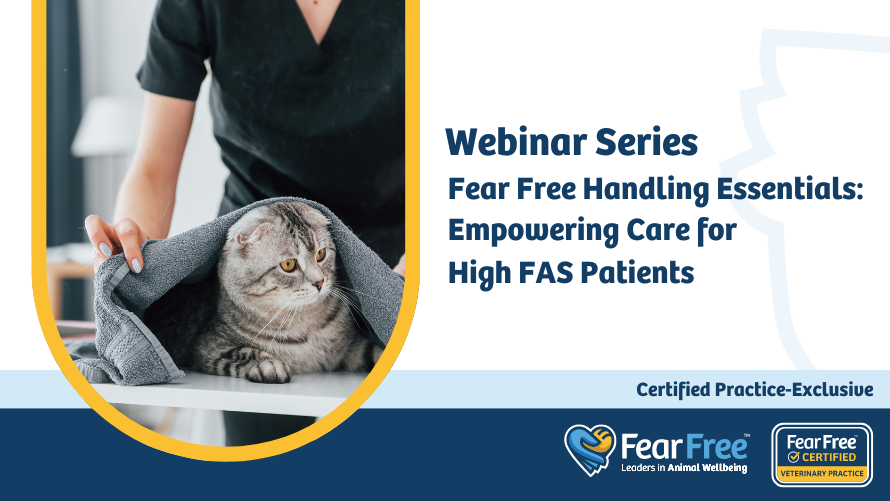
Fear Free Handling Essentials: Empowering Care for High FAS Patients

We know considering the pet’s emotional wellbeing and offering treats during veterinary visits is practicing good medicine. Although, when patients have moderate to high levels of fear, anxiety, and stress (FAS), treats may not be enough for our furry friends. In this webinar, we will explore how veterinary practices can go beyond treats to ensure a positive emotional experience for every patient, especially those with moderate to high FAS.

This webinar will cover a comprehensive Fear Free visit approach, with thoughtful considerations for high FAS patients that benefits patient, client, and team wellbeing. Discover how to craft a tailored visit that addresses the unique needs of high FAS patients, incorporating creative details and remaining adaptable throughout the appointment. From subtle changes in approach to proactive planning, we’ll cover strategies to facilitate successful veterinary care while prioritizing patient comfort.

Sherrie Yuschak, RVT, VTS (Behavior), KPA-CTP, Elite FFCP-V is a faculty member of the Karen Pryor Academy for Animal Behavior and Training where she contributes to the curriculum and teaches several courses. She is a Practice Certification Consultant for Fear Free℠ and has collaborated on several Fear Free℠ educational modules, and certification standards, and is a member of their Speakers Bureau. Sherrie has been a Registered Veterinary Technician for over 25 years with 12 years specializing in animal behavior. Her experience encompasses general practice, academia, research, specialty practice, and consulting. Still passionate about continuing education, Sherrie frequently attends events, lectures at veterinary conferences, and publishes articles and book chapters including the Low Stress Handling book revision and American Animal Hospital Association behavior education booklets. Sherrie is also an Editorial Advisory Board member of Today’s Veterinary Nurse and a Family Paws Parent Educator contributor.

In this webinar, you will learn how to:
– Implement tools that go beyond treats when working with moderate to high FAS patients
– Plan a comprehensive and individualized approach to each appointment for the moderate to high FAS patient
– Observe subtle changes & adapt to those changes throughout the appointment
– Engage every team member in the care plan

You must be a Fear Free Certified Practice member and logged in to view this webinar.

Building Trust, Preventing Bites: Proactive dog bite prevention and handling strategies

Join us as we explore how being proactive, rather than reactive, can significantly enhance workplace safety and foster a harmonious environment for both humans and pets. Discover practical techniques and approaches to mitigate potential aggression and create a happier, safer workplace for everyone involved.