Blog Archives

Mikkel Becker

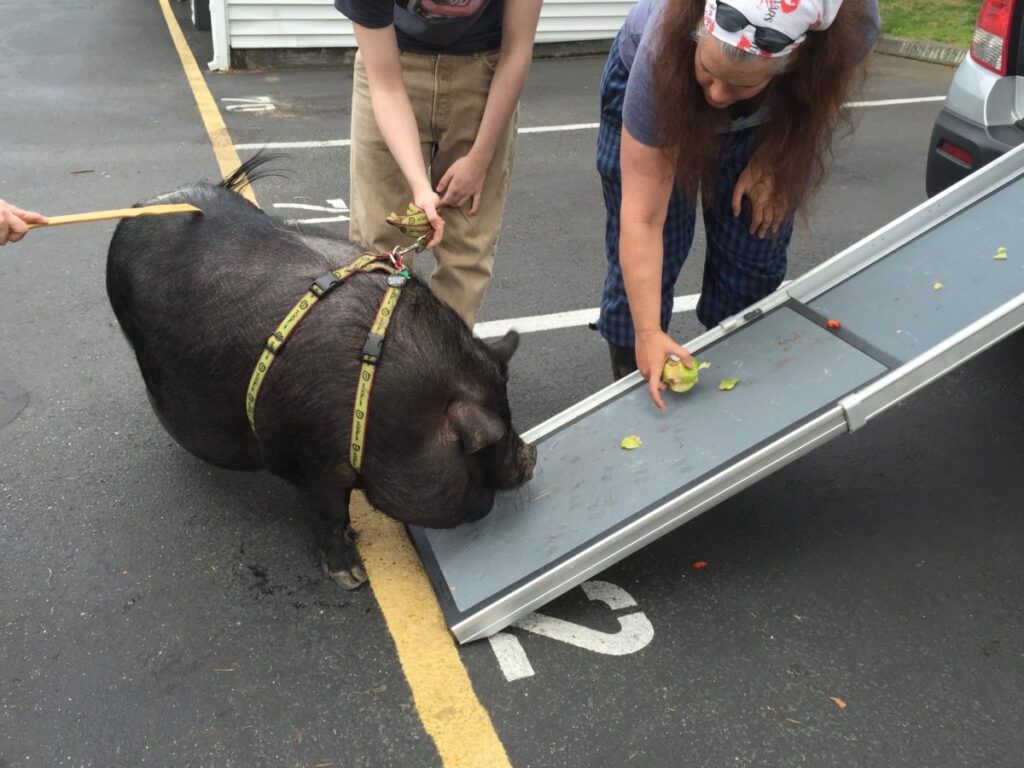
Fear Free is a concept that benefits both animals and the people working with them. This is especially evident when the animal being cared for is of tremendous size and strength, such as the pig patients of Fear Free certified professional Dr. Alicia McLaughlin at The Center for Bird and Exotic Animal Medicine near Seattle, Washington.

“When pigs are stressed, they communicate their stress very clearly, both vocally and with their body language, which can be very upsetting for their family and veterinary staff. When pigs are less stressed, their families are more relaxed, and their veterinarian is able to provide better quality medical care,” says McLaughlin.

Handle With Care

Coercive handling causes increased tension for everyone. Forced handling is also likely to create fear memories and aversions that make the pig more challenging to work with and create a greater safety risk for both pig and people.

“Pigs are very touchy about their bodies. Many don’t like being touched unless they are being scratched in certain areas. If they feel that any handling attempts are coercive, they’re likely to react strongly and negatively,” says McLaughlin. “Most pigs have an extreme dislike for restraint, having their facial area handled, or being picked up. Forcing a pig to remain still with restraint even momentarily for sedation can cause tension for everyone. Many will vocalize in distress when this handling occurs; with squeal decibels rivaling those made by a fighter jet.”

Most pigs who come in are open to the veterinary experience if the staff interacts in a way that signals they are friendly, not threatening. Encouraging the pig’s willing participation during care using treat rewards, setting a soothing care environment, and using calming aids are all approaches resulting in less stress and greater success.

Reading Porcine Body Language

Rewards and food aren’t the only things that work to keep pigs calm during Fear Free care. Carefully observing the pig’s body language for signs of fear, anxiety, and stress (FAS) throughout care is also key for keeping the pig in a calmer, more amenable state and for keeping both pig and humans safe in the process.

Signs of FAS in pigs include muscles tensing, shying away, lowering the head, moving into a corner, or finding security by moving their body next to a wall. In some cases, FAS may be subtle, with one potential indicator being the pig coming up to take treats, but then retreating to a safe distance immediately after the interaction. Loud squeals and excessive vocalizations are audible signs of a pig’s distress.

When in a state of FAS, pigs will attempt to avoid the situation and move away or hide. If pushed, though, pigs on rare occasions may try to bite. Biting is rare, a last-ditch escape effort from pigs who are responding to the situation as if they’re going to die.

Sedation Can Help

It’s far better to note early signs of FAS and make ongoing adjustments to keep the pig calm than it is to risk escalation and the creation of fearful memories of the experience. Sedation isn’t a last resort for pig care, but a protective practice used early and often when it comes to reducing the FAS pigs experience. In many cases, full sedation is recommended to eliminate the distress and ensuing struggle that could otherwise occur if the pig becomes upset. But before jumping immediately to sedation, Dr. McLaughlin is careful to make the sedation itself as non-stressful and Fear Free as possible.

Sedating a pig can be tricky, especially since most pigs are averse to having their faces touched or to being held in place even momentarily. It’s important to Dr. McLaughlin to keep sedation minimally stressful. Oral pre-sedation medication, such as Valium that’s ground up and placed on food, can take the edge off before sedation. With pre-sedation medication on board, the pig is often calm enough to tolerate minimal restraint while a gas mask is placed over the face. No more than a minute later, the pig is out and ready to be cared for.

 “Time pressures can result in handling and care being more coercive than we want it to be. There is something to getting it done quick and dirty. But there are long-term effects that go with that and it’s not my preference to do that,” says Dr. McLaughlin.

This article was reviewed/edited by board-certified veterinary behaviorist Dr. Kenneth Martin and/or veterinary technician specialist in behavior Debbie Martin, LVT.

Mikkel Becker, CBCC-KA, CPDT-KA, KPA CTP, CDBC, CTC, is lead animal trainer for Fear Free Pets. She is a certified behavior consultant and trainer who specializes in reward-based training that’s partnered closely with the pet’s veterinary team. Mikkel is coauthor of six books, including From Fearful to Fear Free.
 

Thoughtful Touch to Improve the Emotional Experience

How we handle our patients and their tactile experience in our practices can impact their comfort and welfare during the veterinary visit. In this webinar, Jacqueline Neilson, DVM, DACVB, covers best practices to ensure that every physical interaction in your practice offers the best possible pet experience.

Certified Practice Member Exclusive: Behavior Triage 101

Hear from one of the profession’s leading experts when it comes to delivering Fear Free care to even your most challenging patients! The higher the level of FAS a patient experiences, the more challenging it is to effectively and safely deliver veterinary care. With her years of experience practicing and teaching, Dr. Susan Barrett shares her unique perspectives on successfully managing these patients.

Consider the Senses of the Fear Free Exam

Dr. Julie Reck explores the details involved in creating a Fear Free experience. She also discusses pre-appointment opportunities, easy-to-implement facility alterations, and exam room cleaning tips to make sure your patients have the best experience possible. Sponsored by Virox.

Reducing Dog Bites by Understanding the Secret Language of Dogs

Dog bites and injury to veterinarians, staff, and pet professionals are often considered an occupational hazard. Many of the situations that may result in a dog bite can be prevented by understanding the language and emotions of dogs.

Celebrity dog trainer and author Victoria Stilwell discusses dog body language, behavior, and how to safely interact with dogs as part of National Dog Bite Prevention Week.

Stilwell is joined by State Farm Brand Specialist Heather Paul, who discusses dog bite insurance claims data for 2018, dog bite liability, and how the insurance company is working to reduce dog-related injuries as a member of the Dog Bite Prevention Coalition.

Sponsored by State Farm

Postcards from the Cat: Highlights of Feline Communication & Natural Behavior

Learn about the facets of feline communication and behavior, as it relates to working and living with this truly fascinating species.

Dr. Marie Hopfensperger is one of two board-certified veterinary behaviorists in the state of Michigan. She graduated with honors from the College of Veterinary Medicine at Michigan State University in 2009. She was a small animal primary care veterinarian in northern Michigan before returning to academia to pursue her passion for behavior. She completed a non-traditional residency, spending time at North Carolina State University and Michigan State University. She has taught primary care and behavior medicine at Michigan State since 2013. Her areas of interest are behavioral medication, aggression, and feline inappropriate urination. Her household includes a human son, two cats, two dogs, two parakeets, and a rabbit, most of whom were adopted from area shelters.

|
By Mikkel BeckerAre you helping or hurting your pet by providing comfort? You may have heard that comforting a pet when he’s frightened is the wrong thing to do because it “reinforces” that he’s right to be fearful. I’m here to share the good news with you that this concept isn’t correct. Here’s what to know about calming your pet.

You’re not “reinforcing fear” by providing comfort to a pet. Many animals act calmer if they are near their favorite human or if they are handled and interacted with in a manner they find reassuring.

You may, however, escalate your pet’s stress if he picks up on cues that you are nervous or on edge. If you are attempting to comfort him in a way that’s different from how you normally interact with him, such as hovering or jumping to attend to him immediately, it may signal to your dog or cat that you are upset. His response may be to become worried himself.

If petting, massage, and T-touch handling help your pet to visibly settle, by all means, do it! But if the dog or cat avoids touch or acts agitated or upset with handling, give him some space or interact in a more hands-off manner such as redirecting his attention to a food puzzle or other favorite toy.

Left untreated fears can escalate overtime. Although it is ok for your dog to seek comfort with your presence when he is afraid, allowing that to be the sole coping strategy can be a recipe for disaster. For example, if your dog becomes frightened by something when he is home alone, he might panic because he has not learned any other successful coping strategies. Talk to your pet’s veterinary team about who they recommend for assistance in addressing your pet’s fears before they escalate.

Dogs pick up cues from people on whether to relax or panic. The more comfortable and calm you feel, the more likely your pet will pick up the message and relax in turn.

To communicate a calm demeanor, start by working with your pet’s veterinary team to create an action plan for responding to fear, anxiety, and stress in the home. Knowing how you’ll react to your pet’s angst is empowering for you and communicates to your pet that all is well.

To reinforce that calm demeanor for yourself, practice deep breathing and mindfulness. Settling down with a relaxing read, watching a feel-good show, or playing music you like are other potential ways to decrease your own stress and, by extension, your dog’s.

This article was reviewed/edited by board-certified veterinary behaviorist Dr. Kenneth Martin and/or veterinary technician specialist in behavior Debbie Martin, LVT.