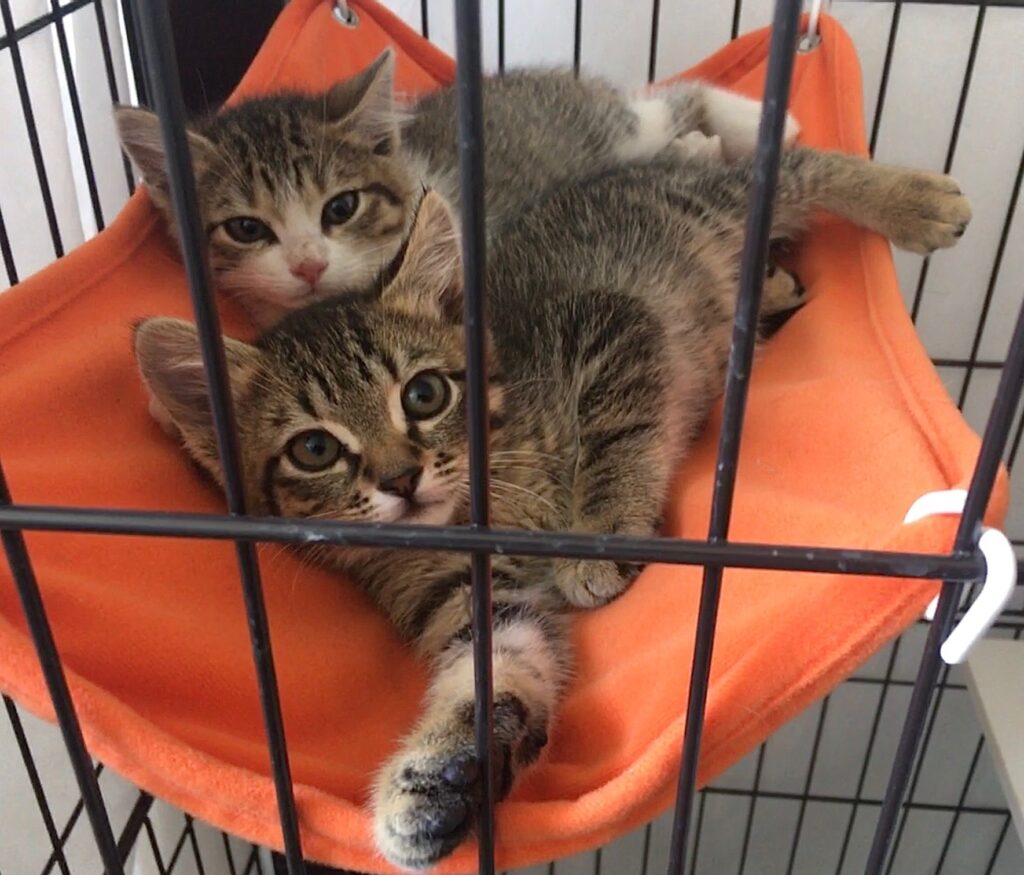
Nancy PetersonClicker training is a simple and fun way to replace unwanted behaviors in frightened kittens with new, desirable behaviors. A tool called a clicker is used. If the sound of the clicker frightens the kitten, a quieter, retractable ballpoint pen can be used. Here’s how it works.

A kitten hisses as you approach the cage. Wait until she stops hissing, click and toss in a treat as close to her as possible, and quietly step back. It shouldn’t take long for her to realize that she gets two rewards when she’s not hissing: a treat and the scary person steps back.

Even if the kitten doesn’t eat the treat, she’s learning. If she eats, repeat your approach, click, treat and back away for two or three more times. If she doesn’t eat after the first few clicks, come back later and try again. Paws up if she ate the treats while you were gone. If she left the treats, carefully remove them and try again the next day with better treats.

What Makes Clicker Training So Effective?

The click lets you capture the exact moment that is being rewarded, and the kitten will make the association between her action and the click and treat. Once the desired behavior is learned, the kitten will let you approach without a click or treat.

Clicker training puts the kitten in control. She chooses to repeat the behavior because she understands that something positive will follow. In a shelter where she may feel like she has lost all control, this is powerful.

You might wonder why clicking is preferable to a “yes” or “good” to mark the behavior. It’s because the kitten will only hear the clicker sound during training, whereas “good” or “yes” are words she’ll hear in other situations. This can confuse her, and the words may lose their meaningfulness. In addition, people’s speech varies, but the sound of the clicker is consistent.

How Else Can Clicker Training Be Used?

When you’re clicker training, you may “catch” the kitten doing something you want repeated. For example, if your goal is for her to come to the front of the crate, click and toss in a treat if she takes even one step toward the front.

As the kitten begins accepting the click-and-treat game, up the ante by putting the treat nearer to the front of the crate. Step back and let the kitten finish the treat. Then, stand still and watch for any movement toward the front of the crate. Click exactly during that movement, give the treat, and step back. The kitten is learning that she can make you click and treat if she moves toward the front of the crate. Once she understands that a step toward the front of the crate is rewarded, wait for her to take two steps before clicking and treating.

When a behavior is understood, give it a name, or cue, such as “Come.” Once the cue is learned, it’s not necessary to click, and rewards can be given less frequently.

How Long Should a Clicker Training Session Last?

Sessions that are five minutes or shorter and more frequent will be more effective than longer, less frequent sessions. Keeping a training log may be helpful to monitor the kitten’s progress and, if you’re working with more than one kitten, reduce confusion on your part.

What Treat and When?

Pick a time when the kitten is hungry and a treat that is pea-size (you can break up a larger treat) and soft so the kitten can eat it quickly. That way she remembers why she got the treat and is more likely to repeat the behavior.

What’s a Target Stick and How Is It Used?

A target stick can be a plastic spoon (easy to disinfect) with a long handle. The goal is to get the kitten to touch her nose to the end of the handle, which you place near the crate door. Hold the spoon end and the clicker in the same hand. (When the clicker is held in the same hand as the spoon, the noise it makes can seem loud to a kitten. If the kitten is frightened by the noise, switch the clicker to the other hand so it’s farther away.)

If the kitten is scared by the handle, smear tasty canned food on the end. The moment she moves toward it, even if she just turns her face to it, click, remove the spoon and toss in a treat. The moment she finishes the treat, offer the handle again. If she doesn’t make any movement, place the handle an inch or two in front of her. Click and treat when she touches the handle with her nose.

Once she reliably touches the handle, offer it to her at a slight distance, so she has to move toward it. Are we having fun yet? Let the kitten absorb the experience, and train again in a few hours or the next day.

What’s the Best Way to Use the Target Stick?

Once the kitten is eagerly touching the target stick, raise the bar by getting her to follow the stick back and forth across the tabletop or onto your lap.

Do Kittens Need to Be Separated for Clicker Training?

Because they learn from one another, it can be beneficial to initially keep kittens together in their crate and train them together. A more frightened kitten may see her bolder littermate getting treats and decide you’re not so bad after all. On the other hand, it may incite aggression between kittens so observe carefully to determine whether to train them together or separately.
Clicker training is fun. It can be used to teach many practical behaviors, such as come, or tricks, such as “high five.” Practice clicker training with your personal pets to help you get the hang of it so you can effectively socialize frightened furballs. You’ll increase their chances of adoption into a forever home, and that’s worth lots of clicks and treats!

This article was reviewed/edited by board-certified veterinary behaviorist Dr. Kenneth Martin and/or veterinary technician specialist in behavior Debbie Martin, LVT.

Nancy Peterson worked as a registered veterinary technician, trainer of dogs for people with disabilities other than blindness, and was Community Cats Program Manager for The Humane Society of the United States. She retired in 2015 and currently serves on the boards of Neighborhood Cats and The National Kitten Coalition. Nancy volunteers as a foster and cat cuddler for her local animal shelter, Colorado Animal Rescue (CARE). During COVID, she became an avid birder and is working to protect cats and birds by building bridges between cat and bird advocates.

Resources

“Getting Started: Clicker Training for Cats,” by Karen Pryor

“Fearful Kitten Socialization 101”
https://static1.squarespace.com/static/590a7f1303596e669d422f5d/t/5ed50c3595645801a7a41f3e/1591020601625/Fearful+Kitten+Socialization+101.pdf

Nancy PetersonSocialization prepares kittens to interact and be comfortable with people, other animals, objects, environments and activities. It can be very rewarding to turn hissing kittens into purring furballs.

However, when there are so many kittens who need homes, socializing those with the best chance of being adopted is important. Generally, the younger the kittens, the quicker they’ll socialize.

Kitten socialization can take from two to six weeks, depending on their age, personality inherited from their mother, friendliness inherited from their father and their early socialization experiences.

Although feral kittens can be weaned at 4 weeks of age, they have the best chance of survival with their healthy mom. For that reason, trap mom and her kittens when they’re 6 weeks old.

At that age, the kittens are still within the primary socialization window, from 2 to 7 weeks of age, when It’s easiest to socialize them. That said, older kittens may still come around since individuals develop at different rates.

Generally, feral kittens older than 16 weeks should be spayed/neutered, vaccinated, ear tipped (the universal sign of a spayed/neutered cat) and returned to their colony. That frees up cage space and staff time for younger kittens.

Housing the family apart from the general kitten population may be impractical, but options exist. Use a quiet one- or two-person office, which allows the family to become comfortable in an indoor environment and daily human activities.

Place a large wire crate with small openings (so kitten body parts don’t get stuck) on a table in the office. Include a hiding box, facing away from the front of the crate, in the crate. Cover the crate with a lightweight sheet that you retract as the family grows more secure.

Food is one of the best tools for socializing kittens. Kitten kibble should always be available, but toss in small, tasty morsels when you approach the crate so kittens and mom look forward to your presence.

When you feed wet food, first place the bowls toward the back of the crate; stay nearby when you provide wet food and treats to help create trust and positive associations with you. Move closer to the crate each time you feed. Then move the bowls closer and closer to the front of the crate and remain close.

If after three days, mom is still highly stressed and charges you when you approach the crate, spay, vaccinate, deworm, ear tip, and return her to her colony.

Older kittens who have learned to swat and bite and continue doing so 1 and a half weeks after removing mom should be spayed, vaccinated, ear tipped, and returned to their colony.

If the kittens are only hissing and spitting, carry on. However, if one isn’t coming around, house him in another location and work with him individually. You can return him to his siblings once he has progressed.

When they’re eating wet food at the front of the crate, try “petting” kittens on their face and chin with a toothbrush through the crate. Offer your bent forefinger through the crate near their bowl and see if they rub against it.

Don’t offer food on your finger or allow kittens to play with your hand. They may accidentally bite or scratch you, teaching them it’s okay to bite and scratch.

Since most feral kittens are initially frightened by interactive toys, start with one that isn’t too threatening, such as a wand toy, that allows you to play with them from a distance through the crate. Aim for small sessions, while talking on the phone or attending an online webinar, for a total of two hours a day.

Once the kittens allow you to touch them through the crate, try the following while they’re eating in the crate, but not after playing with them as they’ll be too worked up.

  • Rest your hand in the crate.
  • Put light pressure on their sides and gently move them from one food bowl to another.
  • Put gentle pressure on their underside in preparation to being picked up.
  • Lift them slightly, facing away from you, with both hands. Gradually lift them a bit longer and higher.

If there’s no struggling or tension, move one kitten at a time out the door; then quickly return him to the crate. Progress until you can lift the kitten out of the crate to a dish of food placed just beyond the door. If the kitten runs back into the crate, leave the crate door open and see if he ventures out on his own.

Once they’re comfortable outside the crate, briefly cuddle each kitten close to your body so they feel your warmth and heartbeat. When kittens are relaxed being held, cuddle them often. Once they seek your company, have other people provide treats and petting in preparation for the kittens’ adoption into a forever home.

If possible, adopt kittens in pairs or into a home with other friendly cats and no young children whose erratic movements and loud voices would be scary. Inform potential adopters that the kittens were feral and provide adopters with the resources listed at the end of this article so they understand the importance of socialization.

As with all new pets, adopted kittens should initially be confined to a kitten-proofed room with food, water, litter box, bed and toys. Hiding is normal and kittens shouldn’t be grabbed and dragged out. They can be lured with a toy onto their adopter’s lap.

Giving kittens time to adjust by talking, playing, petting and offering special treats will build trust and create a lasting bond.

Resources:

http://torontoferalcatcoalition.ca/wp-content/uploads/2014/07/10-the_behaviour_dept_taming_feral_cats.pdf

https://marketplace.animalsheltering.org/magazine/articles/kitty-their-hands\

https://www.psychologytoday.com/us/blog/animal-emotions/202003/the-cat-human-relationship-and-factors-affect-it

https://catvets.com/public/PDFs/PracticeGuidelines/FelineBehaviorGLS.pdf

This article was reviewed/edited by board-certified veterinary behaviorist Dr. Kenneth Martin and/or veterinary technician specialist in behavior Debbie Martin, LVT.

Nancy Peterson worked as a registered veterinary technician, trainer of dogs for people with disabilities other than blindness, and was Community Cats Program Manager for The Humane Society of the United States. She retired in 2015 and currently serves on the boards of Neighborhood Cats and The National Kitten Coalition. Nancy volunteers as a foster and cat cuddler for her local animal shelter, Colorado Animal Rescue (CARE). During COVID, she became an avid birder and is working to protect cats and birds by building bridges between cat and bird advocates.

Valarie V. Tynes, DVM, DACVB, DACAW

Do you still believe that a puppy should have all her vaccinations before ever meeting another dog? Do you think the safest place for every new puppy is within his own home until after the last set of vaccinations? If so, you may be running the risk of the puppy’s early death due to behavior problems.

Studies have demonstrated that behavior problems likely result in more pet deaths than any other single cause.1, 2,3 A properly run puppy socialization class should not put your patients at any increased risk of communicable disease.4

If you do not have a reliable, safe place to refer your clients to for puppy classes, then consider offering them at your own clinic. Puppy classes are fun and, when held at your clinic, allow you and your staff to reap the benefits. Here are four reasons to consider adding puppy classes to your practice’s programs:

1. Proper socialization is critical to the puppy’s proper development and the window for this period of development is only open until about 14-16 weeks. After that time, puppies are not as able to learn to cope with novelty and develop new relationships with other individuals.

Your clinic is a safe place for this experience to happen because:

  • You can sanitize the surfaces puppies will contact.
  • You can be certain that all puppies who attend have had at least one vaccination several days prior to their visit.
  • You can give each puppy a brief exam and send puppies home if they appear to be sick.

2. Puppy classes help create more cooperative patients. When puppies come to your clinic once a week for a few weeks, and the only thing that happens there is they get to play with other puppies, meet some new people, see some strange things and get lots of treats, they learn that there is nothing scary about the vet clinic.

Part of at least one puppy class session should involve demonstrating to pet owners how to handle their new puppy’s ears, toes, tail, and other body parts in a way that mimic handling for veterinary and grooming procedures. When this is done while giving treats, puppies learn that this type of handling is routine and “no big deal.”

You can help set the puppy up for success in advance by recommending the owner use an Adaptil Junior collar. This is a collar impregnated with dog appeasing pheromone, the same pheromone that mother dogs release during the period of time when they are nursing puppies. Numerous placebo-controlled studies have demonstrated its ability to help decrease signs of fear and anxiety in many situations.5,6,7 When placed on puppies during their critical period for socialization, the collar has been proven to help with the socialization process.8 Puppies between 8 and 16 weeks of age who wore an Adaptil collar for just 30 days while attending a puppy class showed signs of being better socialized 1, 3, and 6 months later than puppies who wore a placebo collar.9

3. Puppy classes will bond clients to your practice. When clients see how much you care about their puppy’s healthy development and good behavior, they will appreciate your commitment to their puppy’s overall health.

When they see how happy their puppy is to return to your clinic time and time again because he only has good memories associated with the visit, they will have no reason to ever consider going to another practice.

4. Puppy classes provide an added revenue stream. They do not have to be managed by the veterinarian. It is very possible that you have a staff member who is interested in learning more about how to do this and would love the opportunity to take on such a valuable and rewarding project. There are several excellent resources available for learning how to teach a puppy class and with some training and practice most anyone can add puppy classes to their clinic’s list of services. One of the best is the Puppy Start Right for Instructors Course, which offers a discount to Fear Free Certified Professionals using code FEARFREEPSRI.

This article was reviewed/edited by board-certified veterinary behaviorist Dr. Kenneth Martin and/or veterinary technician specialist in behavior Debbie Martin, LVT.

References

This article was brought to you in collaboration with our friends at Ceva.
  1. Dolan ED, Scotto J, Slater M, et al. Risk factors for dog relinquishment to a Los Angeles municipal animal shelter. Animals (Basel) 2015; 5: 1311-1328.
  2. Dreschel NA. The effects of fear and anxiety on health and lifespan in pet dogs. Appl Anim Behav Sci 2010;125: 157- 162.
  3. Houpt KA, Honig SU, Reisner IR, Breaking the human-companion animal bond. J Am Vet Med Assoc 1996; 208: 1653-1659.
  4. Stepita ME, Bain MJ, Kass PH. Frequency of CPV Infection in Vaccinated Puppies that Attended Puppy Socialization Classes. J Am Anim Hosp Assoc 2013; 49:95-100.
  5. Pageat P, Gaultier E. Current research in canine and feline pheromones. Vet Clin North Am Small Anim Pract 2003: 33;187-211.
  6. Mills DS, Ramos D, Esteller MG, et al. A triple blind placebo controlled AABS investigation into the assessment of the effect of Dof Appeasing Pheromone (DAP) on anxiety related behaviour of problem dogs in the veterinary clinic. 2006;98:114-126.
  7. Gaultier E, Bonnafous L, Vienet-Lague, et al. Efficacy of dog-appeasing pheromones in reducing stress associated with social isolation in newly adopted puppies. Vet Rec 2008;163:73-80.
  8. Gaultier E, Bonnafous L, Vienet-Lague, et al. Efficacy of dog appeasing pheromones in reducing behavours associated with fear of unfamiliar people and new surroundings in newly adopted puppies. Vet Rec 2009;164:708-714.
  9. Effects of dog appeasing pheromone on anxiety and fear in puppies during training and on long term socialization: Denenberg S. & Landsberg G.M. JAVMA, (2008) 233;12

Rachel Lees RVT, KPA CTP, VTS (Behavior)

As veterinary professionals, wouldn’t we all love ways to keep our clients and feline patients happy, healthy, and even make our jobs safer? Let’s scratch the surface of the basics of kitten socialization, the benefits of kitten socialization classes, and how we can start these courses in our own practices.

Who doesn’t love a sweet, fluffy, and cuddly kitten? But they don’t become that way on their own.  Veterinary team members and owners have long recognized the importance of puppy socialization and training classes, and these same tactics can be used for kittens as well. That’s right! Socialization is just as important for kittens as it is for puppies. It’s important for humans, too. Here’s why.

Educating Owners and Staff

As veterinary professionals, we have only a certain amount of time to discuss these things with new kitten owners during appointments. An educated veterinary team is key to starting kittens off on the right track to enjoy handling, being placed in their carriers, and be more comfortable with husbandry care at home.

These things are beneficial for the veterinary team as well. Revenue increases because cats are more compliant about being brought to the veterinary hospital, and everyone is safer because fewer patients display fear, anxiety, or stress. Implementing and recommending these classes in a practice can also increase revenue as a new service and be a way to bond kittens and owners to the practice.

Socialization Timeline

Knowing and acknowledging the kitten socialization period is critical in setting up new owners and kittens for success. For kittens, the socialization period starts at 2 weeks and ends at 7 to 10 weeks. This is the time when kittens begin to become less reliant on the queen for survival and have increased interaction with social and environmental stimuli. It’s the most important sensitive period in feline development and can help to prime felines to live safely and comfortably in human households. Positive social experiences in kittenhood with other species and stimuli are hugely beneficial in creating behaviorally healthy adult cats.

You may be thinking that kittens do not come into the practice until after this developmental period has passed and you are correct! Kittens may not come into our practices until they are 8 to 10 weeks old. Kitten classes can still be beneficial because the socialization window does not slam shut. It closes slowly, so these classes can be beneficial for kittens up to 14 weeks of age.

Kitten Classes

Kitten Kindergarten or Kitten Kindy was brought to the forefront by veterinary behaviorist Kersti Seksel, VBSc (Hons), MRCVS, MA (Hons), FACVSc, DACVB, DECAWBM of Australia. The classes have the following goals:

  • Socialize kittens
  • Educate owners about normal feline behavior
  • Teach owners how to interact and play with their kittens
  • Train kittens to accept handling procedures
  • Identify any problem behaviors and provide up-to-date, humane, and scientific advice
  • Educate owners on all aspects of kitten development, pet care, and living with a cat in the family

I structure and run kitten classes as follows:

  • Interaction with other pet owners and felines of the same age range (with appropriate health and vaccination requirements)
  • Provide different surfaces, textures, objects, and sounds for the kittens to experience during exploratory time
  • Discuss and demonstrate carrier training using marker training
  • Review the following focus points to set the new kitten owners up for success:
    • Litter Box Basics
    • Socialization Period
      • Fear Free has a fantastic Kitten Socialization Bingo Worksheet in the Toolbox. I have used something similar in the past and given prizes for owners who get the “Bingo” or successfully socialize their kittens to many positive things from week to week.
    • Scratching and playing
    • Handling and administering medications

Courses can be offered weekly in a rotational style to get as many kittens into the class as possible, monthly as a kitten party, or in a weekly 3-week course.  The possibilities are endless!

This article was reviewed/edited by board-certified veterinary behaviorist Dr. Kenneth Martin and/or veterinary technician specialist in behavior Debbie Martin, LVT.

Rachel Lees, a Level 3 Fear Free Certified Professional, is a veterinary technician specialist in behavior, a KPA certified training partner, and lead veterinary behavior technician at The Behavior Clinic in Olmsted Falls, Ohio. She loves helping people create and maintain a strong human-animal bond and has a special interest in kitten and puppy socialization and development.