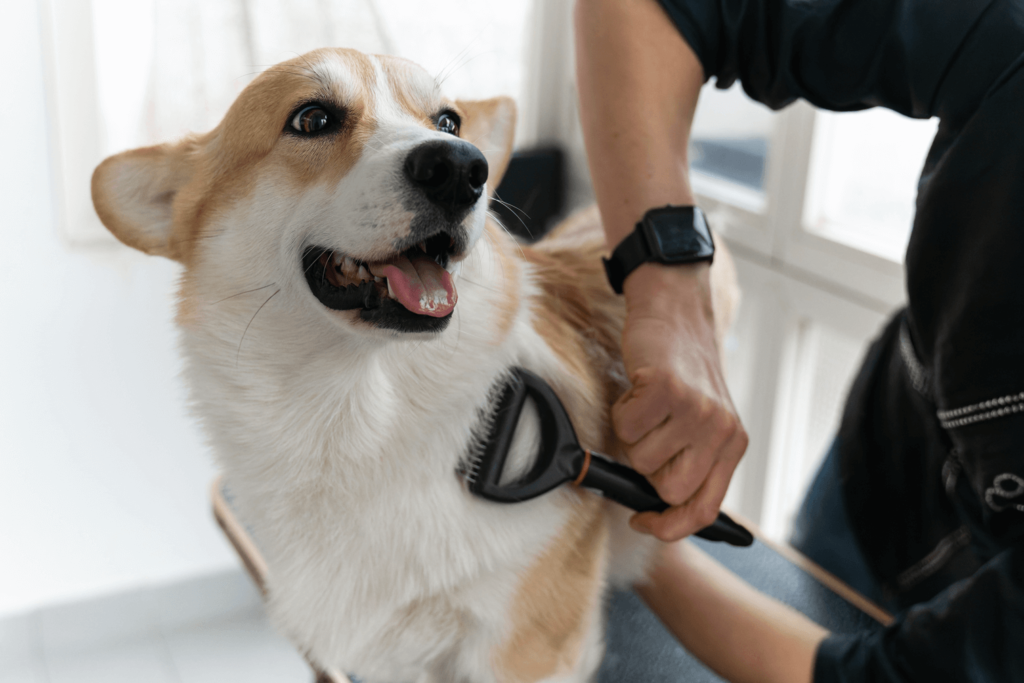
By Elsebeth DeBiaseLearning to groom pets is a challenge. At first, the focus is on mastering equipment, proper trims, and avoiding a bite or nicking an animal. Great workdays for a groomer are filled with cold noses and friendly tail wags. So, what do bad days look like? Hard grooming days look different for everyone, but for me, explaining to an owner that I can’t groom their pet due to behavior is the worst. As a veteran groomer of over 20 years and a graduate of the Animal and Veterinary Sciences program at the University of Maine, Orono, I have always been committed to providing the highest quality grooming services possible with the help of industry continuing education. When the Fear Free Groomer Certification Program was released, I jumped at the chance to be Maine’s first Fear Free Certified Groomer. Fear Free planted a seed that changed my approach to the business of pet grooming. Fear Free enabled me to help more pets who were apprehensive of the professional grooming environment by focusing on the animal’s emotional well-being and forging good groomer-client relationships.

Necessary, but Never Urgent

Pet grooming provides many physical benefits to pets, including healthier skin and coat, shorter nails, and overall cleanliness. Pets and owners have more quality interactions when pets are regularly groomed and feel good. I am a firm believer that grooming enhances the canine-human bond. However, grooming is never urgent enough to sacrifice a pet’s emotional well-being. Sometimes groomers, myself included, feel pressure to do a perfect trim, but this is not always practical or possible. Often, pets require comfort grooms focusing on sanitary issues rather than esthetics; this is especially true of young and old pets. Nevertheless, it is critically important that the pet owner is on board with a pet professional’s care plan.

Individualized Care Plans

Fear Free gives pet professionals the tools to constructively advocate for pets experiencing fear, anxiety, and stress. By incorporating Fear Free practices into my grooming business, I was able to educate clients regarding fear, anxiety, and stress in pets and confidently manage client expectations. As a Fear Free Certified Groomer, I can skillfully demonstrate to a client the need for an individualized approach to grooming their pet, thus reassuring them the pet is in good hands. I have built long-lasting relationships with my clients using Fear Free principles and a sincere desire to help. Additionally, Fear Free techniques are most successful when I actively encourage owners to participate; after all, Fear Free starts in the home.

The Fear Free Difference

Fear Free is a mindset encompassing knowledge, skill, integrity, and compassion backed by behavioral science. Fear Free values helped me develop my pet care philosophy: helping every owner will help every pet. As a result, veterinarians, groomers, local business owners, and clients often refer potential customers to me. I have gained many wonderful customers this way, and I encourage all groomers to continue their education with Fear Free.

Lastly, Fear Free practices are rewarding and fun. There is no better feeling than helping a struggling pet succeed. When it comes to grooming, you can’t always do the “good dogs,” but why can’t all dogs be good with an individualized approach? The answer is they can.

Bio

Elsebeth DeBiase is an award-winning IPG Certified Master Groomer with 22 years of experience in the pet industry. As a graduate of the University of Maine Department of Animal Sciences, she has an understanding of the animal industry that encompasses farm, veterinary, and pet industries alike. In 2011, Elsebeth opened Coastal Creations Pet Salon with the goal of providing individualized services to her four-legged clients while utilizing state-of-the-art equipment, compassionate handling methods, and modern styling techniques. Her specialties include small dogs, cats, and disabled and senior pets. Elsebeth is Fear Free and Low-Stress Handling Certified. She recently completed the Canine Arthritis Management (CAM) training for pet professionals to help raise awareness of the symptoms and prevalence of canine osteoarthritis.

This article was reviewed/edited by board-certified veterinary behaviorist Dr. Kenneth Martin and/or veterinary technician specialist in behavior Debbie Martin, LVT.
Want to learn more about Fear Free? Sign up for our newsletter to stay in the loop on upcoming events, specials, courses, and more by clicking here. 
Sandra Toney
Jeannette Kincaid became interested in dog training over 20 years ago when she adopted a shy, fearful Border Collie/Australian Shepherd mix named Lydia. Unfortunately, Lydia was terrified of the world. Kincaid says she vowed to make a better life for her dog, so she started researching how to make Lydia feel as safe and happy as possible.

“It lit a spark in me and that passion has never subsided,” says Kincaid.

Going on to live 13 years, Lydia was never a social butterfly but, with Kincaid’s love and encouragement, she enjoyed seeing people and trying new adventures.

“Near the end of her life, we took a beach trip and she settled down on the patio for dinner with us,” Kincaid says, “It was truly one of the best moments of my life.”

Kincaid has now been a professional dog trainer for 15 years and, for the past nine years, has worked at Train My Dogs Austin and Onion Creek Kennels. Train My Dogs Austin is a positive training, boarding, and daycare facility in Austin, Texas, while Onion Creek Kennels in south Austin focuses on daycare, cat and dog boarding, and cat and dog grooming – all using positive reinforcement for the pet clients.

As head trainer at both facilities, Kincaid is currently enrolled in Animal Behavior College’s Grooming Instruction program, so she will soon become a professional groomer as well.

Fear Free certified in both training and grooming, Kincaid decided to take the courses when she began having an influx of training clients whose pets had been let go from their groomers for behavior reasons and needed a new facility for their dogs to be groomed.

Since Kincaid also groomed dogs, she began working with her training clients. “The Fear Free program has been very helpful in teaching me how to work with dogs in a manner that can help them grow to like grooming as well as a good foundation of knowing when to continue grooming and when to stop.”

Her training approach was already similar with the Fear Free program’s principles and techniques, says Kincaid, but what she lacked was concrete ways to illustrate and explain to clients and colleagues why she would continue working with a dog in some circumstances, and when she would stop and step back. The Fear Free certification program gave her great handouts with clear illustrations to help clients learn how to identify FAS (fear, anxiety, and stress). It has clear illustrations laying out various levels of stress such as when to push forward and when to stop and reduce stress.

The handouts have had a huge effect on client follow-through and understanding. She loves the continuing education available. “The Fear Free program has the best webinar on how to do a nail trim that I have seen,” says Kincaid. “Becoming Fear Free certified as a trainer and a groomer has really opened up a whole new subset of clients. It is also extremely rewarding to work dogs into grooming that were not able to be groomed previously. The clients are always so grateful.”

Kincaid says one case where her Fear Free certification was crucial was in working with a 6-month-old Schnauzer other groomers wouldn’t handle. He would start biting even while being brushed. Kincaid decided to take him on as a client because he was young and would need to be groomed for the rest of his life.

“We set up a training program where he came once a week and I worked on counterconditioning him to various tools and holds needed for grooming. We only ever pressed on if he stayed in the green level on the FAS ladder. We adjusted if his FAS started rising.

“We really leaned into the idea of need versus want,” she says, “meaning we stopped frequently, and he went home only partially done. But over a few months, we were able to complete an entire full groom and he went home looking great. This dog was labeled as a dog that couldn’t be groomed and now is able to be groomed and,” Kincaid says, “he loves his groomer.”

This article was reviewed/edited by board-certified veterinary behaviorist Dr. Kenneth Martin and/or veterinary technician specialist in behavior Debbie Martin, LVT.

Sandra Toney has been writing about pets for over 25 years and is an award-winning member of Cat Writers Association and Dog Writers Association of America. She has written for many print and online magazines as well as authoring eight books. She lives in northern Indiana with her cat, Angel.