Blog Archives

Vaccines, Clients & Curbside… Oh My! Navigating Your Practice’s Preventative Care Yellow Brick Road During a Pandemic

Join Dr. Julie Reck, owner and founder of Fear Free Certified Practice Veterinary Medical Center of Fort Mill, for a discussion on vaccines, how to administer vaccines in a Fear Free manner, and how to improve communication throughout your practice to navigate preventative care in a curbside environment.

Brought to you by Elanco.

Course Overview

Are you the only person in your clinic who has a passion for Fear Free? It’s easy to get discouraged and frustrated when we are surrounded by obstacles. This course provides tools to achieve your Fear Free goals even when you feel like you are all alone in your work. Learn how to get buy-in, implement strategies from the ground up, and encourage your colleagues to join your heart’s work of protecting the emotional welfare of our treasured animal patients.

This course, approved for 1 RACE CE hour, was written by Monique Feyrecilde BA, LVT, VTS (Behavior).

This course consists of five lessons:

  • Lesson 1: The essence and importance of Fear Free Practice
  • Lesson 2: Understanding the dynamics of change
  • Lesson 3: Implementing change within your practice
  • Lesson 4: Addressing common push-back topics
  • Lesson 5: Thrive where you’re planted, or transplant to a new garden
|

Stand-Up Comedy with Dr. Kevin Fitzgerald

We invite you to join us for the second installation of our Fun Webinar series to break up your stressful weeks with something to look forward to! These webinars are for our human clients and intended to give you a mental break, learn something new and fun, or cater to your own emotional and mental wellbeing.

We’ve been told laughter is the best medicine, so we’ve asked comedian Dr. Kevin Fitzgerald to fill our prescriptions. Best known for his 11 seasons on the popular Animal Planet television series “Emergency Vets”, Dr. Kevin Fitzgerald practices small animal medicine at VCA Alameda East Veterinary Hospital in Denver, continues to do research, has authored over a hundred peer-reviewed scientific articles, and is on multiple boards for different Denver-area veterinary and zoo associations. In addition to his veterinary career, Dr. Fitzgerald has been performing stand-up comedy since 1986, opening for and working with performers such as Joan Rivers, Bob Hope, Kevin Nealon, Brian Regan, and Norm McDonald.

Fear Free

For Dr. Alicia McLaughlin, a key component of Fear Free success with her exotic-animal patients is to encourage clients to prioritize preparation for visits. She educates them on measures they can take at home to increase their pet’s comfort with care and encourages Fear Free fun visits to the hospital. In this way, she lays a calm, positive foundation for animals during care. Pets with mild concerns experience increased comfort and cooperation as trust is established.

In an ideal world, McLaughlin would provide a Fear Free foundation for her patients from the start. When she’s able to do so, Dr. Laughlin starts by accustoming the animal slowly to aspects of care, pairing these experiences with treats. At the same time, she teaches clients proper treat delivery and handling guidelines so they can practice at home and help prepare their pet for future care. Patients with already established FAS at the vet also benefit from conditioning to increase their comfort with handling at the veterinary clinic.

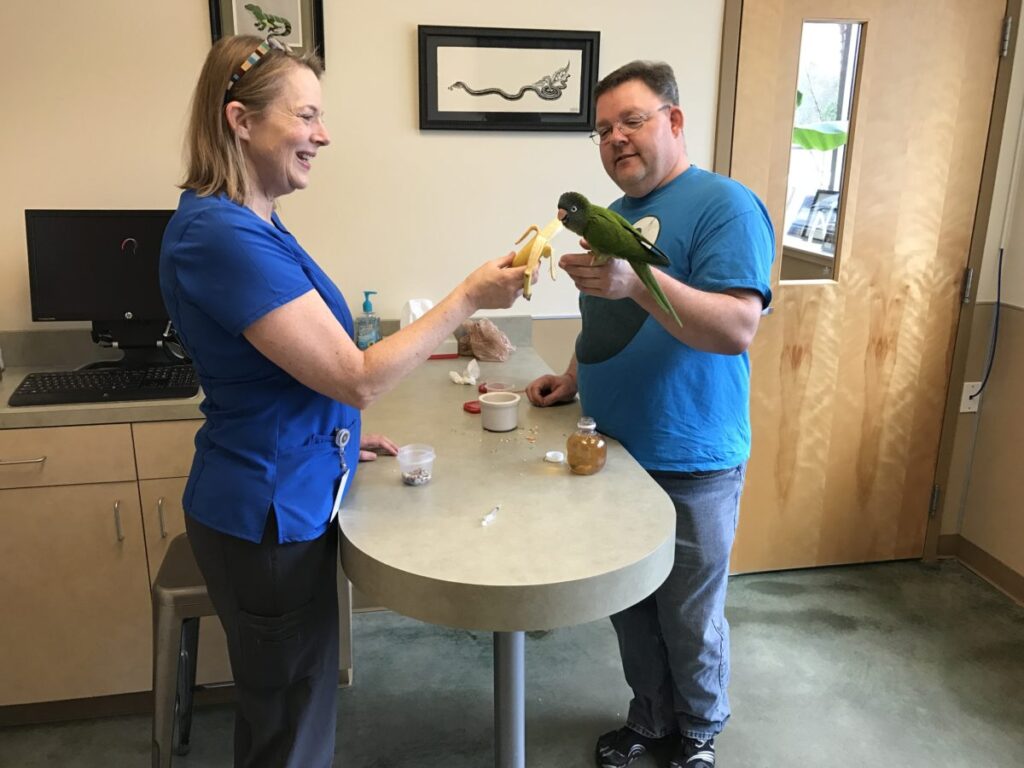
A major benefit for her patients on wellness plans is scheduling at least two Fear Free fun visits a year to positively condition the animal to care. During these practice visits, the animals come in for the equivalent of a treat party, taking treats from members of the staff to increase their tolerance to new people. Nothing stressful or coercive takes place. Instead, the animal is slowly desensitized to aspects of the clinic and the staff may work on developing some tricks to have a foundation for working with the pet during future visits.

The takeaway? Never underestimate the power of having a good time! Fun, positive experiences at home and at the hospital are a powerful force in helping to decrease the fear, anxiety, and stress animals experience during care and increase their happy participation.

This article was reviewed/edited by board-certified veterinary behaviorist Dr. Kenneth Martin and/or veterinary technician specialist in behavior Debbie Martin, LVT.

In a perfect world, Dr. Alicia McLaughlin would establish relationships with animals who have no experience with veterinary visits and thus no fears regarding them. But at the Center for Bird and Exotic Animal Medicine near Seattle, Washington, she is more likely to encounter animals who have already developed fear, anxiety, and stress (FAS) associated with the veterinary environment and physical care. Many of these animals are naturally frightened of new persons, places, and experiences, and limited socialization early in life makes it difficult for them to deal with changes that deviate from the narrow scope of what they’ve learned is normal and safe. Not surprisingly, many of the animals Dr. McLaughlin treats are already on edge before she walks into the exam room.When animals come in with preformed notions and established concerns, the opportunity to start with a clean slate and make the experience positive from the onset has already passed. Instead, with many of these animals McLaughlin is doing damage control, backtracking from previous negative experiences and recovering from a lack of ongoing positive experience and preparation.

“I’m often working up from a negative with my patients because they have such bad history,” says Dr. McLaughlin.

Sadly, common practice for handling birds in many pet care environments is to put the parrot on the ground and throw a towel on him. Such unsettling and scary experiences lead to increased angst for the animals.

“A lot of behavioral flooding happens with birds. It’s the status quo for most places. It’s not just vet hospitals. It happens at many pet stores when the parrot goes in for grooming, too,” says McLaughlin.

Alleviating and reducing FAS helps to bring the animal into a more neutral emotional state. Then he or she is more receptive to pleasant pairings that accompany the veterinary experience and positively affect the animal’s emotional outlook. This makes the situation less concerning for the animal and improves the ability to handle him and provide care.

A greater challenge in helping these patients is dealing with people who don’t understand the signs of FAS or the negative outcomes that can happen because of it.

“The hardest part is dealing with someone who has expectations in their head for how care should be or how it has always been. Or dealing with a person that’s driven by strict time constraints,” says Dr. McLaughlin.

The best approach McLaughlin has found to work gradually with these clients and build a rapport with them. Ultimately, this helps her to reach her goal of improving the lives of animal patients.

“I try to focus on one, two, or three things max they can do per visit to improve their bird’s quality of life. If I build enough rapport they’ll keep coming back and we can keep building,” says Dr. McLaughlin.

Putting the treat into treatment isn’t possible for all of McLaughlin’s patients, who sometimes don’t take food when they’re too upset. But just because the animal won’t take food doesn’t mean the visit can’t be Fear Free. There are numerous Fear Free-friendly tools McLaughlin uses to help.

“Some animals, like pigs, are easy to work with because they’re so food-motivated. Birds are more challenging because they are often already so far over the threshold it’s hard to reach them. Being sensitive to body language and taking things slow can help.”

Because many birds are already amped up and display signs of escalated FAS by the time they arrive for care, sedation is a tool that’s often utilized to deliver physical care in a manner that’s protective of emotional wellbeing.

“Using sedation on those birds that are already really stressed on arrival makes a big difference in how the visits go. It’s safer, the bird has a better quality of life, and it reduces negative experiences to help build for the future of that bird’s care going forward,” says Dr. McLaughlin.

“Emphasizing the need for minimal stress veterinary medicine has changed our approach to patients. Our staff tries to minimize coercion when possible, and sedation is seen as a way to help improve our patient’s veterinary experience when any potentially stressful medical procedures need to happen. There’s an increased urgency to try to quickly bring the stress levels down when they occur, along with more creative problem solving between staff members to either prevent or address stressful situations,” says McLaughlin.

Customer Service Representative Fear Free Training Tool

This checklist is mainly used for customer service representatives. Each client can be assured a Fear Free experience because the person on duty is ensuring that each box is checked throughout each client’s experience.

Talking points and resources to facilitate a successful Fear Free visit

Share these helpful handouts with your staff to ensure a Fear Free visit for every client and pet. Get everyone on board from the moment the client and patient walk in the front door, to the exam room, and when saying goodbye. The Fear Free approach takes the whole team.

Emotional Medical Record Template

A customized care routine is crucial to a successful Fear Free veterinary visit. Use this Fear Free Emotional Medical Record (EMR) template to organize each patient’s preferences of examination area, motivational aid, and specifics of incidents of FAS. Templates are available for dogs/cats and also for birds.

Fear, Anxiety, and Stress (FAS) Scale

Because it is critically important to rate an animal’s level of FAS, Fear Free created this FAS scale for certified professionals. This scale will give you the opportunity to be consistent in assessing and recording every animal’s FAS level, and it will give you recommendations on how to proceed. Page two of the scale is your tool to record details on each animal.

Print out the scale, laminate it, and hang it on the wall. The second page goes into each patient’s medical record. Scales are available for dogs, cats, horses, and birds.