Mikkel Becker
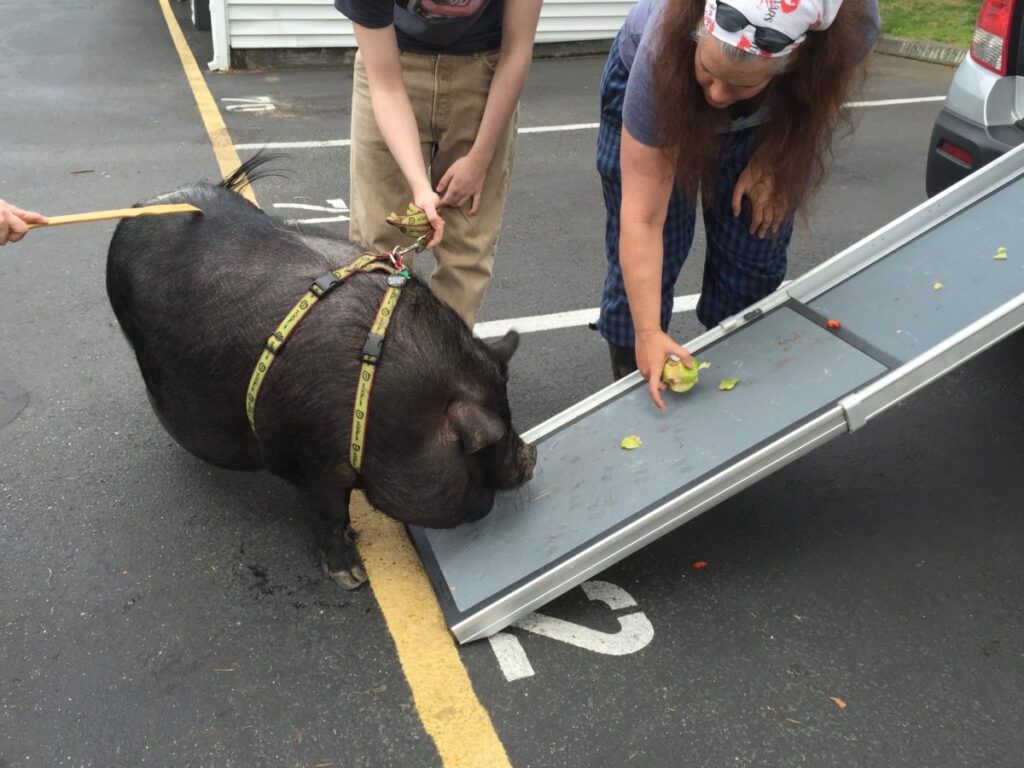
Fear Free is a concept that benefits both animals and the people working with them. This is especially evident when the animal being cared for is of tremendous size and strength, such as the pig patients of Fear Free certified professional Dr. Alicia McLaughlin at The Center for Bird and Exotic Animal Medicine near Seattle, Washington.
“When pigs are stressed, they communicate their stress very clearly, both vocally and with their body language, which can be very upsetting for their family and veterinary staff. When pigs are less stressed, their families are more relaxed, and their veterinarian is able to provide better quality medical care,” says McLaughlin.
Handle With Care
Coercive handling causes increased tension for everyone. Forced handling is also likely to create fear memories and aversions that make the pig more challenging to work with and create a greater safety risk for both pig and people.
“Pigs are very touchy about their bodies. Many don’t like being touched unless they are being scratched in certain areas. If they feel that any handling attempts are coercive, they’re likely to react strongly and negatively,” says McLaughlin. “Most pigs have an extreme dislike for restraint, having their facial area handled, or being picked up. Forcing a pig to remain still with restraint even momentarily for sedation can cause tension for everyone. Many will vocalize in distress when this handling occurs; with squeal decibels rivaling those made by a fighter jet.”
Most pigs who come in are open to the veterinary experience if the staff interacts in a way that signals they are friendly, not threatening. Encouraging the pig’s willing participation during care using treat rewards, setting a soothing care environment, and using calming aids are all approaches resulting in less stress and greater success.
Reading Porcine Body Language
Rewards and food aren’t the only things that work to keep pigs calm during Fear Free care. Carefully observing the pig’s body language for signs of fear, anxiety, and stress (FAS) throughout care is also key for keeping the pig in a calmer, more amenable state and for keeping both pig and humans safe in the process.
Signs of FAS in pigs include muscles tensing, shying away, lowering the head, moving into a corner, or finding security by moving their body next to a wall. In some cases, FAS may be subtle, with one potential indicator being the pig coming up to take treats, but then retreating to a safe distance immediately after the interaction. Loud squeals and excessive vocalizations are audible signs of a pig’s distress.
When in a state of FAS, pigs will attempt to avoid the situation and move away or hide. If pushed, though, pigs on rare occasions may try to bite. Biting is rare, a last-ditch escape effort from pigs who are responding to the situation as if they’re going to die.
Sedation Can Help
It’s far better to note early signs of FAS and make ongoing adjustments to keep the pig calm than it is to risk escalation and the creation of fearful memories of the experience. Sedation isn’t a last resort for pig care, but a protective practice used early and often when it comes to reducing the FAS pigs experience. In many cases, full sedation is recommended to eliminate the distress and ensuing struggle that could otherwise occur if the pig becomes upset. But before jumping immediately to sedation, Dr. McLaughlin is careful to make the sedation itself as non-stressful and Fear Free as possible.
Sedating a pig can be tricky, especially since most pigs are averse to having their faces touched or to being held in place even momentarily. It’s important to Dr. McLaughlin to keep sedation minimally stressful. Oral pre-sedation medication, such as Valium that’s ground up and placed on food, can take the edge off before sedation. With pre-sedation medication on board, the pig is often calm enough to tolerate minimal restraint while a gas mask is placed over the face. No more than a minute later, the pig is out and ready to be cared for.
“Time pressures can result in handling and care being more coercive than we want it to be. There is something to getting it done quick and dirty. But there are long-term effects that go with that and it’s not my preference to do that,” says Dr. McLaughlin.
This article was reviewed/edited by board-certified veterinary behaviorist Dr. Kenneth Martin and/or veterinary technician specialist in behavior Debbie Martin, LVT.
Mikkel Becker, CBCC-KA, CPDT-KA, KPA CTP, CDBC, CTC, is lead animal trainer for Fear Free Pets. She is a certified behavior consultant and trainer who specializes in reward-based training that’s partnered closely with the pet’s veterinary team. Mikkel is coauthor of six books, including From Fearful to Fear Free.

 When Fiona first came to us at Gamble Pet Clinic, an examination without a fearful reaction from her was impossible. An attack by another dog at a young age had caused her to be anxious and nervous ever since. She had been muzzled at every veterinary clinic since her attack until coming to Gamble Pet Clinic. She was fearful initially, trying to nip at the doctor and staff when they attempted to examine her.
 I took the Fear Free course. It was interesting and useful. I’m now working with two local veterinary offices who found me through the Fear Free website.
 Sal was brought to us to establish why he had been having chronic vomiting and diarrhea. When I approached him in the lobby, he immediately pinned his ears and retreated under the couch. We brought him into an exam room, and he warmed up a bit but was still wary. Mom and Dad mentioned that in the past at other clinics he was taken to “the back” for vaccines and they could hear him vocalizing from the exam room.
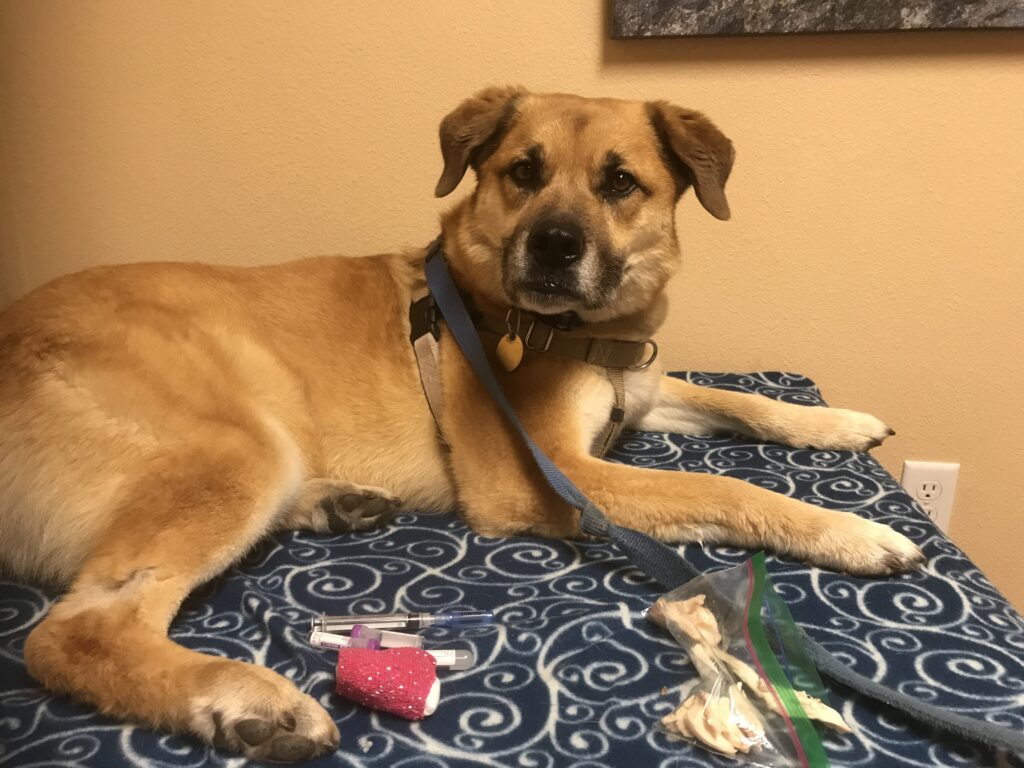
 Hunter, a 2-year-old mixed breed, enjoys looking out the windows in the lobby of our clinic. By starting his visit there, asking his mom questions and listening to his heart and lungs, we can make sure he is comfortable enough to continue his exam in the exam room. But it was a different story when he first came in almost two years ago. Because of a previous frightening experience at another clinic, he was wary of us and the handling and procedures being done. He would bare his teeth, growl, and even try to nip at Dr. Gamble’s hands when she tried to touch him. Through consistent Victory Visits, pre-visit training and medications, and desensitization to areas where vaccines and other needle pokes are typically given, we are now able to provide him and his owner with a comfortable and rewarding experience every time he is in. Now he sits patiently and lets Dr. Gamble examine him—with the help of some cheese and marshmallows, not to mention smears of his favorite treats, peanut butter and canned food. During Hunter’s victory visits, we commonly work on the desensitization process without actually following through with an injection. “Happy visits, along with some training classes and behavior work on our part, have made a world of difference to Hunter,” writes his owner, Beth. “Hunter is now excited to see Emily, Heather, Dr. Gamble, and many other staff members as soon as he walks through the front door. He is a much happier dog at the vet thanks to Gamble Pet Clinic’s Fear Free work.”
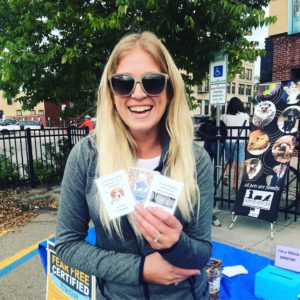 Recently, there was an event called Woof Fest held during a downtown pub crawl. Our clinic sponsored “Dog Trivia,” and I focused the questions on a pet’s emotional health, such as “Is this dog’s body language calm or stressed?” and “A dog wagging their tail is always happy. True or False?” Hundreds of people played our trivia game, and it was such a rewarding experience to educate the public on the topic.
 Sammy had grown up in a hoarding situation and was fearful at the time of his adoption. Unless he was sedated, the six-year-old dog would bark and lunge or even eliminate from fear during veterinary visits. A prescription for an SSRI helped and the team tried additional medications at different doses, but Sammy would push through the medications and continue to show fear aggression. At first, he was unable to generalize that humans weren’t scary, so it was important for him to see the same person at the hospital on each visit. That wasn’t easy, but eventually the right person came along who was able to take the time and effort for Sammy to become comfortable. It took six months of Victory Visits spent eating chicken, practicing chin rests and lying on his side, and undergoing desensitization to having his leg shaved, the scent of alcohol, application of a topical product for numbness, and the pretend poke of a needle, but in July Sammy underwent his first successful blood draw. Now we are routinely doing happy visits to keep the momentum going.
 Bruno is a goofy 8-year-old Bull Arab Cross (a type of Australian working dog). He has always been very friendly at the vet, but once pats stopped and the examination started, he would become suspicious and communicate his discomfort with aggressive behavior. Fortunately, Bruno’s owner has been committed to training. They had private training sessions and attended a Ready, Vet, Go! course. As part of Bruno’s training we incorporated a lot of owner education on subtle body language changes, as well as start and stop cues for Bruno. Bruno was trained with a sustained chin target, using a towel on a chair, as his start cue, meaning “I’m ready for procedure.” If he lifted his head, we immediately stopped the procedure. Bruno was also trained to be comfortable with a Baskerville Ultra Muzzle. We spent time teaching Bruno specific body parts such as tail, ear, and scruff, so that he knew what was about to happen. Over time we were able to pair several good vet clinic experiences (training on a Sunday in clinic) with lots of his fave foods, body scratches, and games. We also introduced veterinary equipment, including syringes, blunt needle, alcohol swabs, and stethoscope. When we weren’t actively training, he was taught a default “chill” behavior and rewarded for relaxed head, tail, and big breaths. He had several socialization visits at the vet, and when he required surgery for a lump removal we did practice runs with pre-visit medication to see what would work best for him. A planned course of action on admission saw him anesthetized as soon as possible to limit buildup of anxiety. Since then Bruno has had further training sessions and socializing vet visits. Recently he had his vaccinations and we were able to give his injection without any restraint by utilizing his muzzle and target training. Bruno is a great example of what teamwork can achieve when you have a committed owner and a Fear Free-trained vet and trainer, not to mention a goofy, food-motivated dog!