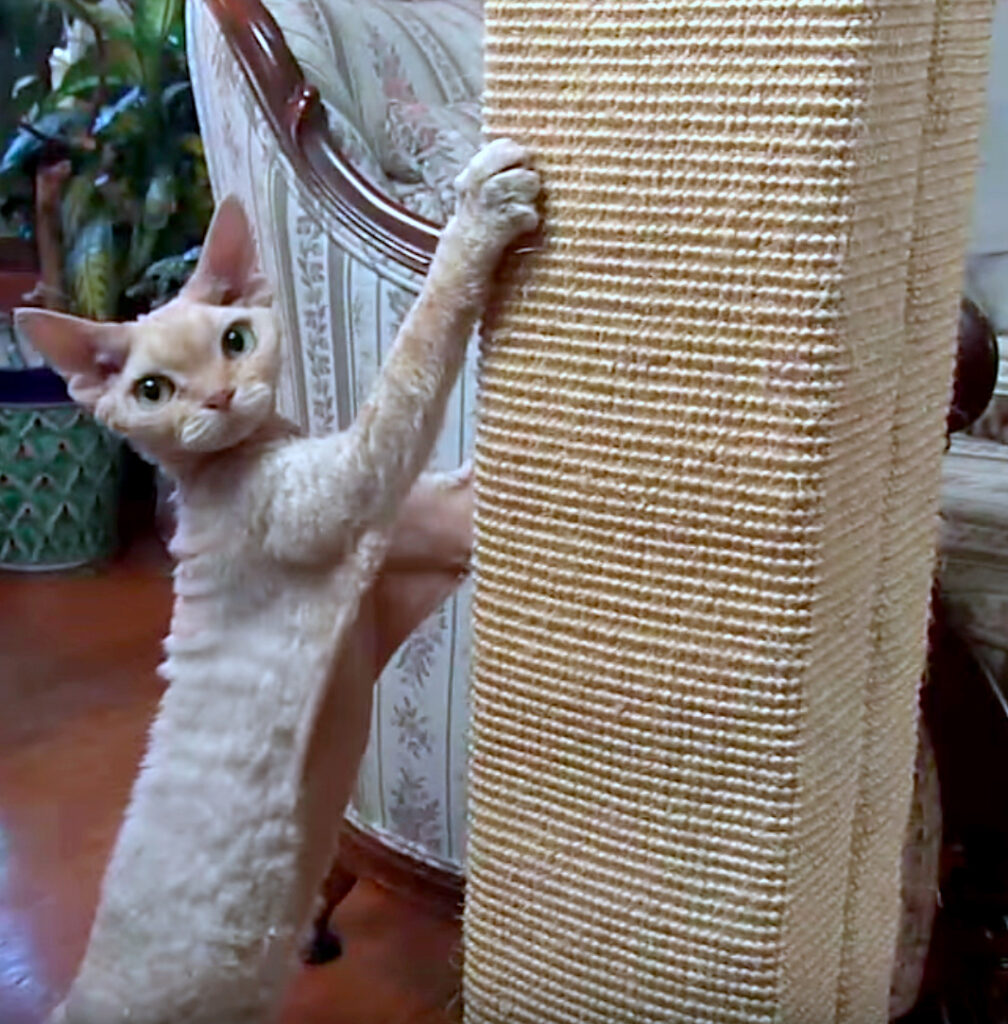
Steve DaleRoxy’s arthritis had worsened. Because of the 18.5-year-old Devon Rex cat’s history of gastrointestinal issues, her veterinarian and owners had few pharmaceutical options for managing her pain.
For clients, seeing a pet in pain is the worst. Cats are especially adept at masking pain, so when they actually show they are in pain, they are really hurting. That’s where we were with Roxy.
Gabapentin had been prescribed, but all it did was increase her catnap time. I consulted an expert. “Let me hold Roxy’s paw and we’ll slowly increase the dosage,” said Robin Downing, DVM, internationally renowned for her knowledge about pain in pets.
Dr. Downing consulted with my Chicago, Illinois-based primary care practitioner Natalie Marks, DVM, who welcomed Dr. Downing’s contribution.
Downing gradually upped the dose of the gabapentin, and her persistent yet measured effort appeared to bring results without an accompanying significant primary side effect of the drug: drowsiness.
“Multimodal is the best approach for osteoarthritis for nearly all cats,” Downing says. To that end, we began to employ a tool called an Assisi Loop, which uses targeted pulsed electromagnetic field technology to treat pain and decrease inflammation. That not only benefited Roxy’s osteoarthritis, but also had the potential to aid her GI issues. In addition, for arthritis I give her injections of Adequan.
That was in 2018 and Roxy clearly benefited from the collaboration between Drs. Downing and Marks and the multimodal approach. However, about a year ago, I noted that Roxy appeared to be struggling a tad more and asked Dr. Marks for further advice.
“The struggle we have as small-animal practitioners is that we only have certain pain medications that are safe and approved for cats as they age, and many are contraindicated for cats with other conditions,” Marks said. “Our goal for our patients is for them to have the best quality of life and to be as pain free as possible every day. The beauty of veterinary medicine today is that we have a variety of integrative therapies which are readily available, and I thought about medical massage therapy. And technology can deliver a way to demonstrate options as never before.”
She suggested I contact Rosemary LoGiudice, DVM, who is boarded in veterinary rehabilitation medicine and practices in Hanover Park, Illinois. She is at least an hour from my home, not to mention this was all happening at the height of the pandemic.
Marks said, “I think this may be the perfect use of telehealth. And I believe massage therapy may help.” Dr. LoGiudice agreed.
LoGiudice noted that ideally she would want to get her hands on Roxy to feel her flexibility and for heat in the joints. But she was able to communicate with Dr. Marks, who has known Roxy most of her life and had recently examined her.
Using my phone, I took video of Roxy moving in her own element from different angles as directed by LoGiudice, who says, “When I can see the dog, cat, or horse moving in a natural way, I can get a good feel for stride and how the joints are moving. Very few dogs and cats are going to show me in the exam room how they move at home.”
LoGiudice and I jumped on a Zoom show and tell call. Dr. LoGiudice held a plush dog in her lap. She showed me exactly what to do, where to do it and how much pressure to exert when offering massage therapy. Old-school written directions could never replicate Dr. LoGiudice demonstrating, and then watching me and directing me, “Move your hand slightly lower.”
I gradually spent more time every night massaging Roxy. Roxy not only didn’t fend off the nightly spa treatment, she began to request it. Even now, a year later, when I stop, she paws at my face demanding more.
That was no surprise to Downing. “If this was causing Roxy pain or discomfort, or Roxy didn’t enjoy it, she still moves well enough to walk away,” she says.
Watching video of Roxy two weeks after the start of the Dale Spa treatment, LoGiudice wasn’t surprised either by the effect of medical massage to slightly but noticeably increase Roxy’s mobility and interest in exploring or moving to whatever room my wife and I are in. Also, LoGiudice is now inspired by the idea of using video and video chat to support clients in a way she hadn’t previously considered.
Downing agreed. “There’s no substitute for being hands-on with our patients, and for office visits, but you can certainly observe more remotely than what is possible in an exam room. And to schedule time for a virtual lesson in medical massage therapy, acupressure techniques, or teaching animals how to stretch are only a few examples.”
From her perspective of having known Roxy for more than half her life, Dr. Marks says, “I absolutely saw a difference in Roxy. What I really loved about this collaboration isn’t only about considering integrative care, it’s about how veterinarians are being creative to help all involved, especially at this time. And right now, we do need to be creative. I hope this specific type of partnership and using technology in the way we did with Roxy becomes a model, sticking around long after the pandemic.”
This article was reviewed/edited by board-certified veterinary behaviorist Dr. Kenneth Martin and/or veterinary technician specialist in behavior Debbie Martin, LVT.
Steve Dale, CABC (certified animal behavior consultant), hosts two national pet radio shows and is on WGN Radio, Chicago. He’s a regular contributor/columnist for many publications, including CATSTER, Veterinary Practice News, and the Journal of the National Association of Veterinary Technicians in America. He’s appeared on dozens of TV shows, including Oprah, many Animal Planet Programs, and National Geographic Explorer. He has contributed to or authored many pet books and veterinary textbooks such as “The Cat: Clinical Medicine and Management” and co-edited Decoding Your Dog, by the American College of Veterinary Behaviorists. He speaks at conferences around the world. www.stevedale.tv.