Blog Archives

Making the Most Out of Your PVQ & EMR

If you have struggled to implement the Fear Free Pre-Visit Questionnaire and Emotional Medical Record, you are not alone! This webinar reviews the updated templates and provide implementation options to make the most out of these integral Fear Free tools.

Taking the Stress Out of Veterinary Care for Clients & Patients Through Technology

Fear, anxiety, and stress should not be barriers for any pet or pet parent when they need care from their veterinary team or other care providers like groomers, walkers, trainers, or pet sitters. Technology is bringing the world as we know it closer and making our day to day lives easier and more convenient. BabelBark has new technology tools that make caring for our beloved pets easier and better. Tanya Cooper, the Director of Veterinary Sales at BabelBark and a Fear Free Certified Professional, explains how the veterinary care team can be unified with the care providers in a pet’s life for better sharing of information between visits and how BabelBark’s tools of remote patient monitoring and enhanced communications can allow you to provide high-quality care that considers the wellbeing of the pet’s body and mind.

Consider the Senses of the Fear Free Exam

Dr. Julie Reck explores the details involved in creating a Fear Free experience. She also discusses pre-appointment opportunities, easy-to-implement facility alterations, and exam room cleaning tips to make sure your patients have the best experience possible. Sponsored by Virox.

Fear Free

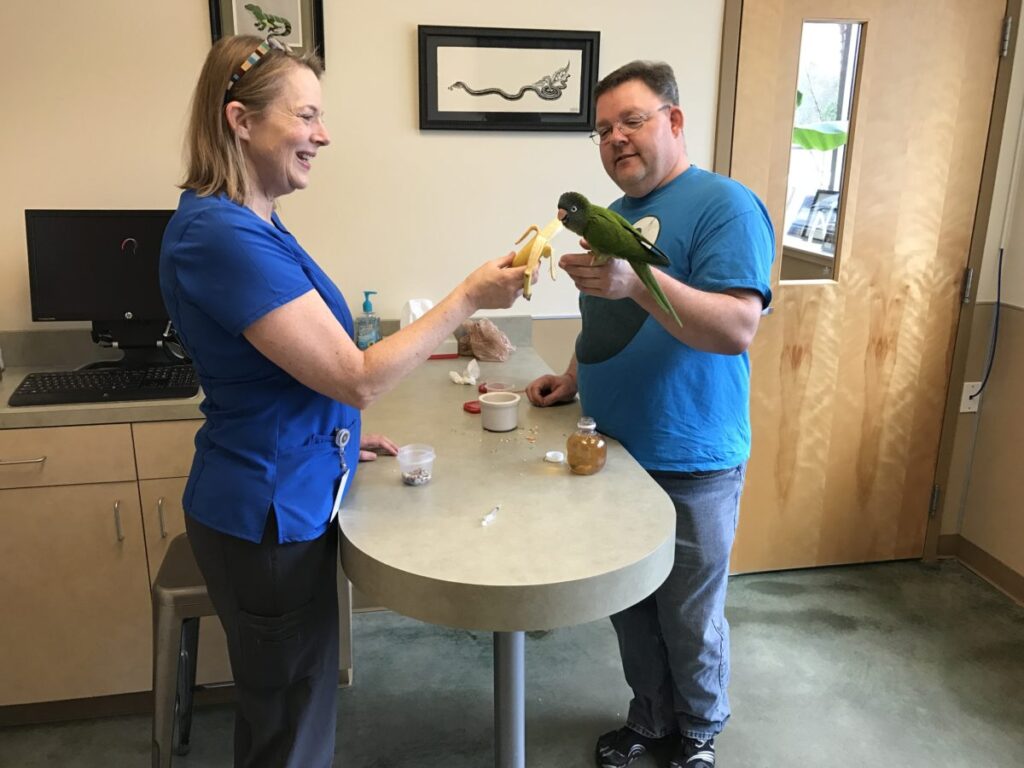
For Dr. Alicia McLaughlin, a key component of Fear Free success with her exotic-animal patients is to encourage clients to prioritize preparation for visits. She educates them on measures they can take at home to increase their pet’s comfort with care and encourages Fear Free fun visits to the hospital. In this way, she lays a calm, positive foundation for animals during care. Pets with mild concerns experience increased comfort and cooperation as trust is established.

In an ideal world, McLaughlin would provide a Fear Free foundation for her patients from the start. When she’s able to do so, Dr. Laughlin starts by accustoming the animal slowly to aspects of care, pairing these experiences with treats. At the same time, she teaches clients proper treat delivery and handling guidelines so they can practice at home and help prepare their pet for future care. Patients with already established FAS at the vet also benefit from conditioning to increase their comfort with handling at the veterinary clinic.

A major benefit for her patients on wellness plans is scheduling at least two Fear Free fun visits a year to positively condition the animal to care. During these practice visits, the animals come in for the equivalent of a treat party, taking treats from members of the staff to increase their tolerance to new people. Nothing stressful or coercive takes place. Instead, the animal is slowly desensitized to aspects of the clinic and the staff may work on developing some tricks to have a foundation for working with the pet during future visits.

The takeaway? Never underestimate the power of having a good time! Fun, positive experiences at home and at the hospital are a powerful force in helping to decrease the fear, anxiety, and stress animals experience during care and increase their happy participation.

This article was reviewed/edited by board-certified veterinary behaviorist Dr. Kenneth Martin and/or veterinary technician specialist in behavior Debbie Martin, LVT.

Akita nose|Akita nose
Until recently, disinfection was considered to be a necessary evil, killing infectious microbes at the cost of exposing pets and people to harsh chemical odors. Disinfectants with unpronounceable names, such as sodium hypochlorite (bleach), quaternary ammonium compounds (QUATs), and potassium peroxymonosulfate, may have been the industry standard for a long time, but just like any other aspect of animal health, we always strive to do better for our pets and create a more positive experience for them in and out of the vet clinic.Accelerated Hydrogen Peroxide® (AHP®) technology had been used extensively in human healthcare to kill some of the toughest pathogens while putting patient safety at the forefront. When Virox Animal Health saw the same need for veterinary care, they knew that AHP would be a perfect fit to help protect people and animals while reducing fear, stress, and anxiety in a veterinary hospital. That led to the creating of Rescue, a disinfectant specifically tailored to protect companion animals and the people who care for them.

While traditional disinfectants have been a trade-off between safety and efficacy, Rescue eliminates the need to make this choice. Rescue’s safety profile, coupled with the lack of harsh chemical odor, realistic contact times, and superior cleaning powers, can help your facility along its journey in becoming Fear Free.

Reducing FAS in the disinfection process doesn’t, however, mean a loss of efficacy. AHP disinfection covers all the bases in a Fear Free approach to animal health. These include:

1. Other chemicals like bleach and QUATs can be harsh. We all know that from experience, but we might not realize that bleach can cause serious skin and eye irritation and respiratory illness1. QUATs, although safer than bleach, have been associated with asthma and can also be irritating to the eyes and skin2. Rescue kills those tough-to-kill pathogens, but its gentle formulation is non-toxic and non-irritating for the safety of your patients, staff, and clients.

2. Bleach and QUATs can often take up to 10 minutes of contact time to kill pathogens, which can really slow down your practice. When was the last time you waited 10 minutes for a disinfectant to do its job before wiping it off? Not to mention the fact that these chemicals may not stay wet on the surface for long enough to meet this contact time. Rescue has realistic contact times, ranging from 30 seconds to 5 minutes. Furthermore, its wetting agents help make sure that it stays wet long enough to disinfect. This means less product used, less waiting between patients, and a more efficient practice overall.

3. Rescue has broad-spectrum bactericidal and viricidal claims against the vast majority of pathogens we encounter in the veterinary setting, so you can be confident that even the toughest pathogens don’t stand a chance. AHP also has none of the odors associated with chemical disinfection, preventing additional stress to our patients during their visit.

4. Cleaning power. Many older disinfectant chemistries have been poor cleaners and were only able to kill pathogens on surfaces that had been pre-cleaned with soap and water. AHP contains powerful detergents, which break down soil and allow it to work in the presence of organic material. This brings cleaning and disinfection into one easy step, saving valuable time and resources along the way. Rescue is also a natural odor eliminator, which may help get rid of some of the smells that can contribute to fear, stress, and anxiety within your clinic.

References

      1. 1. Acute Antimicrobial Pesticide-Related Illnesses Among Workers in Health Care Facilities – California, Louisiana, Michigan, and Texas, 2002-2007. CDC Morbidity and Mortality Weekly Report. May 14, 2010.
        2. Omidbakhsh N, Sattar SA. (2006). Broad-spectrum microbicidal activity, toxicologic assessment, and materials compatibility of a new generation of accelerated hydrogen peroxide-based environmental surface disinfectant. AJIC 34(5), 251-257.

This article is brought to you in collaboration with our friends at Virox.This article is brought to you in collaboration with our friends at Virox/Rescue Disinfectants.
Course Overview

This course will discuss chronic pain, its causes, and its impact on animals’ wellbeing. It will include case studies, as well as a discussion of alternative and complementary treatment.

This course, approved for 1 RACE CE hour, was written by Dr. Michael Petty, DVM, CVPP, CVMA, CCRT, CAAPM.

There are six lessons in this course.

  • Lesson 1: Review of Causes of Chronic Pain
  • Lesson 2: A Brief Discussion of Acute vs. Chronic Pain
  • Lesson 3: Measuring Chronic Pain
  • Lesson 4: Effects of Chronic Pain
  • Lesson 5: Pain Cases
  • Lesson 6: Alternative and Complementary Treatments

This course is endorsed by the International Veterinary Academy of Pain Management.

Course Overview

This course will teach you how to maximize the efficacy of your analgesic protocols. You will learn how and where core and adjunctive medications work along the pain pathway, and the importance of multimodal analgesia.

This course, approved for 1 RACE CE hour, was written by Dr. Tamara Grubb, DVM, PhD, Diplomate ACVAA.

There are four lessons in this course.

  • Lesson 1: Pain and Analgesia: Introduction and Integration into Fear Free
  • Lesson 2: Pain Pathway: Where Do Analgesic Medications Work?
  • Lesson 3: Core Medications for Treatment of Acute Pain
  • Lesson 4: Adjunctive Medications and Techniques for Treating Acute Pain

This course is endorsed by the International Veterinary Academy of Pain Management.

Course Overview

This course provides specific protocols for treating patients experiencing a variety of acute pain conditions, including various surgeries, trauma, dentistry, and more. We will look at several case examples typical of what you might encounter in daily practice.

This course, approved for 1 RACE CE hour, was written by Dr. Tamara Grubb, DVM, PhD, Diplomate ACVAA.

There are three lessons in this course.

  • Lesson 1: Designing Analgesic Protocols: Importance and Strategies
  • Lesson 2: Analgesic Protocols for Elective Soft-Tissue Surgery and Dentistry
  • Lesson 3: Analgesic Protocols for Urgent Soft Tissue and Orthopedic Surgery, Trauma and Medical Conditions

This course is endorsed by the International Veterinary Academy of Pain Management.

Course Overview

This course empowers you to begin or increase your pain management business by offering suggested improvements to both the culture and physical layout of your clinic. It will discuss skills you might want to consider learning, how to effectively communicate with clients, and ways to acquire new pain patients.

This course, approved for 1 RACE CE hour, was written by Dr. Michael Petty, DVM, CVPP, CVMA, CCRT, CAAPM.

This course consists of five lessons.

  • Lesson 1: Acquiring a “Pain Attitude”
  • Lesson 2: The Clinic
  • Lesson 3: Skill Sets to Consider
  • Lesson 4: Treatment Goals and Outcome Measures
  • Lesson 5: Acquiring Patients

This course is endorsed by the International Veterinary Academy of Pain Management.

International Veterinary Academy of Pain Management

How Cats Say Ouch: Feline Pain Scoring & Treatment Made Easy

Cats don’t speak our language and cannot tell us when they are painful. It is up to us to learn how they express pain. Pain is an unpleasant emotional experience and we can gain insight into how our feline patients feel by looking for changes in behavior and facial expressions. Because a picture is worth a thousand words, this webinar will use images and videos to demonstrate how cats with acute pain behave. A scoring system that is suitable for clinical use will be discussed.