By David Hustead, DVM, M.P.H.Balancing the importance of necessary care with the emotional care of pets in the Fear Free clinic can be challenging. There are countless situations, from the dog hit by a car to an outbreak or emerging disease, where the timeliness of medical care seems to outweigh the need to take things slowly and minimize fear, anxiety, and stress (FAS) in the pet.
Consider Lyme disease. While we as well as our clients may be reluctant to add another injection to a dog’s prevention program, new information about Lyme disease’s risks, transmission, and prevalence provides a compelling reason to reconsider that reluctance. What information do we need to balance those risks with the benefit of prevention?
The risk of Lyme disease is increasing, changing, and spreading.
It’s important to understand that what we know about the risk of Lyme disease may be outdated. There is increasing evidence the risks of Lyme disease continue to expand for both people and dogs in the U.S. The CDC reports that vector-borne disease has more than doubled from 2004 to 2016. Of this, human Lyme disease accounts for 82 percent. Additionally, during this period, nine new vector-borne diseases were first observed in the U.S.1
The risk to dogs is also increasing in areas not normally considered at-risk for Lyme disease. According to the Companion Animal Parasite Council (CAPC), while the Northeastern states, upper Midwest, and Pacific Northwest still have the majority of canine Lyme cases, dogs exposed to Borrelia burgdorferi continue to be discovered outside of those areas. Their biggest areas of concern for increases in canine Lyme disease in 2019 include eastern Pennsylvania, eastern Ohio and Kentucky, West Virginia, western Virginia and North Carolina. Northwestern Minnesota and some areas in Indiana are also expected to see higher than average seroprevalence in 2019.
Other longstanding beliefs about transmission may now be outdated. For instance, many of us think the risk of disease transmission from exposure to the Lyme disease tick vector I. scapularis is greatest in the spring, but the CDC says the risk of exposure to these ticks is really greatest throughout spring, summer, and fall. In addition, adult ticks can be active at any time of the year when the temperature is above freezing.3
Consider the critical role of the veterinarian.
It’s easy to see that Lyme disease prevention is a critical issue to raise with clients, and one that requires the expertise of a veterinarian. There is no replacing the combination of client education about the disease and exposure risk reduction and proper vector control, including systemic or topical insecticides and vaccination. But some Fear Free veterinarians are hesitant to add a Lyme vaccine to their protocols, thinking it means yet another needle stick and more vaccine volume administered. The good news for Fear Free Certified practitioners is that, for the majority of your patients, you can add a Lyme vaccine without adding needle sticks or more volume.
For example, dogs needing only a Lyme vaccine can receive Elanco’s TruCan™ Ultra Lyme. TruCan™ Ultra Lyme has only half the volume of most vaccines. While half the volume may not seem like a big deal to you, clients interested in Fear Free techniques will appreciate a reduced-volume vaccine. Let them know you have a Lyme vaccine that offers the same protection but with half the dose volume.
Elanco has options for dogs who need distemper and parvo protection as well as those at risk of Leptospiroris, another disease with changing risk. TruCan™ Lyme L-4 + TruCan™ DAPPi+Lyme L-4, and TruCan™ DAPPi+Lyme CL-4 all provide protection with one needle stick and the same vaccine volume as a 4-way Lepto-only vaccine.
TruCan, Elanco, and the diagonal bar logo are trademarks of Elanco or its affiliates.
©2023 Elanco or its affiliates. PM-US-23-0569
References
-
- 1 Rosenberg, R. Et al. Vital Signs: Trends in Reported Vector Borne Disease Cases US and Territories 2004-2016. MMR Weekly 67 (17) May 4 2018.
2 Yabsley, M. Despite the Availability of Preventative Measures—the Risk of Vector-Borne Disease Remains High in 2019. CAPC website accessed on 16 May 2019 at https://capcvet.org/articles/despite-the-availability-of-preventative-measures-the-risk-of-vector-borne-disease-remains-high./
- 3 CDC accessed Geographic distribution of ticks that bite humans. Accessed at:https://www.cdc.gov/ticks/geographic_distribution.html
This article is brought to you in collaboration with our friends at Elanco.

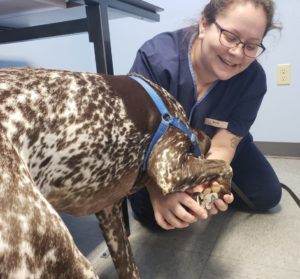 Eva, a spunky and energetic German Shorthaired Pointer, is a staff favorite for more than just her adorable, tongue-hanging-out smile, but there’s one thing Eva never liked: nail trims! Prior to the hospital’s transition to Fear Free in early 2017, it was a challenge to trim Eva’s nails, requiring three or four technicians to assist with restraint, plus a muzzle and calming cap. We started implementing Fear Free teachings right away with all of our patients, but one staff member has really gone above and beyond her commitment to Fear Free training to help Eva overcome her fear. Kayla McNeely volunteered to assist with Eva’s nail trims, and she can now perform Eva’s nail trims solo, standing, with minimal assistance from Eva’s mom, Sheila, who says, “Kayla’s patience and kindness have worked wonders with my girl.” Our hospital requires all staff members to go through Fear Free training to help ensure that all of our clients, patients, and staff have a pleasant experience during their exams. We have seen a tremendous difference in many patients at our hospital since our transition to Fear Free, but Kayla and Eva’s journey together is by far our most successful Fear Free adventure to date.
 One-year-old Ruba disliked having her feet touched and her nails trimmed. We trialed trazodone for six months for all nail trim visits. It started to work well, and we discovered she preferred sitting in Dr. DaCosta’s lap. Ruba now comes in for frequent nail trims with minimal restraint and no trazodone needed. We are so proud of her progress and the team’s dedication to using Fear Free techniques.
 Mikey Bear used to require sedation before blood draws, but I showed his amazing humans how to hold his back leg for a blood draw and wet the vein while giving him treats to get him used to the feeling. They worked on this for a month, and when they came back, the blood draw was a snap. I discovered they had added another step to the homework and were poking the vein with a toothpick at home.
 When I worked at a veterinary emergency clinic, one of the dogs in the hospital was so fearful that he would begin to thrash and hit his head in the ground if anyone touched his leash. I sat in front of his cage with my back to him so he could become accustomed to my scent. Then I started placing treats in his cage and turning my back again. Eventually, I opened the door and put a leash on him and sat next to the door. When he came out of the cage on his own, I was able to walk him with no tension on the leash. Gaining an animal’s trust is a beautiful thing.