Blog Archives

Course Overview

This course will teach you how to maximize the efficacy of your analgesic protocols. You will learn how and where core and adjunctive medications work along the pain pathway, and the importance of multimodal analgesia.

This course, approved for 1 RACE CE hour, was written by Dr. Tamara Grubb, DVM, PhD, Diplomate ACVAA.

There are four lessons in this course.

  • Lesson 1: Pain and Analgesia: Introduction and Integration into Fear Free
  • Lesson 2: Pain Pathway: Where Do Analgesic Medications Work?
  • Lesson 3: Core Medications for Treatment of Acute Pain
  • Lesson 4: Adjunctive Medications and Techniques for Treating Acute Pain

This course is endorsed by the International Veterinary Academy of Pain Management.

Course Overview

This course provides specific protocols for treating patients experiencing a variety of acute pain conditions, including various surgeries, trauma, dentistry, and more. We will look at several case examples typical of what you might encounter in daily practice.

This course, approved for 1 RACE CE hour, was written by Dr. Tamara Grubb, DVM, PhD, Diplomate ACVAA.

There are three lessons in this course.

  • Lesson 1: Designing Analgesic Protocols: Importance and Strategies
  • Lesson 2: Analgesic Protocols for Elective Soft-Tissue Surgery and Dentistry
  • Lesson 3: Analgesic Protocols for Urgent Soft Tissue and Orthopedic Surgery, Trauma and Medical Conditions

This course is endorsed by the International Veterinary Academy of Pain Management.
Course Overview

This course empowers you to begin or increase your pain management business by offering suggested improvements to both the culture and physical layout of your clinic. It will discuss skills you might want to consider learning, how to effectively communicate with clients, and ways to acquire new pain patients.

This course, approved for 1 RACE CE hour, was written by Dr. Michael Petty, DVM, CVPP, CVMA, CCRT, CAAPM.

This course consists of five lessons.

  • Lesson 1: Acquiring a “Pain Attitude”
  • Lesson 2: The Clinic
  • Lesson 3: Skill Sets to Consider
  • Lesson 4: Treatment Goals and Outcome Measures
  • Lesson 5: Acquiring Patients

This course is endorsed by the International Veterinary Academy of Pain Management.
International Veterinary Academy of Pain Management

Reducing Dog Bites by Understanding the Secret Language of Dogs

Dog bites and injury to veterinarians, staff, and pet professionals are often considered an occupational hazard. Many of the situations that may result in a dog bite can be prevented by understanding the language and emotions of dogs.

Celebrity dog trainer and author Victoria Stilwell discusses dog body language, behavior, and how to safely interact with dogs as part of National Dog Bite Prevention Week.

Stilwell is joined by State Farm Brand Specialist Heather Paul, who discusses dog bite insurance claims data for 2018, dog bite liability, and how the insurance company is working to reduce dog-related injuries as a member of the Dog Bite Prevention Coalition.

Sponsored by State Farm

|

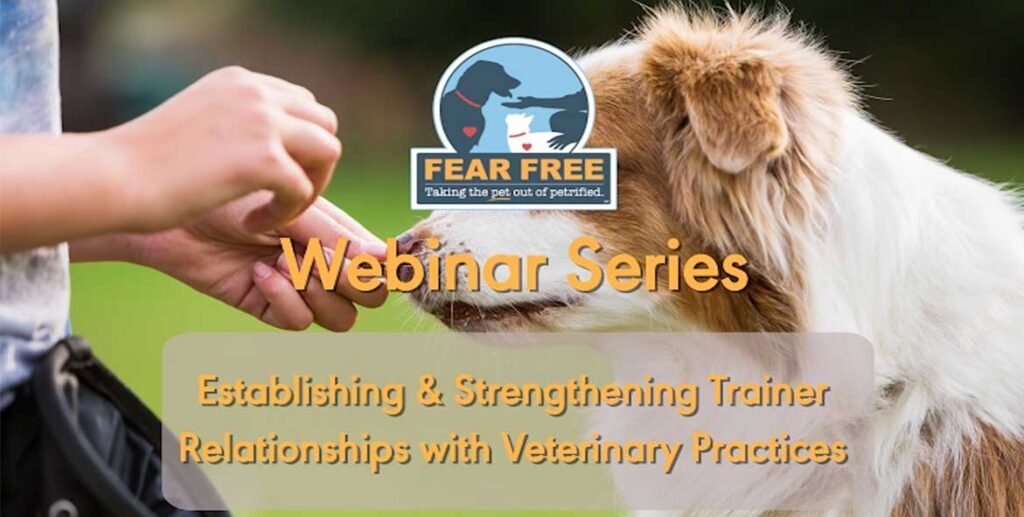
Establishing & Strengthening Trainer Relationships With Veterinary Practices

Establishing a relationship with a trainer is a great way to set your current and future clients up for success, increase revenues, and help to eliminate pet relinquishment and euthanasia. While it may be simple to find a trainer in your area, finding one who fits with your style, needs, and scheduling can become difficult. Dr. Marty Becker, founder of Fear Free, and Mikkel Becker, Lead Animal Trainer for Fear Free, team up to walk you through the process of finding a trainer who fits your practice needs.

Reducing Fear in Veterinary Dentistry for Pets & Pet Owners

In this webinar, Heidi Lobprise, DVM, Diplomate AVDC, will show you how to apply the core concepts of Fear Free to make sure pets get the dental care they need. Sponsored by Zoetis.

Course Overview

In this module, we will review the signs and risk factors associated with infectious diseases in dogs and cats. We will cover how to minimize disease risk when training pets as well as how to properly disinfect and manage the training environment.

This module has been approved for 1.5 RACE CEU and 1 CEU from CCPDT, IAABC and KPA.

The one-hour course is only for trainers with renewal credits and costs 1 credit.

Lesson One: Common infectious diseases of dogs and cats

After completing this lesson, you will be able to:

  • Recognize possible signs for various types of infectious diseases in dogs and cats
  • List common modes of transmission

Lesson Two: Minimizing disease risk when training

At the end of this lesson, you will be able to:

  • Identify ways of minimizing the spread of disease in the training setting
  • Recognize the components of a clean environment and how to achieve it
  • Identify when to liaise with veterinary professionals over preventative health concerns

Communicating Fear Free to Pet Owners: Why It Matters

If you’re not sure what “Clients are made aware of Fear Free tools and techniques” means or not sure why it matters, then join Practice Certification Manager, Dr. Rachel Abrams for a down-n-dirty discussion of what this looks like and why it made its way into the Practice Certification standards.

Every pet’s final visit to the veterinarian should be as Fear Free as the first. In this one-hour module, you will learn how to utilize pre-planning to create a meaningful and low-stress experience for pet and owner. It will cover uses of pre-euthanasia sedation and anesthesia to give the pet a gentle euthanasia and the benefits and downsides of different euthanasia techniques. Also explored will be the dangers of compassion fatigue and how to prevent or alleviate it.

This course was written by Kathleen Cooney, DVM, MS, CHPV, founder of the Companion Animal Euthanasia Training Academy.