
Practicing Curbside Safety
Length: 23 mins
Practicing Curbside Safety
Length: 23 mins

DIY Enrichment: Keeping Dogs from Climbing the Walls
Your clients may find themselves suddenly at home all day with their dogs, whose routine has been disrupted. How can you maintain human and canine sanity in the household and enrich dogs’ minds and bodies during this time? Fear Free Head Trainer Mikkel Becker and Education Manager Lori Chamberland offer several tips and tricks to keep canines calm and content.
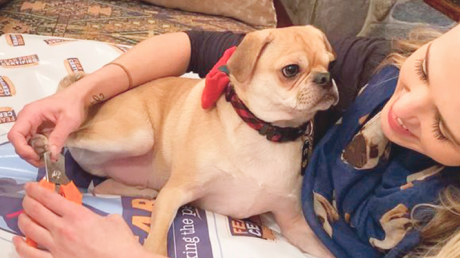
For humans, nail trims are mundane experiences. But for pets, nail care can cause stress by imposing on their personal space, restricting their freedom to move, and sometimes causing discomfort or even pain.
Successful nail care encompasses more than just being able to physically maintain nails. True success is found in gaining calm participation and trust from the animals you’re working with.
This course will teach you to:
This one-hour course is open to all professionals who are signed up for a Fear Free certification program and is approved for 1 RACE CE hour and one hour of CEUs from CCPDT, IAABC and KPA
This course consists of four lessons:

Pharmacologic Options for Veterinary Visit Anxiety: An Evidenced-Based Review
In this webinar, Julia Albright, DVM, DACVB, covers the various pharmacological treatments used for veterinary visit anxiety and reviews the evidence behind each of these options.
Dr. Albright will:
1. Discuss the need to address veterinary visit anxiety
2. Review the evidence behind the commonly used pharmacological treatment options
3. Present protocols for reducing veterinary visit anxiety
Sponsored by Zoetis Petcare.

Six Client Tips for Puppy Socialization
Veterinarians often recommend that new puppy owners actively socialize their puppy during the sensitive socialization period. Well-intentioned pet parents may take that general guidance and inadvertently create, not prevent, problems. In this webinar, Jacqueline Neilson, DVM, DACVB, demonstrates how sharing six socialization principles will allow veterinary staff to help owners make wise choices for socialization that promote the pups’ emotional and physical wellbeing.
Sponsored by Elanco.

Sight Serenity: Considerations for a Tranquil Visual Experience
In this final webinar of a three-part series, Jacqueline Neilson, DVM, DACVB, reviews how cats and dogs have different visual experiences than humans do in the same environment. She explains why ignoring those differences can often trigger fear, anxiety, and stress in our patient population. By understanding their perspective, we can provide a more tranquil visual experience for our patients during veterinary visits and thereby improve their overall emotional experience.
Sponsored by Elanco.

Canine Allergic Dermatitis: Creating a Higher Quality of Life for Everyone Involved
What better way to decrease stress than by increasing quality of life? In this webinar, Dana Liska, DVM, DACVD, expands the discussion surrounding canine allergic dermatitis and the stress chronic disease causes for dogs and for owners and veterinarians caring for them. She looks at data supporting an improved quality of life for everyone involved in the veterinarian-client-patient relationship.
Sponsored by Zoetis Petcare.
Canine Allergic Dermatitis: Creating a Higher Quality of Life for Everyone Involved
What better way to decrease stress than by increasing quality of life? In this webinar, Dana Liska, DVM, DACVD, expands the discussion surrounding canine allergic dermatitis and the stress chronic disease causes for dogs and for owners and veterinarians caring for them. She looks at data supporting an improved quality of life for everyone involved in the veterinarian-client-patient relationship.
Sponsored by Zoetis Petcare.

Kitten Socialization: Do Kittens Need Kindergarten?
Getting kittens off to a good start lays the foundation for an adulthood free of fear, anxiety, and stress. But just what does a “good start” mean? What exactly is kitten socialization? What role does genetics play, and what should we be doing for our kitten patients? In this webinar, Dr. Krista Sirois answers these questions and discuss the benefits of establishing a Kitty Kindergarten program in your clinic for your patients, pet parents, and your team.
Although animal trainers can typically recognize the external signs of an animal in serious pain or distress, they are not necessarily aware of what’s going on inside the animal’s body and how it can affect their behavior. This module will discuss common conditions as well as take an in-depth look at pain management strategies and the effects of pain and stress on an animal.
This module has been approved for 1 RACE CEU and 1 CEU from CCPDT, IAABC and KPA.
This module is divided into three lessons.