
Fireworks and other loud noises are a common cause of fear and anxiety in dogs. A recent study provides some insight into the progression of this fear over time and provides evidence of the effectiveness of training and the importance of preventive training before fear develops.
“Not a one-way road—Severity, progression and prevention of firework fears in dogs” by Stefanie Riemer, published in PLoS ONE in September, analyzes the results of an online survey of dog owners who answered questions about the severity and development of fear, demographic factors, other behavior issues, and efforts made to address the problem. Out of 1,225 responses analyzed, 52 percent of dogs were affected by this fear to some extent. The severity of the fear was assigned a “Welfare-impaired score” based on the question “Please rate your level of agreement with the following statement: The overall welfare of my dog is strongly compromised by fireworks,” answered on a five-point scale from “disagree strongly” to “agree strongly.”
This fear often showed up early: in 45 percent of cases, at under one year. However, it also developed later, although in almost all cases before six years of age. Responses also showed that this fear can change considerably over time, both for the worse and the better, even if nothing is done to address it. Great improvement was reported for 10 percent of dogs and almost one-third of dogs tended to improve; just under one-fifth reported the fear had gotten worse, and 8.5 percent, much worse. One-third of dogs were reported to have shown no change.
Improvement was not always due to training or medication. For the subset of dogs whose owners had not sought advice for the problem and were not professionals such as trainers or veterinarians themselves, there was slightly less improvement, but also less deterioration – about half reported no change.
Owners of 530 dogs (43.3 percent) reported doing some training to prevent or treat firework fears. Preventive training was most effective: the median Welfare-Impaired score was 1 (lowest possible) in dogs trained in puppyhood and 2 in dogs trained as adults, compared to a median score of 4 for dogs with no training before the onset of fear. Statistical testing showed no significant difference between preventive training as a puppy and as an adult. However, there was a significant difference between having preventive training and having training only after fears had developed.
Training after fears developed was nevertheless shown to be worth doing, as those dogs were significantly more likely to show improvement. The effect of training was independent of whether the dog was treated with medication, as there was no difference in the proportion of dogs in groups that did and did not receive training.
The importance of some other factors investigated, including potential correlations with health problems and other behavior problems, were unclear, but one finding was that certain breed groups were more likely to suffer from this fear, including herding dogs. At the same time, one of the two most significant risk factors was being a mixed-breed. These results may seem contradictory, but they suggest that both genetics and upbringing are relevant. “Mixed-breed dogs originated from shelters or from the street more often so, on average, mixed-breed dogs probably had less positive socialization experiences,” says author Stefanie Riemer.
The other significant risk factor was older age. Again, at first glance this might seem to contradict the finding that fears develop at an earlier age, but fears are not static with aging. “While in over 70 percent, firework fear was noticeable before the age of two years, firework fear often does not disappear on its own, even though it may be improved, as I found in my study,” says Riemer. “Therefore, the longer the dog has been in the world, the more likely it is to have developed a fear of firework at some point in its life. Moreover, often the fear gets worse over time, which may lead to higher average fear scores in older dogs.”
The high number of owners who sought help for the problem (45 percent overall and 70 percent of owners of fearful dogs) was large compared with what has been found in other research. Riemer says, “I am sure the owners in the sample were above-average motivated to work with their dog. I don’t think this invalidates the finding regarding the effectiveness of training but of course a higher level of experience might make them more effective trainers.”
The results suggest that because preventive training is most effective, it’s a good idea to do some training with dogs who are not showing fear, but even after fear develops, it’s not too late. “This study shows that if your dog is afraid of fireworks or other loud noises, it’s important to do something about it, because it can make a difference,” says Zazie Todd, PhD, author of the blog Companion Animal Psychology. “There are several ways to help dogs who are afraid of fireworks, including gradual desensitization and counter-conditioning using a recording of the sound.”
Todd notes that Riemer’s recently published followup study on the effectiveness of various training methods found that owners reported that both ad-hoc counterconditioning and relaxation training helped.
She also observes that while some dogs’ response to noise is too obvious to miss, owners may need to be educated to notice it in others: “Other research has shown that sometimes people miss the signs their dog is afraid of fireworks, so it’s important to be aware and look for them.”
This article was reviewed/edited by board-certified veterinary behaviorist Dr. Kenneth Martin and/or veterinary technician specialist in behavior Debbie Martin, LVT.
Linda Lombardi writes about the animals that share our planet and our homes for magazines including The Bark, websites including National Geographic and Mongabay.com, and for the Associated Press. Her most recent book, co-authored with Deirdre Franklin, is The Pit Bull Life: A Dog Lover’s Companion.

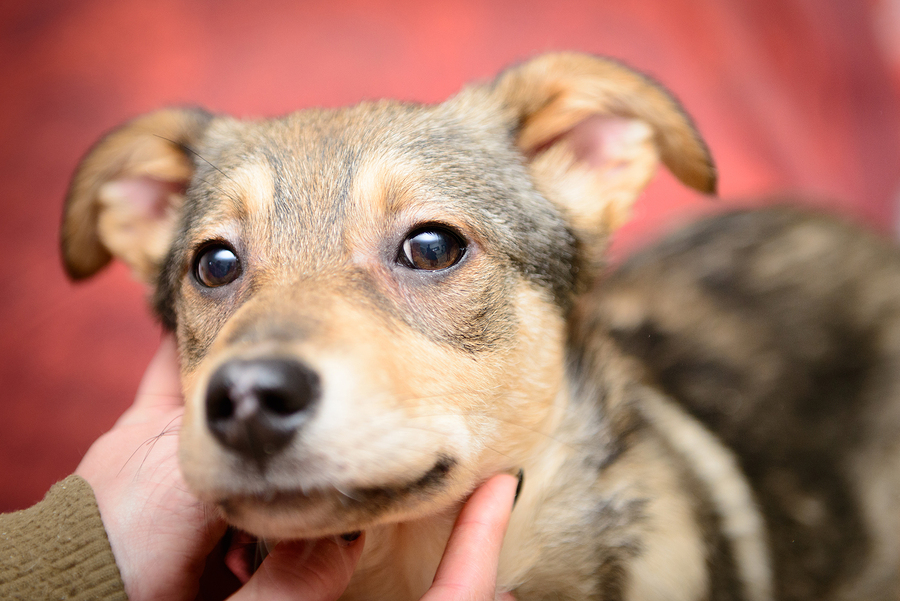
 year I’ve raised a pup following Summit’s training guidelines based on positive reinforcement and what puppies can handle at each developmental stage. Each pup explores the world in tiny increments based on what they tell me through body language about how the new environment feels to them. Sometimes we don’t even get out of the car if the pup seems to be hesitant. If they’re not ready for a new place, we go somewhere they have already been to build confidence. Each pup is born with unique strengths and levels of confidence. The big and bold ones move through environments more quickly than timid pups. My current pup, Jazz, came to me at 11 months of age. She was timid about change, so we moved slowly and calmly. We joined a scent work class, which allows the dogs to move freely at their own pace. This built her confidence quickly and now she rocks in almost any setting. Watching what your pet tells you through body language (relaxed, happy, withdrawn, cowering) is key to a truly Fear Free companion.
 store when she was three months old. Early veterinary visits had caused her to become fearful. Medication didn’t help and she required heavy restraint. Her pet parents called our clinic about taking her on as it had been suggested that she might prefer a female veterinarian.
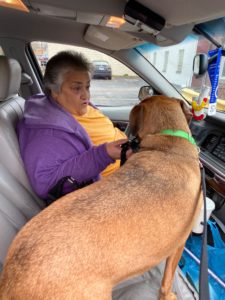 Canasta is fearful of strangers and handling, which makes veterinary visits difficult for both Canasta and her caregiver. I recently started working with Canasta on basket muzzle training and being more comfortable with strangers, but she was in need of bloodwork immediately. Her veterinarian prescribed pre-visit pharmaceuticals, and I worked with the technician to create a handling plan and came to the visit to assist. When Canasta walked in wearing her basket muzzle, I used gentle control to restrain her while the technician drew blood. Canasta even took a treat from the technician when we were done, which is a huge win! Her mother was crying, knowing her dog did so well, and I will continue to work on cooperative care with the caregiver and Canasta.

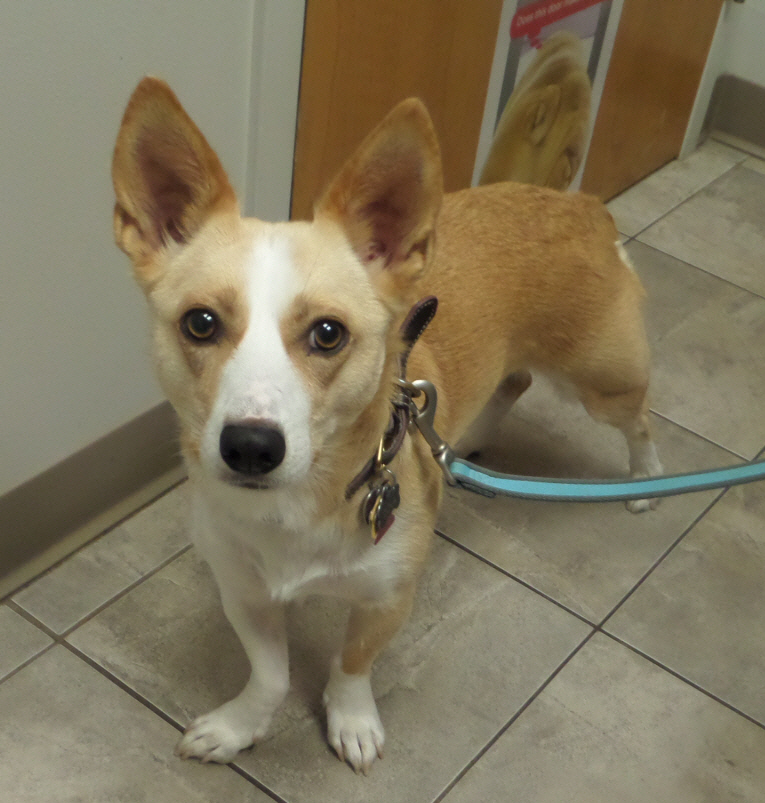
 veterinarian, Dianicia Kirton, DVM, whose Hopkinton, Massachusetts, practice is Fear Free certified, has been recommending that Sushi get her teeth cleaned but my sister was hesitant. The veterinarian addressed each of her concerns until eventually she was ready to move forward. A few weeks later, Sushi’s mom brought her in for the teeth cleaning, although she was still nervous and reluctant. The veterinarian and staff were very calming and worked on Sushi quickly. Everything went well, and Sushi was her normal, happy self afterward. My sister told the vet that she felt like she had been “Fear Freed,” and Dr. Kirton responded, “Yes, it’s as much for the people as it is for the animals.” My sister was happy with the whole experience and thankful to have found a practice that uses these methods!
 Pennie, a 7-year-old 78-pound Chesapeake Bay Retriever, had never had a full veterinary exam after her puppy vaccines because she bared her teeth and growled at veterinary team members at every clinic she was taken to. When she was brought to us, we implemented several Fear Free strategies, spending 45 minutes building her trust both outside the clinic and in the exam room. We were able to get her to stand on the lift table and receive vaccinations without being muzzled. On her third visit, we were able to lift her lips and examine her teeth. Now she boards with us routinely and is a big part of our veterinary practice family. Implementing these Fear Free tools has changed Pennie’s life and her owner is now able to better understand and relate to her dog, making it much safer to take her for walks and be groomed.
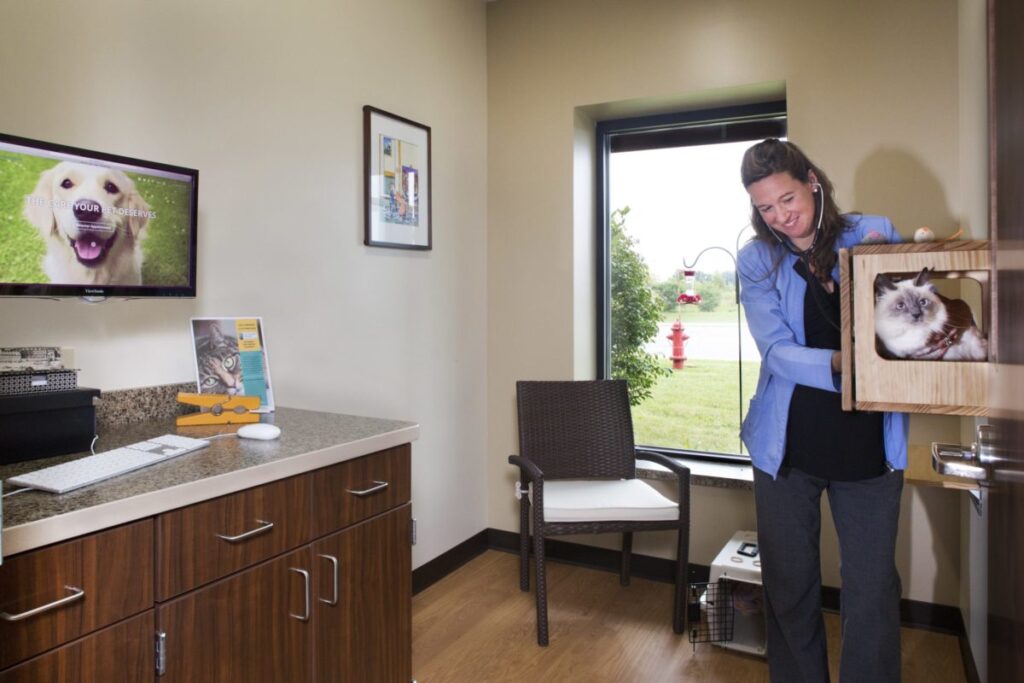
 We love our Fear Free veterinary hospital. At TLC, there are separate areas for cats and dogs. We took our two cats in last week, and the exam room was comfortable, with shelves for the cats to explore. A board listed the names of the technician and veterinarian who would be seeing the cats, so we knew who would be treating them. The technician who went over the intake information was sweet and tender with Lucy and Lilu. An email ahead of time alerted us that a new veterinarian would be seeing the cats. She was calm and handled the cats gently. Both cats were calm throughout the visit—although Lucy didn’t much like having her teeth examined—and when they got home they came out of their carriers calmly and went about their day. Lilu was her regular self and didn’t hide away as she has on some prior visits to other clinics. The clinic called the next day to see how the cats reacted to their vaccines and visit. We feel we have found our new clinic!
 reactive. During her first appointment she was quite nervous, but with the help of some peanut butter as a distraction she allowed us to pet her. We decided that that was a win and that Zola would benefit from coming back another time after having gabapentin to help calm her. At her next visit, Zola was visibly more relaxed, and we had a Kong full of peanut butter ready for her. Knowing that Zola did better with minimal restraint we kept her focused on the Kong and were able to do a full exam, vaccinations and a blood draw. Zola’s owners had never seen her so relaxed at the vet and she has since come back willing and happy to see us.