Mild cases of noise reactivity in dogs are often not considered problematic enough to treat. However, in a recently published study, even mild noise sensitivity was associated with lower performance on a puzzle test. This suggests that these dogs have impaired functioning even when noise is not present and that more screening and treatment is called for.
Researchers analyzed three types of data collected as part of a larger study of pet dogs. Dogs were evaluated for noise sensitivity via a questionnaire and a score was calculated based on the number of categories of noise that caused a reaction, the behaviors indicative of fear and anxiety that were exhibited, and the intensity of the reaction. Dogs were also tested for noise sensitivity using a custom noise recording that was played starting at a low volume and gradually turned up.
Learning Affected
Dogs were then evaluated for their performance on a puzzle-box test. The clear plastic puzzle box had nine holes on top and one at the end. A tennis ball was rolled into the box and dogs were given five minutes to try to get it out. If they succeeded in under two minutes, they repeated the test, up to three times in total. While attempting the puzzle, the dogs were wearing a device that recorded their movements.
Comparing data from 17 noise-reactive dogs and 11 non-noise-reactive dogs, those who were sensitive to noise performed worse on the puzzle box. Movement recordings also showed a difference, says lead author Karen Overall. “The ones who did the best moved very efficiently and very quickly. Their movements counted. The dogs who reacted to noise and who did more poorly, or could not solve the test, had very jagged and inconsistent movements.”
These dogs did not seem to be able to move in a deliberate, coordinated manner in response to how the ball acted when they tried to manipulate it. “They have to correct their behavior according to the movement of the object that they see,” she says. “These dogs couldn’t do that.”
Some of the noise-reactive dogs did not perform well enough to repeat the test, but when they did, they also differed. “Unlike the dogs who didn’t react to noise, the dogs who did react to noise couldn’t learn from their previous tests and didn’t improve their scores,” she says.
Sound Effects
While it’s understood that being in a state of anxiety interferes with functioning, the results show that being noise-sensitive has more wide-reaching effects. Even in a relatively low-stress situation where noise was not an issue, these dogs showed impaired performance: “The room is quiet, they’re getting food treats, their people are there, but they still can’t learn.”
Overall says it’s important to understand that this was not a clinical population of noise-fearful dogs. “Largely they were fairly mild, and yet they still couldn’t do this,” she says.
They also were not generally fearful, which was screened for. “The dog who was the worst in the test, the only dog for whom we had to turn off the recording, she was the meet-and-greet queen of the universe,” she says. “She was charming and social and lovely until you played noise, and then she was broken.”
“Moderate to severe noise sensitivity in dogs is a well-known behavior problem. A connection between separation anxiety and noise sensitivity has also been recognized before. What has not been appreciated until Dr. Overall and her colleagues published this research is the impact that noise sensitivity has on the general anxiety levels and learning ability of affected dogs,” says Bonnie Beaver, DVM, DACVB, of Texas A&M University. “These changes exist even in mildly affected dogs, impacting their daily lives with ever-present stress.”
Screening and Treatment
Overall concludes that even mild fear of noises needs to be aggressively screened for and treated.
“I think we don’t realize how much these dogs are suffering,” she says. “This shows that you’ve got dogs who are afraid of noises and it’s impairing other parts of their life that people haven’t looked at. It’s impairing their ability to get information from the environment and their ability to problem solve.” This has a broad impact on their social functioning and their fundamental ability to enjoy life.
Overall now believes dogs should be screened for noise reactivity on every vet visit and that it’s particularly critical to screen young dogs. “I want vets to see dogs three or four times a year in the first two years of life, when their brains are developing, and subject them to standard screening tests,” she says.
This is important because early diagnosis and treatment can make a huge difference. “The rodent literature has shown that if you’re anxious and fearful and from a genetically fearful line, and they treat you as a baby, your brain develops normally,” she says. “And what wouldn’t we give for that? There’s too much suffering; I want these dogs to have joy.”
This article was reviewed/edited by board-certified veterinary behaviorist Dr. Kenneth Martin and/or veterinary technician specialist in behavior Debbie Martin, LVT.
Linda Lombardi writes about the animals that share our planet and our homes for magazines including The Bark, websites including National Geographic and Mongabay.com, and for the Associated Press. Her most recent book, co-authored with Deirdre Franklin, is The Pit Bull Life: A Dog Lover’s Companion.
 I’m a Fear Free trainer, but there are no veterinarians I trust in my town, so I travel an hour to TLC Pet Hospital in Albuquerque and have had the most amazing experiences, thanks to the patience, kindness, and knowledge of the staff there. My dogs are fearful, and one is especially vet-phobic after traumatic experiences elsewhere. Some of his past vet visits have been so anxiety-inducing for him that I also end up in tears. But with gabapentin on board and the Fear Free approach from Dr. Long and Sam the veterinary assistant, my dog was wagging, approaching them, licking their faces, asking for pets, and acting like the brave and social dog he is at home. All of us in the room were floored by the change! At the next checkup he took food from them, did some chin-rest stationing with them, targeted their hands, and showed off his tricks. My own fear, anxiety, and stress levels have been drastically reduced thanks to their dedication to Fear Free vet visits. I’ll continue to do the two-hour round trip because I love having a veterinarian who listens to me and treats me like an adult, and because my dogs’ mental and emotional health is taken as seriously as their physical health at TLC. I am so thankful for their care and commitment to Fear Free vet visits and their overall friendly clinic.
 I work closely with the veterinary hospitals in my town. The team at Appalachian New River Veterinary Associates (ANRVA) referred Toby to me. Toby was terrified at the veterinary hospital and could not take food, even as a young puppy. I established a rapport with Toby away from the veterinary hospital. I did this using special food and something else Toby loved – play! Toby learned foundation behaviors that gave some predictability to our sessions and helped him feel safe.
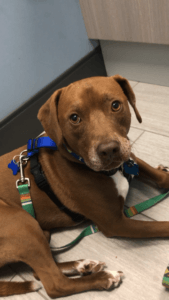 Maxwell is a 7-year-old retriever/hound mix who was rescued from a hoarding situation with more than 100 dogs. Maxwell was the most fearful of them. We don’t know a lot about Maxwell’s day-to-day life while on the hoarder’s property, but volunteers reported that he was kept in a small shed without much social interaction.
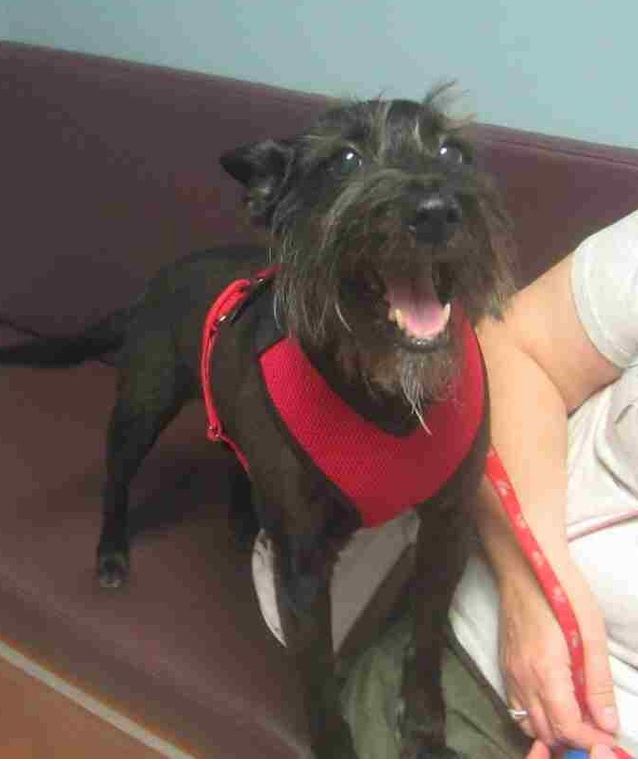
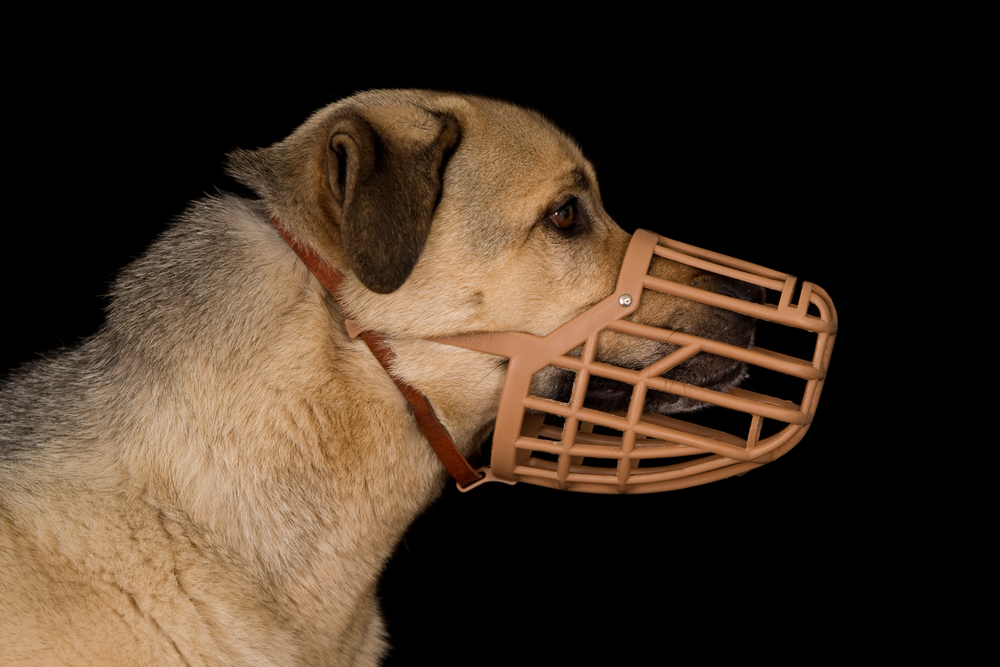
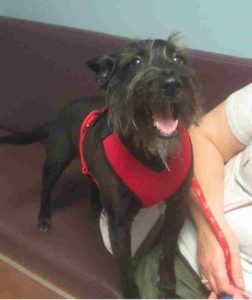 owner told us that his previous clinic had to muzzle him, and he was handled somewhat roughly. She wanted to get away from that. On his first visit we just got a feel for his comfort level. He barked and growled at us in the room but took treats willingly. He allowed an otoscopic exam but was tense, and when the stethoscope was introduced, he actively tried to bite. Approaching him with a muzzle sent him into a panic. We sent some Trazodone home with him that day for future visits and discussed doing a set of behavioral visits to help desensitize him to handling and instruments.
 able to make her visit less stressful and even a bit enjoyable. Our veterinarian is part of a Fear Free practice (Thank you,
 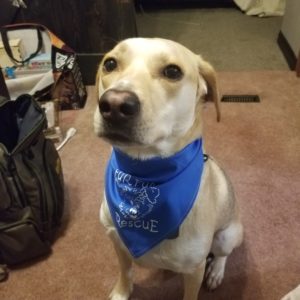 We were beside ourselves on how to handle taking Roger to the vet. We put him through basic obedience and advanced obedience classes twice to learn manners and how to act appropriately. He has done great in our home and in our families’ homes as we know how to handle his anxiety. In our vet’s office, though, Roger would go crazy as his anxiety shot through the roof from all the smells and people. Thanks to the Fear Free program and team at Frey Pet Hospital, Roger can feel safer and happier
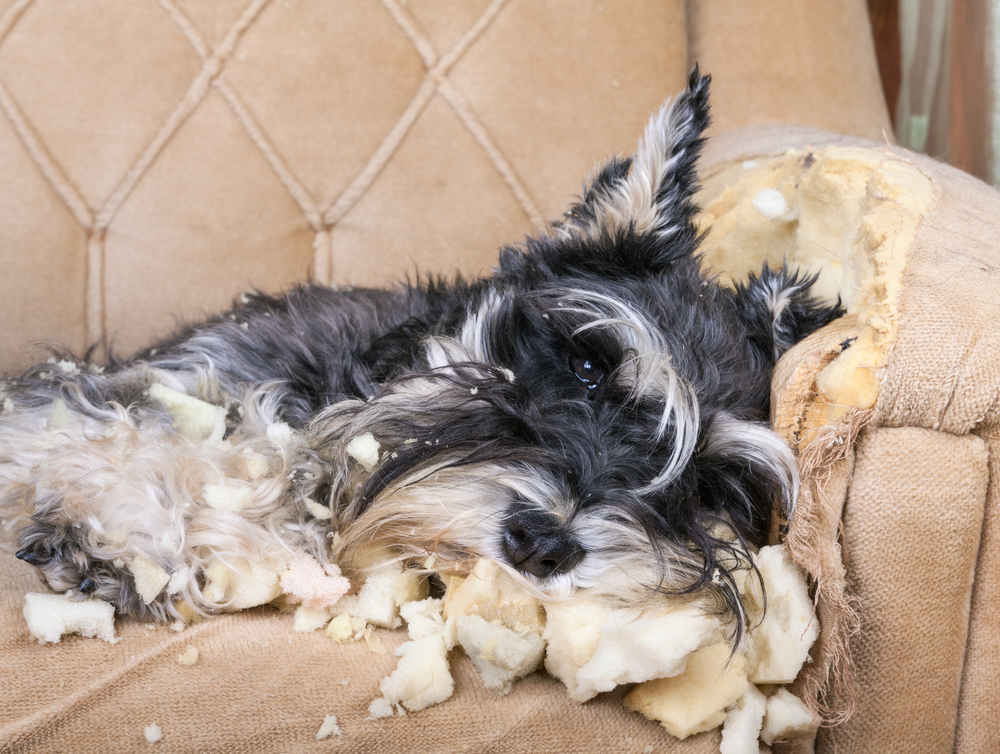
 When Fiona first came to us at Gamble Pet Clinic, an examination without a fearful reaction from her was impossible. An attack by another dog at a young age had caused her to be anxious and nervous ever since. She had been muzzled at every veterinary clinic since her attack until coming to Gamble Pet Clinic. She was fearful initially, trying to nip at the doctor and staff when they attempted to examine her.
 I took the Fear Free course. It was interesting and useful. I’m now working with two local veterinary offices who found me through the Fear Free website.
 Sal was brought to us to establish why he had been having chronic vomiting and diarrhea. When I approached him in the lobby, he immediately pinned his ears and retreated under the couch. We brought him into an exam room, and he warmed up a bit but was still wary. Mom and Dad mentioned that in the past at other clinics he was taken to “the back” for vaccines and they could hear him vocalizing from the exam room.